
Baku urges Tehran not to heighten tension over cargo halt
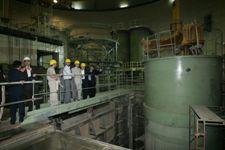
Azerbaijan has called on Tehran not to heighten tension over the
recent halt of a cargo of Russian equipment for Iran's Bushehr
nuclear plant on the border, the Foreign Ministry spokesman said
Monday.
"I have heard that an Iranian Foreign Ministry spokesman issued
some kind of a demanding statement," Khazar Ibrahim said. "If he
indeed used such expressions, this is not in line with the spirit
of bilateral relations, diplomatic norms or simply general
ethics."
The vehicles carrying about 10 tons of heat insulators needed to
complete construction of the Islamic republic's first atomic power
plant were detained by Azerbaijan's customs and border officials at
the Astara border checkpoint on March 29. Customs officials say the
cargo needs a special permit which was not supplied. But Moscow
argued that the move was illegitimate, claiming that it had
complied with all procedures required for the transit of the
consignment through Azerbaijan's territory.
Iran has urged Azerbaijan to release the consignment of the atomic
plant parts.
"We call on the government of the Republic of Azerbaijan to carry
out the necessary measures for the delivery of the consignment to
the Islamic Republic of Iran," Foreign Ministry spokesman Mohammad
Ali Hosseini told the press.
"The consignment is within the framework of Iran-Russia cooperation
with respect to the completion of Bushehr power plant. There is no
ban regarding the consignment."
Hosseini said Azerbaijan's ambassador to Iran had been called to
the ministry and asked to do everything in his power to facilitate
the delivery of the cargo.
Khazar Ibrahim said Azerbaijan was "in no need of anyone's
recommendations or demands".
"Azerbaijan is primarily guided by its legislation with regard to
the transit of any cargoes through its territory. On the other
hand, international legal norms and regulations are in place
concerning the transportation of such consignments from one country
to another, and we take them as a basis," the spokesman said.
Ibrahim said information about the owner of the cargo and its final
destination was not enough. Therefore, Baku is seeking
comprehensive data about the cargo from Russia.
"In general, when a simple cargo is transported via a country's
territory, all the information needed is provided about it. Given
that there is sensitive material involved here, obtaining
all-rounded information is pivotal. If Azerbaijan receives relevant
documents complying with its legislation and international law, an
adequate step will be taken."
The Azerbaijan Foreign Ministry has forwarded a note to the Russian
embassy over the issue and is now awaiting Moscow's response.
Azerbaijani Deputy Foreign Minister Araz Azimov said Tuesday that
no talks were underway on releasing the cargo. Azimov told the
press that if Russia is looking to transport cargo through
Azerbaijan's territory, it is required to submit respective
official papers.
"For some reason they have not submitted these documents. Instead,
they are sending us messages through the media on releasing the
cargo.
"First of all, we do not understand such language. Secondly, there
are international regulations, laws and procedures in place. Why
should Baku turn a blind eye to the illegitimacies?"
Azimov said the issue could be resolved swiftly if Russian
Ambassador Vasiliy Istratov conveyed accurate information from his
government to Baku.
The Azerbaijani ambassador in Tehran Abbasali Hasanov said Russian
contractor Atomstroiexport was building the Bushehr plant, which
means the responsibility for timely delivery of the cargo rested
with Russia.
Iran's ambassador to Azerbaijan, Nasser Hamidi Zare, said the cargo
had been detained because of "technical problems". He told
reporters after talks at the Foreign Ministry on Tuesday that Baku
had assured Iran of a speedy solution for the cargo detention
issue.
"The Azerbaijani government has told us that the problem will be
solved in the shortest time possible. The cargo is being
transported to Iran in accord with international law, and there
should be no hurdles for its delivery. This contradicts [the spirit
of] Iran-Azerbaijan relations, diplomatic and ethical norms," the
ambassador said.
The US State Department spokesman Sean McCormack has said
Azerbaijan and Russia should solve the issue on their own.
"In our view, this is something that the Azerbaijan and Russian
governments need to work out consistent with everybody's UN
Security Council resolution obligations, enforcing those
obligations in terms of the transshipment of materials potentially
for illicit purposes," McCormack told a press briefing on
Monday.
Russia has already delivered nuclear fuel under a $1 billion
contract to build the Bushehr plant, work on which has faced
multiple delays since construction began before the 1979 Islamic
revolution. Work stopped completely for years before Russia took
over construction. Iranian officials say the reactor is likely to
be launched in 2008.
The United States and Russia say the Bushehr plant means Tehran
does not need to enrich uranium itself. Western powers suspect that
Iran is seeking to master enrichment technology to make nuclear
bombs. Tehran strenuously denies the charge, saying its enrichment
program is peaceful.
'Suspicions'
Former state adviser Vafa Guluzada said the failure to submit the
paperwork required for transporting the cargo raised
suspicions.
"Iran is facing a United Nations embargo, and if Azerbaijan allows
its transit to Iran without an inspection, it will be in violation
of UN sanctions, and thus face outrage of the UN.
"The best way to resolve the situation is for Russia to go ahead
and submit the documents. But Moscow is reluctant to do so, as it
realizes that after that Azerbaijan will have to open the carriages
[trucks] jointly with UN representatives and examine whether or not
the consignment inside complies with what was indicated in the
list. It is this aspect of the matter that Tehran and Moscow are
wary of."
The analyst went on to say that Tehran was earlier not inclined to
interfere, expecting that Russia would be able to solve the issue
with Azerbaijan.
"But Baku's persistence caused Tehran's patience to run out and it
started talking in the language of ultimatums with Azerbaijan,"
Guluzada said.
He noted that Moscow, which was unable to find a solution for the
problem, has chosen the tactics of blackmailing Azerbaijan. Russia
claims that Azerbaijan had provided assistance to its war-battered
republic of Chechnya in the early 1990s.
"This is an absolute lie. I held a government post at the time. We
were short of funds needed to solve the problems inside the
country. On the contrary, Russia was openly aiding Armenians in
Upper (Nagorno) Garabagh. We were then hit by a problem of a
million displaced refugees, and money required to settle them was
in short supply. Even finding money for President Heydar Aliyev's
foreign visits then was a challenging issue."
Guluzada said Azerbaijan is currently facing an intricate
situation. "Baku is being pressured by Russia on one side and Iran
on the other. There is also a third player here - the United States
- which has succeeded in imposing an embargo on Iran. All the three
countries are closely cooperating with Azerbaijan, and Baku is now
to find a solution that would be the most optimal for itself," the
analyst concluded.
Here we are to serve you with news right now. It does not cost much, but worth your attention.
Choose to support open, independent, quality journalism and subscribe on a monthly basis.
By subscribing to our online newspaper, you can have full digital access to all news, analysis, and much more.
You can also follow AzerNEWS on Twitter @AzerNewsAz or Facebook @AzerNewsNewspaper
Thank you!