
Mediators' stance on UN resolution sparks outcry
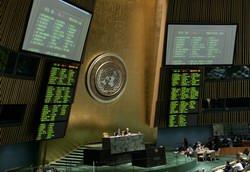
The Azerbaijani public was outraged with the United States, France
and Russia's votes on Friday against a United Nations resolution on
the situation in the occupied territories of Azerbaijan.
The credibility of the countries co-chairing the mediating OSCE Minsk Group was damaged after their failure to back the resolution condemning Armenian occupation at the UN General Assembly, a senior Azerbaijani official said Saturday.
The three countries voted against the paper asserting Azerbaijan's territorial integrity and demanding unconditional pullout of the Armenian armed forces from the occupied territories.
"We will remember the spirit of hostility and resistance with which they approached Azerbaijan's stance," the President's Upper (Nagorno) Garabagh negotiator, Deputy Foreign Minister Araz Azimov said. "This resolution should be a serious message to Armenia and a serious warning to the co-chairs. We will not keep on moving in the direction of obscurity."
Despite opposition of the mediating states, the UN GA backed the draft resolution on the situation in the occupied land forwarded by Azerbaijani representatives. 39 countries voted for the document, while seven - the U.S., Russia, France, Armenia, Angola, India and Vanuatu - opposed the initiative, and 100 member states abstained.
The deputy minister said the intermediaries had even lobbied against the passage of the document. Nonetheless, other UN member states such as Turkey and Germany stood by Azerbaijan in its initiative. "We therefore do not rule out a change in the composition of the Minsk Group in the future."
Azimov said the resolution does not disrupt peace talks, on the contrary, it brings clarity to the negotiating process.
"The co-chairmen have repeatedly pledged [commitment to] the principles laid out in the document, but this was not reflected in their proposals afterwards," he said, concluding that Garabagh talks have so far been "outside Azerbaijan's interests".
"So far, the draft of the basic principles put forth by the mediators has lacked proposals on the return of Kalbajar and Lachin [the strategic districts occupied by the Armenian forces], the use of the Lachin corridor by both sides and Azerbaijanis' return to Upper Garabagh. We stand firm on this and will continue to do so.
The Lachin corridor is a road connecting the occupied Upper Garabagh region with Armenian territory.
Local non-governmental organizations have demanded to estrange the three co-chair countries from mediation in the Garabagh conflict. The National NGO Forum that comprises 463 local NGOs urged to launch urgent discussions with the OSCE on the matter.
"An organization that has assumed a serious commitment like facilitating the conflict resolution should not put forth such a position," the group’s president Azay Guliyev told a press conference Tuesday. "They are openly supporting the aggressor country. The task of the mediators is to work toward reconciliation of the sides. They should adhere to a neutral stance."
Azerbaijan and Armenia fought a lengthy war that ended with the signing of a cease-fire in 1994, but Armenia continues to occupy Upper Garabagh and seven other Azerbaijani districts in defiance of international law. Peace talks have been fruitless so far and refugees remain stranded.
Azerbaijani officials said the UN GA resolution did not pose obstacles for the activity of the Minsk Group.
But the OSCE mediators and Armenia maintain that raising the issue at the UN serves changing the existing format of peace talks.
In a statement issued on Monday, the mediators said that while the co-chair countries voted against "a unilateral draft resolution that threatens to undermine the peace process", they reaffirmed their support for the territorial integrity of Azerbaijan.
Moscow attempted to justify the Minsk Group's opposition to the document, claiming that the UN resolution met strictly Baku's interests.
"In a joint statement, the countries co-chairing the Minsk Group explained their stance by the fact that such a step by Azerbaijan was unilateral, untimely and useless. This position has been repeatedly conveyed to Baku on different levels," the Russian Foreign Ministry said in a statement.
"Only the parts of the basic principles on the conflict settlement meeting Azerbaijan's interests had been included in the resolution. For instance, the clause on the determination of Upper Garabagh's final legal status by a nationwide poll among its population was not reflected in it," the ministry said.
It said this approach allegedly made the draft resolution unacceptable for Yerevan and diminished prospects for the new Armenian leader's swiftly resuming high-level talks with Azerbaijan after he takes office in April.
At the same time, Russia said it was ready to continue its active mediating efforts jointly with the U.S. and France to finalize agreement on basic principles of the conflict resolution.
US Ambassador Anne Derse has said her country's voting against the UN resolution "was not a vote cast against Azerbaijan's territorial integrity".
"We support Azerbaijan's territorial integrity and do not recognize Upper Garabagh's independence," she said.
Derse said Washington disagreed with the resolution for several reasons. First of all, the White House backs a balanced resolution of the Garabagh conflict.
"Last November the Minsk Group co-chairs submitted to the sides a package of proposals that could play a key role in the conflict resolution. These proposals are based on the Helsinki Final Act including the principles of territorial integrity, unacceptability of the use of force and the right of nations' to self-determination. If Baku had submitted a more balanced draft resolution that was in line with the proposed principles, the U.S. would have supported it."
Derse noted that the U.S. voted against the document to avoid its potential impact on the peace process.
The spokesman for the US embassy in Baku Johnatan Henick said resolutions passed at the UN had no impact on the resolution of the Garabagh conflict.
Henick told journalists that although the UN adopts resolutions, it has no authority to enforce them. He said hundreds of such resolutions are yet to be implemented, citing as an example the documents concerning the Israel-Palestine conflict.
The embassy spokesman added that the most efficient way to deal with the Garabagh problem was the peace process mediated by the Minsk Group.
Armenian Foreign Minister Vardan Oskanian claimed that the outcomes of the UN vote should be seen by Azerbaijan as a signal of the international community.
"By staying neutral, the majority of the UN member states rejected Azerbaijan's one-sided approach to the issue," he was quoted by local media as saying.
The resolution passed by the UN cited the need for "a swift, full and unconditional withdrawal of the Armenian forces" from the occupied Azerbaijani land. It reasserted the "inalienable right of the population evicted from the occupied territories of the Azerbaijan Republic" to return home and stressed the need for creating favorable conditions for this, including comprehensive rehabilitation of the territories affected by the armed conflict.
The General Assembly also expressed utter concern over the continuing threat posed by the conflict to regional stability. It reaffirmed that "no state should recognize as lawful the situation resulting from the occupation of Azerbaijan's territories or render assistance in maintaining that situation".
The UN has already passed four resolutions on the unconditional pullout of the Armenian forces but none of them have been implemented so far.
Here we are to serve you with news right now. It does not cost much, but worth your attention.
Choose to support open, independent, quality journalism and subscribe on a monthly basis.
By subscribing to our online newspaper, you can have full digital access to all news, analysis, and much more.
Subscribe
You can also follow AzerNEWS on Twitter @AzerNewsAz or Facebook @AzerNewsNewspaper
Thank you!