
Azeri, Armenian leaders vow ‘more decisive efforts’ on Karabakh
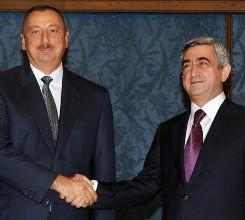
ASTANA – The presidents of Azerbaijan and Armenia and the mediating countries’ senior officials said in a joint statement "the time has come for more decisive efforts" to resolve the Nagorno-Karabakh conflict as the OSCE summit started in Astana, Kazakhstan on Wednesday.
Presidents Ilham Aliyev and Serzh Sargsyan agreed that a peaceful, negotiated settlement will bring stability and security and is the only way to bring "real reconciliation" to the peoples of the region, says the statement, issued jointly with Russian President Dmitry Medvedev, French Prime Minister Francois Fillon, and US Secretary of State Hillary Clinton, who headed delegations of the OSCE Minsk Group co-chair countries.
The Armenian and Azerbaijani presidents reaffirmed their commitment to seek a final settlement of the Nagorno Karabakh conflict, based upon the principles of international law; the United Nations Charter; the Helsinki Final Act; as well as the statements of Presidents Medvedev, Sarkozy, and Obama, at L'Aquila on July 10, 2009, and at Muskoka on June 26, 2010, according to the OSCE website.
The three OSCE co-chair countries pledged their support for the presidents of Azerbaijan and Armenia as they make the necessary decisions to reach a peaceful settlement. They urged the two leaders "to focus with renewed energy on the issues that still remain in the Basic Principles, and instructed their co-chairs to continue to work with the parties to the conflict to assist in these efforts". In order to create a better atmosphere for the negotiations, they called for additional steps to strengthen the ceasefire and carry out confidence-building measures in all fields.
The presidents of Russia, the United States and France said in their joint statements, issued at the G8 summits in L'Aquila and Muskoka, that a solution of the Karabakh conflict must be based on a number of principles, including returning the Armenia-occupied territories surrounding Nagorno Karabakh to Azerbaijani control, an interim status for the Azerbaijani region, and determination of the future status of Nagorno Karabakh through "a legally binding expression of will" and the right of internally displaced persons and refugees to return home, and international guarantees of security, including peacekeeping operations.
Presidents Aliyev and Sargsyan were expected to hold talks on the sidelines of the OSCE summit, but the meeting did not take place. Though neither side had confirmed that the meeting was scheduled, the two leaders were expected to continue negotiations on Karabakh settlement in the Kazakh capital.
The Minsk Group co-chairs’ visit to the region ahead of the summit primarily aimed to agree upon a meeting between the Azerbaijani and Armenian presidents. However, in conclusion of their visit the mediators did not elaborate to the media whether or not the presidential meeting would take place.
Some analysts say that earlier Armenian media reports saying that President Sargsyan would not attend the Astana summit indicate that the talks were not held due to the Armenian leader’s refusal.
The conflict between the two former Soviet republics began in 1988 due to Armenia’s territorial claims against Azerbaijan. The two countries fought a lengthy war that ended with the signing of a cease-fire in 1994. About 20 percent of Azerbaijani territory, including Nagorno Karabakh and seven adjacent regions, is still under the occupation of the Armenian armed forces.
Talks between Baku and Yerevan are underway on the basis of the Madrid principles, a peace outline proposed by the Minsk Group co-chairs in the Spanish capital in November 2007 and further updated in November 2009. Azerbaijan stated that it generally accepts the renewed Madrid principles early this year, while the Armenian stance remains unclear.
Here we are to serve you with news right now. It does not cost much, but worth your attention.
Choose to support open, independent, quality journalism and subscribe on a monthly basis.
By subscribing to our online newspaper, you can have full digital access to all news, analysis, and much more.
You can also follow AzerNEWS on Twitter @AzerNewsAz or Facebook @AzerNewsNewspaper
Thank you!