
Alban-Udi community defends Caucasian Albanian heritage amid Armenian claims

Ulviyya Poladova
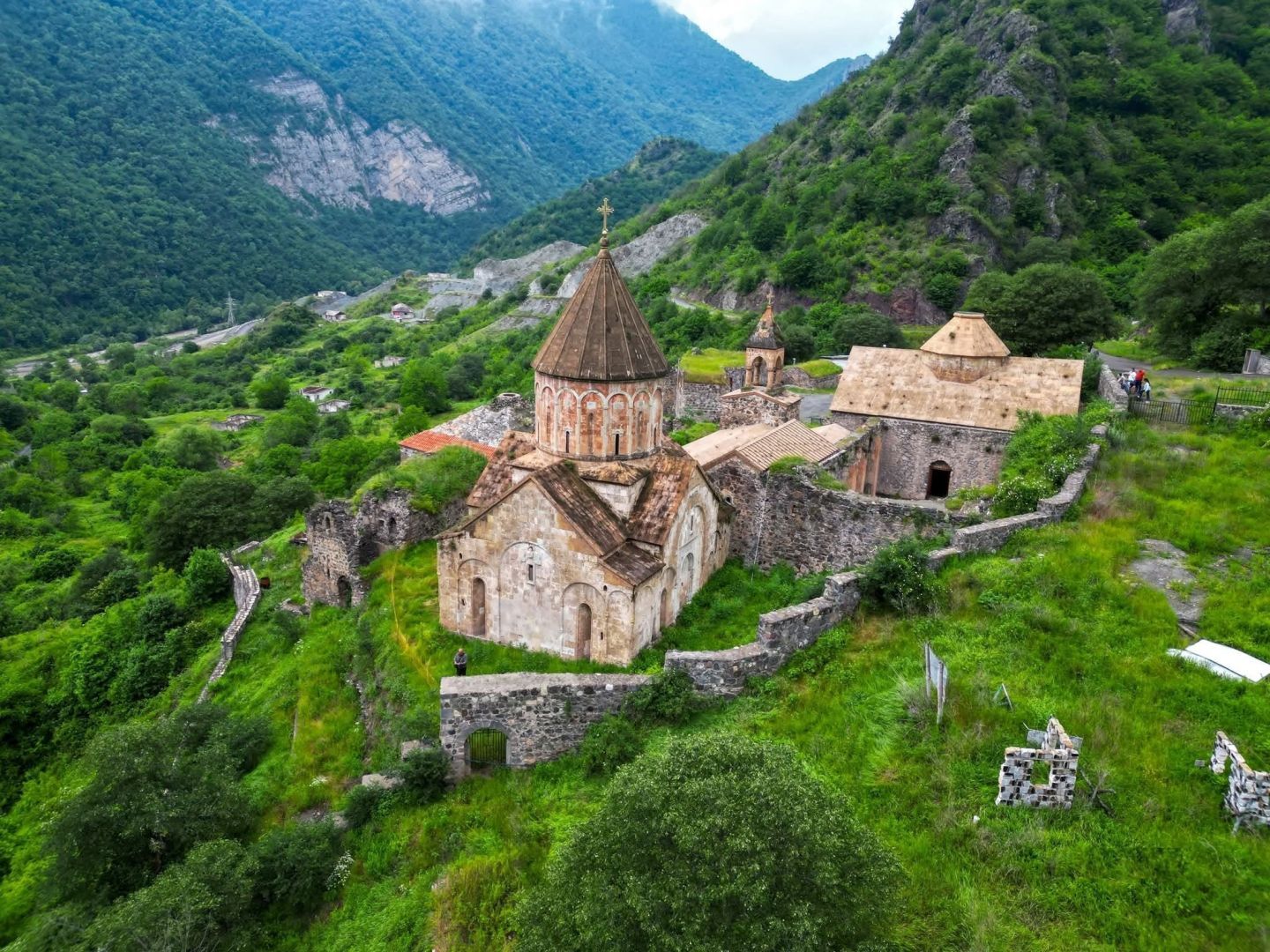
Read moreThe Alban-Udi Christian religious community of Azerbaijan, describing itself as the successor to the Albanian (Caucasian) Apostolic Autocephalous Church, has strongly condemned revanchist reactions in Armenian society and political circles to the recent visit of representatives of the diplomatic corps accredited in Azerbaijan to Karabakh and Eastern Zangazur, particularly to the Gandzasar and Khudavang religious sites associated with Albanian historical and cultural heritage.
The community said that attempts by the Armenian side, including Armenian lobbying circles that have yet to abandon war rhetoric, as well as Armenian Prime Minister Nikol Pashinyan and other senior officials, to present historical Azerbaijani monuments such as Gandzasar and Khudavang as Armenian heritage amount to a denial and distortion of historical facts and pose a threat to the fragile peace process taking shape in the region.
According to the statement, the campaign in Armenia against the visit of diplomatic representatives demonstrates that political and religious circles in the country are not sincere in their stated commitment to peace and continue to take an intolerant approach toward Azerbaijan’s legitimate rights.
The community stated that Caucasian Albania is an integral part of Azerbaijani statehood and said Armenia’s policy of denying the historical and cultural heritage of Caucasian Albania is unacceptable. It also described that Armenia’s activities as manifestations of "false national exceptionalism" and "false history," as well as containing elements of racism. It said that the hostile attitude toward the religious and cultural heritage of Caucasian Albania demonstrates Armenia’s fear of historical facts.
The Alban Church has a long history as the first apostolic church in the Caucasus and left an enduring mark not only on Azerbaijan but on the religious and cultural life of the wider region. The community stressed that Caucasian Albania developed a significant civilization and had its own alphabet, adding that attempts to challenge this heritage would ultimately fail.
The statement recalled that, according to historical records cited by the community, Albanian King Urnayr adopted Christianity as the state religion in 313. It also emphasized that the history of the Khudavang Monastery, regarded as one of the remarkable examples of Azerbaijani architecture, dates back to the sixth and seventh centuries.
The community further stated that the Gandzasar monastery was built between 1216 and 1238 on the orders of Albanian prince Hasan Jalal Dawla and received the blessing of Albanian Patriarch Nerses in 1240. According to the statement, Gandzasar was the residence of the Albanian Catholicosate and holds particular importance for the Alban-Udi community.
The members of the Hasan Jalal dynasty and religious figures, including Hasan Jalal Allahverdi Bey, were buried on the monastery grounds. Following various pressures and influences, a decision of the Tsarist Synod in 1836 brought an end to the activities of the Albanian Apostolic Church, after which the Armenian-Gregorian Church attempted to take control of part of its material and spiritual heritage.
According to the statement, historical Albanian churches in Azerbaijan, particularly in Karabakh, were subsequently Gregorianized, while archival materials and documents were either destroyed or falsified alongside the historical monuments themselves. The community argued that attempts to Armenize and appropriate the historical and cultural heritage of Caucasian Albania had become state policy in Armenia over the past century. It claimed that, as a result, not a single Albanian church in what is now Armenia or in the territories of Azerbaijan that were previously under occupation has retained its historical appearance intact.
The Alban-Udi community said it categorically rejects attempts to appropriate its historical and religious heritage, describing itself as the descendants of the first Christians of the land. The community also stated that the historical and political, cultural and religious heritage of Caucasian Albania belongs to the Azerbaijani state and people, where different ethnic groups, religions and faiths have lived together for centuries in conditions of tolerance.
It added that, just as Udis currently worship in churches in Gabala and Oghuz, they also freely conduct religious ceremonies at ancient Albanian sites in the territories liberated from occupation, including Gandzasar, Aghoglan, Khudavang and Amaras. Following the restoration of Azerbaijan’s independence, an opportunity had emerged to address as the injustice faced by the Albanian Apostolic Church, objectively study its history and present it to the international community.
According to the statement, the Azerbaijani government is carrying out extensive restoration and renovation work on historical and religious monuments across the country, regardless of their affiliation, and is paying particular attention to this heritage. Among the restored monuments, the community highlighted the Apostolic Church of Kish in the village of Kish, Shaki district, which it described as the "mother of churches" in the Caucasus, as well as the Chotari and Mother Mary churches in the settlement of Nic in Gabala, where Udis live compactly.
The Alban-Udi Christian community expressed its gratitude to Azerbaijani President Ilham Aliyev for these efforts. The statement also said that the liberation of Azerbaijan’s territories had restored historical justice, ensured the country’s territorial integrity and sovereignty, and created new realities in the region.
The community called on the Armenian side to accept this reality and to refrain from actions, revanchist propaganda and distortions of historical facts that could obstruct the peace process as essential for the security and stability of the region and its peoples.
It should be noted that last week, Assistant to the President of the Republic of Azerbaijan and Head of the Foreign Policy Affairs Department of the Presidential Administration Hikmet Hajiyev, together with representatives of the diplomatic corps accredited in Baku, visited several Albanian churches. During the visit, Hajiyev spoke about the ancient state of Caucasian Albania and its rich Christian heritage. This caused a violent reaction among Armenian revanchists.
The history of Caucasian Albania is very rich and dates back thousands of years. Both before the adoption of Christianity and after, in the VII-VIII centuries, Caucasian Albania was a large state. Subsequently, in the XVIII-XIX centuries, historians began to share this concept, distinguishing Balkan and Caucasian Albania.
Here we are to serve you with news right now. It does not cost much, but worth your attention.
Choose to support open, independent, quality journalism and subscribe on a monthly basis.
By subscribing to our online newspaper, you can have full digital access to all news, analysis, and much more.
You can also follow AzerNEWS on Twitter @AzerNewsAz or Facebook @AzerNewsNewspaper
Thank you!