
Armenia ‘lacks interest’ in conflict settlement
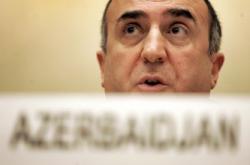
BAKU – Foreign Minister Elmar Mammadyarov has said Azerbaijan was concerned over the alarming signs of Armenia’s lack of interest in seeking a peaceful settlement to the Upper (Nagorno) Karabakh conflict.
Addressing the North Atlantic Council in Brussels last week, Mammadyarov said this year has marked an important stage in resolving the long-standing conflict.
"During the meeting between the Azerbaijani and Armenian presidents held with the Russian president’s participation in Sochi on January 25, the Armenian side sought two weeks to state its position on the ‘updated Madrid principles’ [a peace outline proposed by the OSCE mediators]. The latest meeting [between the presidents] held in St. Petersburg this June was fruitless as well."
The OSCE Minsk Group co-chairs, representing Russia, France and the United States, initially proposed a peace outline in Madrid in November 2007. In Athens in November 2009, its updated version was submitted to the sides. The Madrid Document covers "the return of the territories surrounding Nagorno Karabakh to Azerbaijani control" and a future determination of the legal status of Nagorno Karabakh "through a legally binding expression of will" and the right of "internally displaced persons and refugees to return to their former places of residence."
President Ilham Aliyev and other Azerbaijani officials have repeatedly stated that Baku accepts the updated Madrid Document. They also said Yerevan has not formally stated its clear-cut stance on the peace outline in the past months. Though Armenian officials have repeatedly said Yerevan accepts the document, no official statements have been issued so far to the mediators or international organizations.
"Unfortunately, Armenia is still delaying a definite response to the co-chairs’ proposal," Mammadyarov said. "Since this summer, Armenia, with its destructive stance, has backed down from the peace process and increased ceasefire violations. Its goal is to divert the Minsk Group co-chairs’ attention from the pivotal peace process to the technical aspects of the ceasefire regime."
Mammadyarov said Azerbaijan comprehends the importance of reinforcing the ceasefire signed in 1994 to reduce human casualties on the frontline, "but the international community should not deal only with the technical aspects of the ceasefire".
"We affirm our commitment to the ceasefire regime and hope for redoubling efforts for the sake of achieving progress in the peace process…Our situation is currently very sensitive. The issue is not just about Armenia’s accepting or rejecting the OSCE Minsk Group’s proposals. The point is whether or not Armenia indeed has intent to alter the current status quo…This country’s actions in the occupied territories, its subversions on the frontline and military exercises staged in the occupied lands make the situation dangerous."
The Karabakh conflict emerged during the last few years of the Soviet Union. 20 percent of Azerbaijan’s territory, including Nagorno Karabakh and seven adjacent districts, has been under Armenian occupation since the two South Caucasus republics signed a precarious cease-fire in 1994 following a lengthy war. Peace talks have been largely fruitless so far.
Meanwhile, Armenia claimed that it has accepted the renewed peace outline, while Azerbaijan is actually rejecting the mediators’ proposals.
"Over twenty working proposals followed based on the Madrid Document," Foreign Minister Eduard Nalbandian maintained in a speech at Tufts University’s Fletcher School of Law and Diplomacy in Boston. "As a result of intense talks held in the past few months, the latest version of the Madrid proposals was presented to the sides this June in St. Petersburg, and we stated that we accept it as a basis for negotiations, just as we did regarding the document submitted in November 2007."
Nalbandian was quoted by Armenia’s foreign ministry as saying that Azerbaijan allegedly does not accept either the initial or the latest version of the Madrid principles. He alleged that Baku has said it accepts one of the working proposals with certain exceptions, but "it turned out that there are more exceptions than the points it deems acceptable".
"What does it mean – to accept something with adjustments? This actually means not accepting it. What is Azerbaijan expecting? That Armenia and Karabakh will accept its adjusted proposals?"
Though the separatist regime in Nagorno Karabakh declared so-called independence in 1991, this "independence", which blatantly tramples on international law, has not been recognized by the world community.
Here we are to serve you with news right now. It does not cost much, but worth your attention.
Choose to support open, independent, quality journalism and subscribe on a monthly basis.
By subscribing to our online newspaper, you can have full digital access to all news, analysis, and much more.
You can also follow AzerNEWS on Twitter @AzerNewsAz or Facebook @AzerNewsNewspaper
Thank you!