
OSCE calls to bolster democracy, hold fair poll
The European security body has called on Azerbaijan to speed up
democratic development and hold a free and fair presidential
election this October.
The statement came after talks between the OSCE chairman-in-office, Finnish Foreign Minister Ilkka Kanerva and Foreign Ministry officials in Baku last week.
Kanerva said his organization would support all reforms to be conducted by the government to bolster democracy, regarding these efforts as pivotal in terms of "our common future and respect for European values".
"Azerbaijani authorities have repeatedly stated that they are keen on modernizing the country and advancing it toward Europe. Both of these commitments mean that Azerbaijan should definitely comply with the recommendations issued with regard to the elections," the OSCE chair said.
Foreign Minister Elmar Mammadyarov said Azerbaijan was working with the OSCE to ensure democratic conduct of the presidential poll. "For my part, I assured Kanerva that we will deliver on the obligations assumed within the OSCE, the Council of Europe and the European Union's New Neighborhood Policy, and this election will be absolutely free."
The Armenia-Azerbaijan conflict over Upper (Nagorno) Garabagh was discussed with the OSCE chairman as well. Kanerva said the group backed settlement to the long-running dispute within Azerbaijan's territorial integrity. He pledged that the OSCE would continue working to advance the peace process through its team of mediators referred to as the Minsk Group. "This is a priority in our activity," Kanerva said.
Kanerva emphasized that there was a need for accelerating Garabagh talks, saying the conflict could be resolved strictly in peace. "It is very reassuring that the political leaderships of both Azerbaijan and Armenia are demonstrating will to continue negotiations."
The OSCE chair noted that some reports were circulating about drawing "outside forces", including the United Nations, to the peace process, but the organization would not back such initiatives.
Azerbaijan has forwarded a number of documents concerning the Garabagh problem to the UN in the past years. Several days ago, a draft resolution reflecting situation in the occupied territories was distributed at the 62nd session of the UN General Assembly. Yerevan opposes tabling the issue at the UN.
The document demanded unconditional withdrawal of the Armenian armed forces from the occupied Azerbaijani territories. It also pointed to the importance of providing suitable conditions for the co-existence of the Azerbaijani and Armenian communities of Upper Garabagh in the future.
The UN has already passed four resolutions on the unconditional pullout of the Armenian forces but none of them have been implemented so far.
The conflict between the two South Caucasus republics reared up in the late 1980s due to Armenia's territorial claims. Armenia has been occupying over 20% of Azerbaijan's internationally-recognized territory since the early 1990s in defiance of international law.
With regard to the illegal "polling" in the country's occupied territories during Armenia's February 19 presidential election, Kanerva said that if such facts are confirmed in the OSCE election observation mission's report to be divulged soon, they will be given due assessment, as "holding elections outside Armenia's administrative territory is unacceptable".
The Azerbaijani Foreign Ministry has sent a note to the OSCE, the Council of Europe Parliamentary Assembly and the European Parliament over the establishment of illegal polling stations in Upper Garabagh and adjacent districts.
Asked whether the OSCE could bring the criminals who perpetrated the massacre in Azerbaijan's Khojaly district in 1992 before a court martial, similar to the trial against those who committed war crimes in Bosnia, Kanerva avoided the question. He apologized to journalists, saying he did not have comprehensive information to that end. Kanerva added, however, that the head of the OSCE office in Baku Jose Luis Herrero might be able to answer the question, but the latter could not elaborate either.
While in Baku, Kanerva also discussed President Ilham Aliyev's visit to Finland due in May.
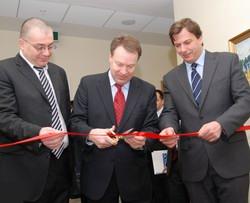
The OSCE chairman attended the ceremony of opening the new OSCE office downtown Baku on Thursday. Addressing the event, Kanerva voiced confidence that it would promote further cooperation with Azerbaijan as well as a more efficient activity of the European security body.
The Finnish diplomat said the OSCE Baku office that started operation eight years ago had played the role of a bridge between the organization and Azerbaijan, and made a contribution to the fulfillment of the country's international commitments.
Experience shows that no in-depth conclusions should be made from the statements made by the acting OSCE chairman. This was apparently an ordinary working visit that is paid every time after a new head of the organization embarks on his duties, which happens every six months. Such statements on the importance of democratic values and the need for settling the Garabagh conflict in peace are made every time. It therefore did not come as a surprise that the Finnish minister was not even aware of the Khojaly tragedy. Therefore, Kanerva's statement on the recognition of Azerbaijan's territorial integrity and the need to solve the Garabagh problem strictly based on this principle should not be taken very seriously.
Here we are to serve you with news right now. It does not cost much, but worth your attention.
Choose to support open, independent, quality journalism and subscribe on a monthly basis.
By subscribing to our online newspaper, you can have full digital access to all news, analysis, and much more.
Subscribe
You can also follow AzerNEWS on Twitter @AzerNewsAz or Facebook @AzerNewsNewspaper
Thank you!