
OSCE PA chief: Armenia ‘more to blame’ for stalling Garabagh settlement
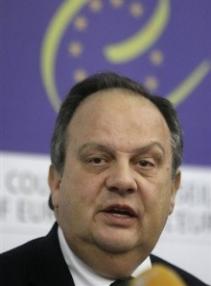
VIENNA - Armenia is more responsible for delays in the process
of settling the Armenia-Azerbaijan conflict over Upper (Nagorno)
Garabagh, the outgoing OSCE Parliamentary Assembly (OSCE PA)
President Joao Soares has said.
Soares told the BBC’s Azerbaijani service that since he was about
to step down from the post, he was sincerely expressing his
personal views. He said there was a good opportunity to reach peace
in the Garabagh conflict.
"There is such will both in the Armenian and Azerbaijani
presidents. On the Azerbaijani side, besides will, there is
capability to do so," Soares said.
But he questioned the Armenian leader’s taking resolute steps
toward a settlement to the long-standing dispute.
"After he was elected, he made a great effort. I can’t say whether
or not he commands ample leverage among Armenia’s political circles
to deliver on his intent. Azerbaijani President Ilham Aliyev has
all this – the will and influence. Therefore, I see the problem on
the Armenian side."
According to Soares, the formula for a conflict settlement since
the peace outline called the Madrid principles was proposed is
common knowledge. However, there are other factors that come into
play. He said that though major steps were taken toward
reconciliation between Armenia and Turkey in late 2009 – when two
documents were signed to establish diplomatic relations and reopen
the sealed borders between the two countries – challenges emerged
with parliamentary approval of the documents afterwards. Moreover,
there are problems in Yerevan’s domestic policies. Soares believes
that the Armenian diaspora in Russia, Europe and the United States
has a considerable clout in Armenia, and many agree that the
diaspora is a factor complicating resolution of the Garabagh
conflict.
The OSCE official said that if Armenia takes the needed steps, this
will result in the reopening of its border with Turkey, which
remains shut due to long-standing enmity.
"Certainly, they should also take their diaspora into
consideration. But the Armenians who have lived away from Armenia
prosperously for 30 years should not determine the policy in
Yerevan. Though the proposal on a conflict settlement [Madrid
Document] that is on the table is not optimal, it is good."
Azerbaijan and Armenia fought a lengthy war that ended with the
signing of a cease-fire in 1994, but Armenia continues to occupy
Upper Garabagh and seven other Azerbaijani districts in defiance of
international law.
Peace talks have been fruitless so far but are still ongoing. The
Madrid Document, initially presented by the US, Russian and French
mediators in the Spanish capital in November 2007, calls for "the
return of the territories surrounding Upper Garabagh to Azerbaijani
control." The outline also covered "a corridor linking Armenia to
Upper Garabagh" as well as a future determination of the final
legal status of Upper Garabagh "through a legally binding
expression of will" and the right of "internally displaced persons
and refugees to return to their former places of residence."
Here we are to serve you with news right now. It does not cost much, but worth your attention.
Choose to support open, independent, quality journalism and subscribe on a monthly basis.
By subscribing to our online newspaper, you can have full digital access to all news, analysis, and much more.
You can also follow AzerNEWS on Twitter @AzerNewsAz or Facebook @AzerNewsNewspaper
Thank you!