
Aliyev, Sarkisian commit to peace outline; analysts skeptical
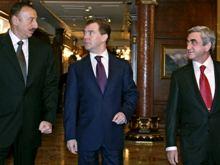
Azerbaijani and Armenian Presidents Ilham Aliyev and Serzh
Sarkisian stated their countries’ readiness to continue talks on
the Upper (Nagorno) Garabagh conflict based on the peace outline
initially offered by international mediators in late 2007.
Kremlin spokeswoman Natalya Timakova made the announcement following the two leaders’ talks on Thursday with their Russian counterpart, Dmitry Medvedev, in St. Petersburg, Russian RIA Novosti news agency reported.
According to Timakova, the sides’ positions drew closer on some disputed issues pertaining to the basic principles of a conflict settlement.
"Options for resolving the Upper Garabagh conflict were reviewed during the trilateral meeting. The Azerbaijani and Armenian presidents affirmed their readiness to continue holding dialog aiming to finalize work on the Madrid Document, within the [mediating] OSCE Minsk Group and with the mediation of the United States, Russia and France [the Minsk Group co-chairs]."
The trilateral meeting was held on the sidelines of the International Economic Forum.
Armenian Foreign Minister Eduard Nalbandian confirmed that Baku and Yerevan had agreed to continue holding talks. Novosti Armenii news agency quoted him as saying that the trilateral talks were constructive and beneficial. "This meeting is an important stage in the ongoing talks on settling the Upper Garabagh conflict," he told reporters.
Nalbandian said the two presidents had instructed their foreign ministers to continue communicating with one another. In this framework, meetings are planned with the Minsk Group co-chairs as well.
According to Nalbandian, the mediators are expected to visit the region in early July.
President Aliyev hosted the co-chairs - Bernard Fassier of France, Robert Bradtke of the United States and Igor Popov of Russia - as well as the personal representative of the OSCE Chairman-in-Office, Andrzej Kasprzyk, at the residence designated for him on Thursday. Views were exchanged on the current state and prospects of the ongoing peace talks, Azerbaijan’s state-run AzerTAj news agency reported.
On Friday, President Sarkisian also received the co-chairs in St. Petersburg.
Azerbaijan and Armenia fought a lengthy war that ended with the signing of a cease-fire in 1994, but Armenia continues to occupy Upper Garabagh and seven other Azerbaijani districts in defiance of international law. Years of peace talks have brought few tangible results. The Minsk Group co-chairs initially proposed a peace outline in the Spanish capital in November 2007. In Athens in November 2009, the updated version of the Madrid Document was put forward. The document covers "the return of the territories surrounding Upper Garabagh to Azerbaijani control" and a future determination of the legal status of Upper Garabagh "through a legally binding expression of will" and the right of "internally displaced persons and refugees to return to their former places of residence." Azerbaijan stated that it accepts the renewed Madrid principles early this year, while the Armenian stance remains unclear.
Elkhan Polukhov, the spokesman for the Azerbaijan Foreign Ministry, said an intense exchange of opinions had been carried out at the presidential meeting in St. Petersburg.
"We believe that meetings on the level of presidents, particularly any meeting held with the participation of the RF [Russian Federation] leader plays an important role in finding ways of resolving the Upper Garabagh conflict," Polukhov said.
According to him, such meetings always inspire hope for jointly finding solutions to the long-standing dispute. "Azerbaijan’s position is that there is currently an updated document entitled the ‘Madrid proposals’ on the negotiating table and this document creates opportunities to shift to the next stage in negotiations."
Vafa Guluzada, an Azerbaijani former state adviser and political analyst, opined that the St. Petersburg meeting and the statements issued there were of formal nature.
"Armenia has turned down the Madrid principles. And this step did not go down well with the world community. It is therefore trying to create a vision as if it is ready for dialog."
The analyst said there is no need to hold dialog with Armenia altogether.
"Azerbaijan’s lands have been occupied by the Armenians. Therefore, decisions should be made by the UN and NATO, they should demand that the Armenians withdraw from the territories they occupy.
"At the same time, Russia should be punished, because it is Russia that stands behind them. If this does not happen, any meetings, any dialog would be a mere formality."
Natig Miri, another analyst, also believes the latest trilateral meeting is "of visual nature" and says reaching a specific agreement on Nagorno Garabagh currently does not appear feasible.
"It appears to me that there is no unequivocal agreement among world powers about the solution of this problem. At the same time, those forces have a lot of wishes from Azerbaijan and those wishes have yet to be fully fulfilled. Therefore, as a tool of pressure, the Upper Garabagh problem is being kept in this state for now."
Miri went on to say that it should be taken into account that there are a number of different approaches to the Garabagh issue in Russia.
"President Dmitry Medvedev has one plan, and Prime Minister Vladimir Putin has another one. Putin believes that the problems over Upper Garabagh, Iran and Georgia should not be settled until Russia has re-asserted its might not only in the CIS area but on the worldwide scale. He unequivocally expressed these views during a visit to Turkey. President Medvedev wants to raise Russia to the upper layers amongst world powers by means of modernizing the country. Therefore, he is in much need of the U.S. and Western countries. Medvedev has even forged very warm relations with these countries and is holding effective discussions with them.
"I believe that since there is no agreement on this issue in Russia proper, a solution of the Nagorno Garabagh problem is not realistic," the analyst concluded.*
Here we are to serve you with news right now. It does not cost much, but worth your attention.
Choose to support open, independent, quality journalism and subscribe on a monthly basis.
By subscribing to our online newspaper, you can have full digital access to all news, analysis, and much more.
Subscribe
You can also follow AzerNEWS on Twitter @AzerNewsAz or Facebook @AzerNewsNewspaper
Thank you!