
Azerbaijan bracing up for war: think tank
Reports have been circulating that Azerbaijan is likely to launch
military action to liberate its territory occupied by Armenia for
over a decade. A number of international groups as well as
Armenians have cited Azerbaijan’s ongoing military build-up, saying
hostilities could erupt any time.
The Stockholm International Peace Research Institute (SIPRI) has said in a report that Georgia, Armenia and Azerbaijan "have gone on a weapons spending spree" over the past decade, collectively increasing their defense spending five-fold.
Armenia increased its annual defense spending from $93 million in 1999 to $217 million in 2008, SIPRI reported. Azerbaijan’s military budget rose from $133 million in 1999 to $697 million in 2008, and Georgia’s went from $39.8 million to $651 million over the same period, Joshua Kucera, a Washington-based freelance writer who specializes in security issues in Central Asia, the Caucasus and the Middle East, quoted the report as saying.
Regional tensions were the primary cause of the buildup, said the report’s author, Paul Holtom, director of the SIPRI Arms Transfers Program.
"In the decade preceding the August 2008 Georgia-Russia conflict in South Ossetia, military expenditure in Armenia, Azerbaijan and Georgia increased by more than 500 percent in real terms," Holtom wrote.
"Military reform and modernization have been offered as justifications for increased military spending and arms procurement in Armenia, Azerbaijan, Georgia and Russia, but unresolved border disputes, territorial claims and separatism remain among the main national security threats facing these countries," the report said.
Over the last two years, Georgia, Azerbaijan, Kazakhstan and Turkmenistan have all made significant defense procurements from foreign suppliers, according to SIPRI data, while Armenia and the rest of the post-Soviet Central Asian states did not.
Azerbaijan acquired 70 armored personnel carriers (of the BTR-80A variety) from Russia in 2009, and arranged with South Africa’s Paramount Groups to start producing Matador and Marauder mine-protected vehicles in Azerbaijan. Those vehicles will likely be assembled in Azerbaijan, and could mark the first movement toward Baku’s stated goal of creating a domestic defense industry that can produce export-worthy military hardware, Holtom said in an interview with EurasiaNet.
Azerbaijan’s focus on new ground vehicles and recent purchases of unmanned drone aircraft from Israel, combined with Baku’s increasingly bellicose rhetoric towards Armenia leaves little doubt that Azerbaijan is preparing for the possibility of a renewed conflict over Upper (Nagorno) Garabagh, an Armenia-occupied region, Holtom said.
"With the rhetoric that’s been coming out in recent months, it’s clear to what end this buildup is for, it’s Upper Garabagh," Holtom said. While Azerbaijan may have a decisive material advantage now, the key factor in any potential conflict with Armenia would be the posture of the Russian forces in Armenia, he added. "The Russian reaction is going to be the key thing, with the security pact that Russia and Armenia have, whether Azerbaijan feels if it can go for it," he said.
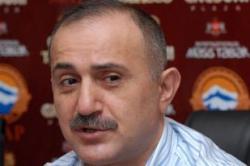
Samvel Babayan, the former "defense minister" of the Upper Garabagh separatist regime, said last week that Azerbaijan is bracing up for war. He told a press conference that if hostilities resume, no superpower will come to Armenia’s defense.
"Armenia lost its political chance to resolve the Garabagh conflict. We should not have confined to 1994 [when a ceasefire was signed with Azerbaijan following a lengthy war] and should have compelled Baku to sign a peace accord once and for all," Babayan said.
In Azerbaijan, many analysts also believe that chances are high for a resumption of hostilities. Natig Miri, head of the Azerbaijan National Strategic Research Center, says that it is common knowledge and natural that Azerbaijan is striving to increase its military power in order to restore its territorial integrity. However, presenting it as a country that favors war would be erroneous.
"The statistics indicates the opposite of the Stockholm [institute] statement. Whereas Armenia is allocating 4.5 percent of its state budget for military spending, Azerbaijan is allotting 3.6 percent. It is a different issue that Armenia’s budget is increasingly shrinking, its economy is collapsing and the funds designated for its army equal $300 million. Azerbaijan’s military expenses exceed the figure more than six-fold. And that is what the Christian countries are concerned with, because the European Union, which is not interested in the existence of a subsidized region [country], is aware that Armenia will lose to Azerbaijan in this [armament] race over the short term, and they are therefore trying to restrain Azerbaijan. But they realize that if it goes on like this, the balance of forces in the region will tremendously shift toward the Muslim-Turk ethnic group."
Miri also said Babayan’s statement that Armenia will not receive international assistance should war break out had merit.
"The situation has changed in Azerbaijan’s favor over the past period. Azerbaijan has now turned into a country the world community should reckon with and a guarantor of security in the South Caucasus region. Russia, Armenia’s protector in the region, as well as the U.S. and European Union, cannot secure their geo-political and geo-economic interests in the region without taking Azerbaijan into consideration, and this will further increase their need for us. Moreover, Azerbaijan is working to secure military allies. From early April to June, the Azerbaijani army will be holding joint exercises of various profiles with Turkey and Pakistan’s militaries. Considering all this, it will be more complicated for Armenia’s supporters to lose Azerbaijan for good while defending Armenia."*
Here we are to serve you with news right now. It does not cost much, but worth your attention.
Choose to support open, independent, quality journalism and subscribe on a monthly basis.
By subscribing to our online newspaper, you can have full digital access to all news, analysis, and much more.
Subscribe
You can also follow AzerNEWS on Twitter @AzerNewsAz or Facebook @AzerNewsNewspaper
Thank you!