
Mediators praise Baku, Yerevan’s commitment to conflict settlement
The OSCE mediators brokering settlement to the
Armenia-Azerbaijan conflict over Upper (Nagorno) Garabagh have
welcomed the commitment of the parties to reach a negotiated
solution based on the peace outline dubbed the Madrid principles
that is under discussion.
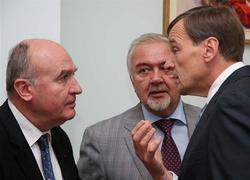
The OSCE Minsk Group (MG) co-chairs - Yuri Merzlyakov of Russia, Bernard Fassier of France, and Robert Bradtke of the United States - issued the statement following their recent meetings with the two countries’ foreign ministers.
The mediators visited Armenia and Azerbaijan’s Upper (Nagorno) Garabagh region March 26-29. In Yerevan March 28, the co-chairs met President Serzh Sarkisian and Foreign Minister Eduard Nalbandian to further discuss Armenian comments on the basic principles for the peaceful settlement of the Garabagh conflict. While in Armenia, the co-chairs also had a number of other separate bilateral meetings, they said in the statement, released Tuesday.
The co-chairs did not visit Baku this time. The Russian MG co-chairman, Yuri Merzlyakov, said talks will be continued with Azerbaijani officials in April.
"We have agreed with [Azerbaijani Foreign Minister] Elmar Mammadyarov when we will visit Baku. We didn’t talk about this with anyone else. He already knows that we will come here in April next time. But the precise date [of the visit] is not known."
According to Elkhan Polukhov, the spokesman for the Azerbaijan Foreign Ministry, Baku had been informed that the co-chairs would not visit the Azerbaijani capital. Polukhov explained that Azerbaijan supports the updated Madrid Document with some exceptions, which, according to his earlier statement, cover the wording of the conflict settlement principles and the translation of terms. The spokesman added that it was Yerevan that should now respond to the intermediaries’ proposals, which were initially proposed in late 2007.
The conflict between the two South Caucasus republics flared up in the late 1980s due to Armenia's territorial claims. Armenia has been occupying over 20 percent of Azerbaijan's territory since the early 1990s. The ceasefire accord was signed in 1994, but years of peace talks have brought few tangible results. The Minsk Group co-chairs representing the United States, Russia and France initially proposed a peace outline on settling the conflict in the Spanish capital in November 2007. In Athens in November 2009, the updated version of the Madrid Document was submitted to the sides. The gist of the conflict settlement outline has yet to be detailed for the public. Azerbaijan stated that it accepts the renewed Madrid principles early this year, while the Armenian stance remains unclear.
Meanwhile, the Russian MG co-chairman dismissed Armenian media reports quoting him as saying on Monday in Khankandi, the center of the self-proclaimed Upper Garabagh republic, that Yerevan disagrees with some provisions of the updated Madrid Document. According to Armenia Today news agency, Merzlyakov said his statement had been distorted by journalists.
"It is necessary to divulge information as it was actually stated, not make comments, as it was done by the journalists in Stepanakert [Khankandi]," the Russian co-chairman said.
Merzlyakov said he had not stated that the sides have reached general agreement on the Madrid principles with the exception of four provisions. "I never said that. This never happened," he said.
Merzlyakov reportedly told the press in Khankandi that though Armenia has said it disagrees with some provisions of the updated Madrid Document, "we are not trying to increase tension, because a similar situation with the Madrid principles was observed two years ago", when Armenia was accepting the Madrid principles, while Azerbaijan was rejecting the proposals.
The Armenian media reported that Merzlyakov had issued this refutation hot on the heels of his meeting with Foreign Minister Nalbandian in Yerevan on Monday evening. Nalbandian reportedly said while referring to the recent speculations about the Madrid proposals: "The Madrid principles were taken by Armenia as a basis for negotiations as early as two years ago and remain as such."*
Here we are to serve you with news right now. It does not cost much, but worth your attention.
Choose to support open, independent, quality journalism and subscribe on a monthly basis.
By subscribing to our online newspaper, you can have full digital access to all news, analysis, and much more.
Subscribe
You can also follow AzerNEWS on Twitter @AzerNewsAz or Facebook @AzerNewsNewspaper
Thank you!