
Drug use on the rise in Azerbaijan: US report
Azerbaijan is located along drug transit routes
running from Afghanistan and Central Asia or Iran to Russia and
Europe and transporting drugs through its territory is a challenge
facing the country, but domestic consumption of narcotics is also
increasing, claims a US State Department report released
Monday.
Afghan opiates transit to Azerbaijan by three primary routes: from Central Asia and across the Caspian Sea, or from Iran through the south of the country or through uncontrolled regions, which refers to the Armenia-occupied Upper (Nagorno) Garabagh region, the annual International Narcotics Control Strategy Report found.
The Iranian route accounts for 95 percent of this flow, with commercial trucks and horses serving as the mode of transportation across the border. Drugs are then smuggled through Azerbaijan to Russia, its northern neighbor, and finally on to Central and Western Europe. Efforts by Turkey to increase enforcement along its border with Iran may have contributed to increased transit through Azerbaijan, according to the report.
It said Azerbaijan emerged as a narcotics transit route in the 1990s because of the disruption of the "Balkan Route" during the wars among the countries of the former Yugoslavia.
The most widely abused drugs in Azerbaijan are opiates - especially heroin. Also, illicit medicines, cannabis, Ecstasy, hashish, cocaine and LSD are widely abused. 23,254 persons are registered as drug addicts in the country. Unofficial figures are estimated at approximately 300,000, the majority of which are heroin addicts. Students are thought to be a large share of total drug abusers at 30-35 percent. The majority of heroin users are concentrated in the region of Absheron, which includes the capital Baku, while the rest are primarily in the Lankaran district near Iran. Drug use and drug dealing among women has been rising, and illegal drug use among unemployed young men in rural areas is "a chronic problem", the report said.
Assessing law enforcement efforts, it said that during the first nine months of 2009, Azerbaijani law enforcement agencies confiscated about 900 kilograms of narcotics, a 60 percent increase compared to the same period in 2008. Of this amount, the majority was seized while being smuggled across the border with Iran. During the year 1,956 drug traffickers were arrested, of whom 1,843 were described as able-bodied, unemployed people who were not in school, 392 had a previous criminal record, 65 were women and 4 were underage children.
Azerbaijan shares a 380 mile (611 km) frontier with Iran, and its security forces need additional material resources and training to combat increasingly sophisticated trafficking groups. Iranian and other traffickers are exploiting this situation, the report said.
Numerous seizures occurred throughout the year, in which large quantities of drugs were transported from Iran and through Azerbaijan by multinational criminal groups. While the majority of drugs enter Azerbaijan via land routes from Iran, some are transported by ships on the Caspian Sea.
The State Department said that as a matter of government policy, Azerbaijan does not encourage or facilitate illicit production or distribution of narcotic or psychotropic drugs or other controlled substances, or the laundering of proceeds from illegal drug transactions. "However, corruption remains a significant problem in Azerbaijan… In October 2008, several police officers from a Baku counter-narcotics trafficking unit were arrested on distribution charges. One kilogram of heroin was seized during the search of their offices."
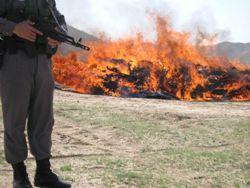
The US government said that Azerbaijan’s problem with narcotics largely stems from its role as a transit state, rather than as a significant drug cultivation site. Cannabis and poppy are cultivated illegally, mostly in southern Azerbaijan, but only to a modest extent. During 2009 448 tons of illegally cultivated and wild narcotic producing plants were destroyed.
Azerbaijan cooperates with Black Sea and Caspian Sea littoral states in tracking and interdicting narcotics shipments, especially morphine base and heroin. Caspian Sea cooperation includes efforts to interdict narcotics transported across the Caspian Sea by ferry. In 2008, Azerbaijan created 50 new border guard outposts and coast guard bases and a canine training center. Smugglers are increasingly trafficking by air: during 2009 the number of seizures at airports increased. Azerbaijan is in the process of ratifying a new customs code, which has not been modernized since Soviet times. This modernization process should assist in interdicting illicit drugs at Azerbaijan’s borders before they enter into transit through the country, the report said.*
Here we are to serve you with news right now. It does not cost much, but worth your attention.
Choose to support open, independent, quality journalism and subscribe on a monthly basis.
By subscribing to our online newspaper, you can have full digital access to all news, analysis, and much more.
Subscribe
You can also follow AzerNEWS on Twitter @AzerNewsAz or Facebook @AzerNewsNewspaper
Thank you!