
EU foreign ministers hail new South Caucasus strategy
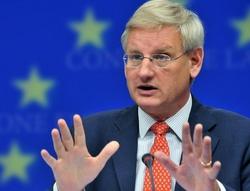
The European Union foreign ministers back the
bloc`s new strategy paper on the South Caucasus region prepared by
the current Swedish presidency, the country`s Foreign Minister,
Carl Bildt, told a press conference after an EU meeting early last
week.
The strategy opens up new opportunities for Azerbaijan, Georgia and
Armenia in their cooperation with the 27-member EU. The strategy
calls for the three regional states being offered open-ended
association agreements which could, in the longer term, lead to
free trade and easier travel arrangements.
The three countries have signed on to the EU`s European
Neighborhood Policy (ENP) and, earlier this year, joined the bloc`s
Eastern Partnership program, along with Ukraine, Moldova and
Belarus.
Bildt made note of the right of Azerbaijan, Georgia and Armenia to
pick their own allies.
``These countries are sovereign nations and they have their right
to choose their own destiny. They`ve expressed a [wish] for a
closer relationship with the European Union.``
Bildt added that the three countries ``have the right not to be
restricted by the wishes of anyone else``, apparently hinting at
Russia.
Commenting on the current situation in the region, Bildt did not
differentiate between Azerbaijan, Georgia and Armenia. He said the
three countries were working to establish the rule of law,
democracy and good governance complying with EU standards, but
added that he ``wouldn`t say everyone has made the kind of progress
we`d like to see.``
Regarding the Armenia-Azerbaijan Upper (Nagorno) Garabagh conflict,
the Swedish minister said the EU foreign ministers had called on
the mediating OSCE Minsk Group to reach a speedy resolution of the
long-standing dispute. He added that the EU was closely following
the ongoing talks between Baku and Yerevan.
Bildt said the European Commission was formally authorized on
September 15 to establish bilateral association agreements with the
three South Caucasus states. The associations will replace the EU`s
existing partnership plans.
Eastern Partnership
Just days after the EU meeting, the bloc`s representatives held
discussions in Baku on the Eastern Partnership program that seeks
to boost cooperation with ex-Soviet partners, according to the
European Commission office in Azerbaijan.
John Kjaer, Head of Unit for Ukraine, Moldova, Belarus and South
Caucasus of the General Directorate for External Relation of the
European Commission, and Giovanni Cremonini, Administrator of the
European Neighborhood Policy Directorate, discussed with
participants the benefits of this important initiative in a two-day
event dubbed the ``Road Show``.
The Eastern Partnership seeks to develop increasingly close
political and economic ties with the EU`s Eastern neighbors and
represents an upgrading of the political engagement between the EU
and Azerbaijan.
The EU officials participated in two high-level workshops with
officials and civil society organizations. They gave presentations
on the prospects and impact of deepening EU-Azerbaijan bilateral
and multilateral relations under the Eastern Partnership.
The Eastern Partnership initiative, initially floated by Poland and
Sweden, envisions simplified visa regulations, free trade and
closer energy cooperation. However, participating countries are
required to bring their laws into compliance with EU standards,
pursue economic reforms and bolster democratic development at home.
Membership in the bloc is not on the agenda, at this
point.
Here we are to serve you with news right now. It does not cost much, but worth your attention.
Choose to support open, independent, quality journalism and subscribe on a monthly basis.
By subscribing to our online newspaper, you can have full digital access to all news, analysis, and much more.
You can also follow AzerNEWS on Twitter @AzerNewsAz or Facebook @AzerNewsNewspaper
Thank you!