
Mixed responses to top US official`s visit
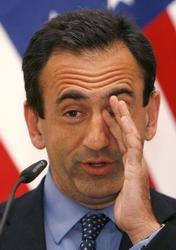
Azerbaijani media continue speculating on the
reasons for the short length of last week`s visit to Baku by Philip
Gordon, the newly-appointed US assistant secretary of state for
European and Eurasian affairs.
Even before the visit, official sources reported that Gordon had not been scheduled to meet with President Ilham Aliyev, though he had held talks with the Georgian and Armenian leaders during his prior visits to the two countries as part of his first tour of the South Caucasus region. Neither the Presidential Administration nor the US Embassy has elaborated on the reasons for the meeting not taking place.
Although it had been initially reported that Gordon was to stay in Baku for two days, the State Department official spent only several hours in the Azerbaijani capital on Thursday, during which he met with Foreign Minister Elmar Mammadyarov, leaving the country in the evening. Azerbaijan`s opposition claimed this signals a cooling-down in Baku`s relations with the White House.
Hikmat Hajizada, an Azerbaijani political analyst, said that what he describes as a cool attitude displayed toward Gordon in Baku had been caused by his statement on the Upper (Nagorno) Garabagh conflict, previously made in Yerevan. While in the Armenian capital, Gordon took notice of the long-standing dispute, claiming that its solution is based upon Azerbaijan`s territorial integrity and the right of Garabagh Armenians to self-determination. The US official believes that people`s right to self-determination is one of the principles to settling this conflict, along with territorial integrity and non-use of force. Hajizada said Gordon should not have equated these three principles, emphasizing that the inviolability of countries` borders is a core issue in international law.
Armenia and Azerbaijan waged war over the mountainous region of Upper Garabagh in the early 1990s, which claimed some 30,000 lives and displaced some one million Azerbaijanis. Armenia has been occupying over 20% of Azerbaijan`s internationally-recognized territory since then. The ceasefire accord was signed in 1994, but peace talks, mediated by the U.S., Russia and France through the OSCE Minsk Group, have been fruitless so far, and sporadic clashes on the frontline continue.
Vafa Guluzada, a former Azerbaijani state adviser and political analyst, supported President Aliyev`s not meeting with the US assistant secretary. He believes Washington`s policy on the Garabagh conflict lacks balance.
"The U.S. recognized Garabagh Armenians` right to self-determination at the Lisbon summit, and this is an erroneous approach. One can talk only about Azerbaijan`s territorial integrity here. Garabagh Armenians have no right, whatsoever, to decide their own fate. [If they did], it turns out that Armenians living in Los Angeles and Boston have that right too."
According to Guluzada, the Obama administration has to clearly state that Azerbaijani territories are under occupation and must be freed, while Baku is to ensure the rights of the Armenian population in Garabagh. Only in this case will Azerbaijani officials display a willingness to communicate with White House representatives. Before that happens, however, such short visits and limited discussions with official circles could continue, the analyst concluded.
Assistant Secretary Gordon said his visit aimed to convey the interest of President Barack Obama`s government in the region and Azerbaijan, in particular. Washington is profoundly interested in the regional security and the resolution of the Armenia-Azerbaijan conflict, he noted.
"I believe that a historic opportunity has emerged for restoring peace and security in the region, and the United States stands ready to comprehensively support these efforts," Gordon said.
Gordon noted that resolution of the Garabagh conflict is moving forward and America is closely following the process. "I hope the conflict will soon be resolved at the negotiating table," Gordon said.
Democratic development issues were a focal point during the State Department official`s meetings in Baku, as well. Gordon pointed out that the spread of democracy is important for the Obama administration.
"We believe that the more open and free that countries are, the more they benefit, and their cooperation with the U.S., with the West, becomes easier. We want Azerbaijan to be a close partner of the U.S. as well," Gordon said.
Also, the assistant secretary discussed resuming foreign radio broadcasts with Azerbaijani officials. The US government offered bilateral cooperation to Azerbaijan in order to return these radio stations to the national FM frequencies, but it has not yet received a reply to the proposal.
Asked by journalists whether or not Washington has other plans regarding the broadcasts, Gordon replied: "I don`t think an alternate plan is needed here. We have to continue holding discussions based on our proposal. In my view, working together could foster a solution to the problem."
Radio Liberty, Voice of America and the BBC were removed from the national airwaves on January 1, 2009. The decision, passed by the television and radio broadcasting body, complies with the 2002 law prohibiting broadcasts of foreign radios on national frequencies.
Here we are to serve you with news right now. It does not cost much, but worth your attention.
Choose to support open, independent, quality journalism and subscribe on a monthly basis.
By subscribing to our online newspaper, you can have full digital access to all news, analysis, and much more.
Subscribe
You can also follow AzerNEWS on Twitter @AzerNewsAz or Facebook @AzerNewsNewspaper
Thank you!