
Mediators see major progress following talks
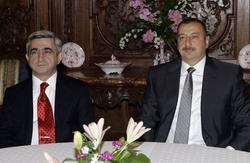
Various reports about Thursday`s round of talks on
settling the Upper (Nagorno) Garabagh conflict between the
Azerbaijani and Armenian presidents in Prague have caused observers
to conclude that the discussions were extremely tense but the sides
achieved rapprochement on numerous key issues regarding the peace
process. Nonetheless, the fact that the reports are
differently-worded, depending on the source of information and, at
times, even conflicting, makes it rather challenging to express an
unequivocal opinion about the outcome.
Following the meeting of Presidents Ilham Aliyev and Serzh Sarkisian, the OSCE mediators brokering the conflict settlement told the press that the talks were constructive and their outcomes were promising. The co-chairs of the OSCE Minsk Group - Yury Merzlyakov of Russia, Bernard Fassier of France, and Matthew Bryza of the United States - said in a statement that "significant progress" had been achieved in narrowing the differences between the parties and that the discussions "had brought the sides closer to a breakthrough."
"The presidents welcomed the co-chairs` plan to further intensify their shuttle diplomacy to assemble all the elements required for a breakthrough," said the joint statement, released after the mediators organized a meeting of Presidents Aliyev and Sarkisian at the residence of the US ambassador in Prague.
"The co-chairs look forward to their next trip to the region and to prepare a further summit, as proposed to the presidents, in St. Petersburg [on the sidelines of an informal CIS summit] in early June. The co-chairs expect that these coming meetings will allow for the concrete realization of a breakthrough on the Basic Principles by the end of the year," noted the joint statement, which was posted on the OSCE`s website.
The Basic Principles for a negotiated settlement of the long-standing dispute were submitted by the mediators to Baku and Yerevan in the Spanish capital Madrid in November 2007. The principles include determination of the final status of Upper Garabagh, an Azerbaijani region currently under Armenian occupation, through a nationwide poll to be conducted during the final stage of the peace process.
This is possible after confidence is built between the sides, including the gradual pullout of Armenian armed forces from the occupied Azerbaijani territories, pledges on non-use of force, the return of Azerbaijani refugees displaced by the armed conflict in the early 1990s, and the resumption of trade and communications. The Basic Principles represent the outcome of numerous meetings between the Azerbaijani and Armenian foreign ministers launched in the Czech capital in 2004 and dubbed the "Prague process."
Azerbaijan and Armenia fought a lengthy war that ended with the signing of a cease-fire in 1994, but Armenia continues to occupy Upper Garabagh and seven other Azerbaijani districts in defiance of international law. Azerbaijan is ready to grant the region the status of a high autonomy within its territorial integrity, while Armenia claims it should be granted independence.
US co-chair Bryza told Radio Liberty that the two countries` presidents had agreed to the main ideas of a Garabagh settlement.
"Throughout my co-chairmanship in the Minsk Group, this meeting was the most substantial one in terms of the essence of the issues being discussed. Progress has been achieved in the past as well. But this time - and the other co-chairmen agreed with me on that -- the presidents agreed on the main ideas of the complicated concept of the basic settlement principles. In other words, the presidents recommended that the co-chairs, jointly with the foreign ministers, finalize work on detailing these ideas."
At the same time, the diplomat admitted that hard work on certain details is still ahead to achieve a final agreement, as the two leaders are adhering to a view that "so long as everything has not been agreed, nothing is considered to have been agreed."
Further, Bryza emphasized that the Azerbaijani and Armenian presidents are ready for mutual compromises. This, in his opinion, is clear from their messages, which aim to shape public opinion about the conflict resolution in their countries.
The Aliyev-Sarkisian talks lasted two and a half hours, though previous meetings usually took three to four hours. This presidential meeting was attended by Foreign Ministers Elmar Mammadyarov and Eduard Nalbandian, the MG co-chairs, as well as Andrjej Kasprzyk, the OSCE chairman`s special envoy. The broad talks were followed by one-on-one discussions.
It is indicative that, amid outright optimism by the mediators, a split has been observed in the conflicting sides` statements regarding the outcome of the Prague talks. Yerevan believes that their positions have drawn closer after the presidential meeting, while Baku said no progress had been achieved.
"The presidents` meeting in Prague was prolific and brought the positions of the sides closer on separate provisions of the Garabagh settlement," the Armenian presidential statement claimed.
However, Azerbaijani Foreign Minister Elmar Mammadyarov told journalists that "unfortunately, no advances were made at the meeting of the Azerbaijani and Armenian presidents."
"I can`t say that any advances were achieved, and talks must be continued. Discussions were held on complicated issues in Prague but, unfortunately, Armenia, again, failed to be constructive," said Mammadyarov.
Novruz Mammadov, head of the Azerbaijan President`s Office international relations department, has strongly criticized the co-chairs, blaming them for spreading false information about the current state of peace talks. He said Yerevan was very non-constructive during the last presidential meeting.
"The Armenian side was unwilling to take even a step toward a conflict settlement and once again demonstrated that it had claims to Azerbaijani territories. Nonetheless, despite the lack of mutual agreement, the co-chairs issued a statement supporting the position of the Armenian leader, and, it turns out, that of their own, without any prior consultations with the Azerbaijani president. Providing erroneous information to the US president and secretary of state, and the leaders of other states, they indicated that peace talks are allegedly going very well and the positions of the sides are drawing closer," Mammadov said.
"We don`t understand what the purpose of saying all this is. It seems to me that all this once again shows that bias toward aggressor Armenia persists and the process of defending its interests continues. On the other hand, the co-chairs are interested in this process stalling, for them to come and go on official trips and fulfill their duties, as if this is their career. Or else, it could be that Mathew Bryza [the US MG co-chairman], himself, has an interest in advancing his career, his job, and so forth, by misinforming Hillary Clinton and Barack Obama. That`s the only presumption that comes to my mind."
According to sources close to diplomatic circles, the two presidents` talks proceeded in a very complex environment, as Yerevan failed to display flexibility and, on the contrary, toughened its position.
During the talks, the Armenian side again put forth the formula for a peace process that had been discussed two years ago and rejected by Azerbaijan. The sources did not elaborate which formula was in question, but one may presume that it pertains to the determination of Garabagh`s status through a referendum among the current residents of the region, i.e. Armenians.
French Foreign Minister Bernard Kouchner has confirmed that the latest round of presidential talks proceeded in a complicated manner. The Russian Echo Moskvi radio station quoted Kouchner as saying that a number of misunderstandings remain between the conflicting sides.
"Each side is going its own way and reacts to the same pictures differently. But this should not be a discouragement, as there is a very long road ahead between Aliyev and Sarkisian."
Some Azerbaijani media have linked Yerevan`s toughening its stance during the Prague talks with the recent Armenia-Turkey dialog. The Armenian leadership`s stance on the Garabagh problem reportedly became harsher after it had agreed upon a "roadmap" with Turkey, Azerbaijan`s ally, with which it also faces long-standing tensions. This toughening, as Azerbaijan has pointed out, is adversely affecting the peace process.
Of note, the Turkish media, which has been widely covering the Prague meeting reported that, on the contrary, the Garabagh talks made considerable progress and that the Ankara-Yerevan dialog is moving the parties towards resolving the conflict.
The reports are based upon the meetings held by US mediator Bryza with the Turkish foreign minister and deputy minister in Prague. Thus, the co-chairman had informed Turkish diplomats about the course of Garabagh talks following the Aliyev-Sarkisian meeting, while officials in Ankara apparently leaked some information to the press after the meeting.
The Turkish reports suggest that the presidential meeting, despite its being tense, was generally a round of talks that fostered some rapprochement in the positions of Baku and Yerevan. Thus, the parties reportedly considered, while in the Czech Republic, the future status of Upper Garabagh, which has so far been one of the toughest sticking points in the peace process. The reports claimed that the Azerbaijani president had, for the first time, agreed to launch discussions on how the status of the region will be determined. At the same time, it was specifically emphasized that Baku did not mention the notion of a referendum during the talks.
The Armenian president, in turn, agreed that after occupation of the regions around Upper Garabagh ends, the status-quo will be maintained in the region.
At the same time, Yerevan agreed to withdraw from five of seven Azerbaijani districts it occupies in the initial stage and to pull out of Kalbajar, another occupied region, five years after a peace accord is reached.
As for Lachin, the remaining district around Upper Garabagh, this is one of the two issues that are awaiting their solution in the course of negotiations. This refers to an overland corridor that is to be created to link Upper Garabagh with Armenian territory through Lachin. The reports said that during further stages of the negotiating process the parties are to strike a common ground on the status of the Lachin corridor, its parameters and security. Further, the final and key part of peace talks is to take place and a schedule is to be set for the pullout of Armenian troops from the regions adjacent to Upper Garabagh and the return of the displaced Azerbaijanis to their native lands.
Here we are to serve you with news right now. It does not cost much, but worth your attention.
Choose to support open, independent, quality journalism and subscribe on a monthly basis.
By subscribing to our online newspaper, you can have full digital access to all news, analysis, and much more.
Subscribe
You can also follow AzerNEWS on Twitter @AzerNewsAz or Facebook @AzerNewsNewspaper
Thank you!