
Unique Azerbaijani art samples in world museums
By Nigar Orujova
Unique samples of any civil country's culture are usually kept not only at home, but also in the world's most well-known museums.
Azerbaijan's cultural heritage -- samples of carpet-making art, unmatched architectural and domestic ceramics, metal works, delicate fabrics, and luxuriant specimens of jewelry -- rightfully hold their place in the precious pool of the world artistic heritage.
Azerbaijani applied art pieces can be found in numerous countries of Europe, Asia and the Americas. The art samples created by Azerbaijani masters have been appreciated all over the world since the ancient times because of their excellence.
Most of rare art works showcased in museums and private collections located on the European, Asian, and American continents were either purchased or taken, at different times, from Azerbaijan by foreign travelers, merchants, diplomats and academics, or were simply stolen.
Nowadays, Azerbaijani art samples from Tabriz, Nakhchivan, Ganja, Gazakh, Guba, Baku, Sheki, Shamakhi and Garabagh can be found in the rich museum collections of Victoria and Albert Museum in London, the Louvre in Paris, the Metropolitan Museum of Art in New York, as well as the museums in Vienna, Rome, Berlin, Istanbul, Tehran, and Cairo.
Samples in France
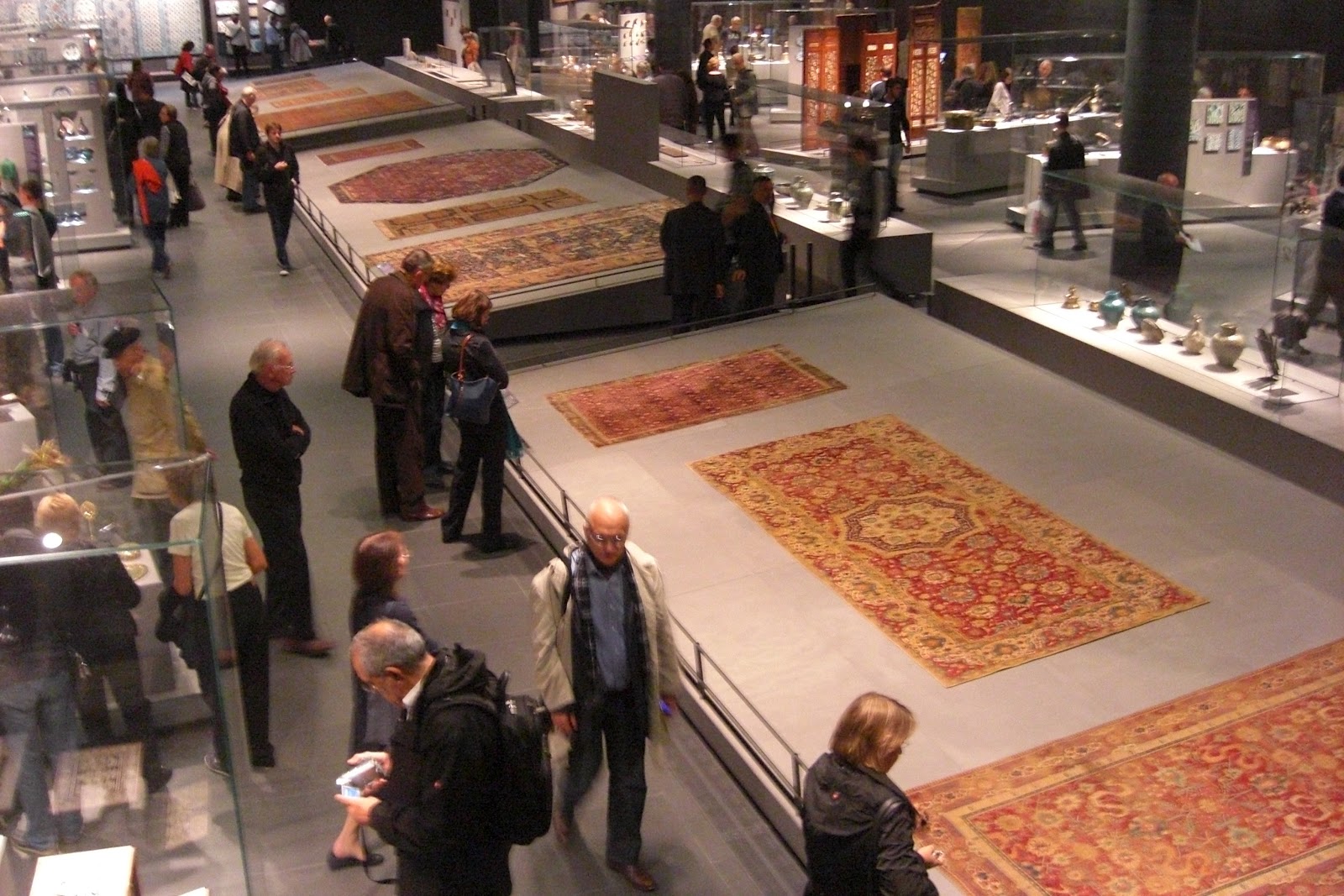
As for Azerbaijani carpets, the most graphically and technologically valuable samples are kept in the museums of decorative arts and the Louvre, and though these carpets were made in traditional hunting or garden themes, they are different in composition.
One of the biggest Azerbaijani art collections is showcased at the world's most frequently visited Louvre museum, which was visited by over 10 million people in 2012. Azerbaijan made one of the biggest contributions, along with Oman, Kuwait and Morocco, to the creation of the Islamic art department, which opened at the museum in September 2012.
Weaving samples account for a large part of the Azerbaijani art samples showcased in the Louvre; the most valuable Azerbaijani carpets are placed in the "Decorative arts" exposition of the museum.
One of them is a carpet dating back to the 16th century. The carpet with a length of 783 cm and width of 379 cm describes symmetric images of a fight between four dragons and a phoenix.
According to French art experts, the carpet was kept in the Notre Dame Cathedral in Paris until the beginning of the 20th century.
Furthermore, there are hundreds of samples of Azerbaijani pottery, enamelware and graceful metal art in the museum.
Some silver, copper and bronze specimens of Azerbaijani metal art kept in the Louvre are considered unique. Among them is a bronze vase dated 1190, which is currently exhibited on the first floor of the Eastern art hall.
The originality of the long-necked vase, which looks like a bird, is not only in its form, but also in its style comprising three thin rims and medallions between them.
The decorations made by the technique of forging and scratching are composed of stylized ornamental plant elements and scripts. One of the scripts reflects the name of the master, Osman Salman oglu Nakhchivani.
The works of Azerbaijani weaving art representatives from Shamakhi, Tabriz, Nakhchivan, Ganja and Sheki are also available in other museums and personal collections of France. Brocades dating back to the 16th-7th centuries comprise a prominent part in these collections.
A Tabriz silk fabric dating back to the 16th century, which is showcased in the Museum of Decorative Arts in Paris, describes a young horseman who is riding while dragging a man in a noose. According to researches, two other parts of the fabric are now kept in the Kiev and Moscow museums.
Another 16th century eminent fabric, which is 26 cm long, is demonstrated in the Museum of Decorative Arts. The storyline of this fabric is similar to the mentioned Tabriz silk fabric, but it shows a man dragging a young woman in a noose. Both fabrics' storylines are symmetric.
All these ancient, diverse and ingenious art samples kept in world-famous museums indicate that Azerbaijan belongs to the world cultural history, and reveal the wealth and uniqueness of Azerbaijani applied art, making it one of the first countries representing Eastern culture and art.
Here we are to serve you with news right now. It does not cost much, but worth your attention.
Choose to support open, independent, quality journalism and subscribe on a monthly basis.
By subscribing to our online newspaper, you can have full digital access to all news, analysis, and much more.
You can also follow AzerNEWS on Twitter @AzerNewsAz or Facebook @AzerNewsNewspaper
Thank you!