
Greece gets provisional bailout deal ahead of review next week
By Bloomberg
Greece obtained a provisional deal from euro-area finance ministers intended to keep aid flowing to the country in return for oversight on fiscal measures, buying time to work out the detail of longer-term Greek financing.
Talks in Brussels between officials from the 19 euro-area countries concluded late Friday with an agreement to extend bailout funds to Greece for four months. Prime Minister Alexis Tsipras’s government must submit a list of economic measures it will undertake on Monday. Finance chiefs will then decide whether his proposals go far enough.
The text of the agreement allows Greece to lower previously agreed targets on reaching a primary budget surplus, potentially freeing up some money to meet at least some of Tsipras’s election pledges. A Greek official, who asked not to be identified in line with policy, said that tax increases and cuts to pensions had been averted in the accord.
“We won time. Neither the Greek economy nor the Greek government were strangled,” government spokesman Gabriel Sakellaridis said in live comments on Mega TV on Saturday. The deal did secure “major achievements” for Greece such as on primary surpluses and “that we’re now not talking anymore about austerity measures,” he added.
U.S. stocks rose Friday, sending benchmark indexes to records, on the prospect of an easing in the standoff between Greece and its creditors. The breakthrough reduces the immediate risk of Tsipras’s government running out of cash as early as next month.
Reform List
The list of reforms that Greece has to present will concern corruption fight, public administration and tax system changes while a comprehensive list of reforms must be submitted and approved by the end of April, Sakellaridis said. Greece’s pledge not to take unilateral actions applies to those with a fiscal cost, the Greek government official said.
The outcome may still prove politically bruising for Tsipras and his Syriza party since his policies are subject to validation by the International Monetary Fund, the European Central Bank and the European Commission, the institutions collectively known as the troika from which Tsipras vowed to break free.
“Saying we have a four month solution is a little bit premature,” Jens Nordvig, managing director of currency research at Nomura Holdings Inc., told Bloomberg Television’s Trish Regan on “Street Smart.”“We have something that avoids a disaster next week or the next two weeks. We’ll have to see whether this can actually be voted through the Greek parliament.”
‘First Step’
Austrian Finance Minister Hans Joerg Schelling said that a new finance ministers’ meeting will be called “immediately” if the list of measures is deemed insufficient.
“Tonight was a first step in this process of rebuilding trust,” Jeroen Dijsselbloem, who chairs euro-area finance ministers meetings said late Friday. The Greeks “have room in the program to change and to replace things. That’s very serious. But we have agreed it will happen after mutual discussions.”
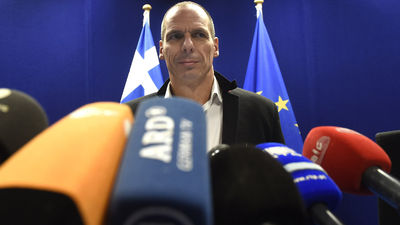
Greek Finance Minister Yanis Varoufakis told reporters late Friday that if the “list of reforms is not backed by the institutions, this agreement is dead and buried. But it’s not going to be knocked down by the institutions.” Greece had to abandon plans to use about 11 billion euros ($12.5 billion) in leftover European bank support funds to help restart the Greek economy.
‘Troika Retreat’
The deal “represents a significant retreat by the troika and shows that their austerity program, which has failed miserably, is no longer politically enforceable,” said Mark Weisbrot, an economist and co-director at the Center for Economic Policy Research in Washington in an e-mail Friday.
The agreement opens a new chapter in a saga that goes back to 2010, when Greece became the first euro-area country to request an international bailout, causing a ripple effect that prompted four more rescues and raised doubts about the durability of the euro. Five years and as many prime ministers later, Greece’s economy has shrunk by about a quarter and it’s shouldering the highest unemployment in the region.
The deal removes the threat of the ECB pulling the plug on the nation’s banks, a prospect that would have risked Greece crashing out of the euro. Capital controls are now out of the question, according to a euro-area official. Uncertainty has triggered deposit withdrawals of about 20 billion euros since December from Greek banks.
Capital Controls
The next major financial hurdle comes next month, when the government must service 2.2 billion euros of debt to the IMF, with the treasury’s coffers nearly exhausted.
Monday is a bank holiday in Greece. The country’s media welcomed the provisional aid extension as an important first step. To Vima said the agreement has given “breathing space.”
Finance ministers will hold a conference call Tuesday to discuss the Greek response, after which the deal, if approved, will be put to national parliaments next week. That includes the Bundestag, where German lawmakers must approve any extension or changes to the terms of euro-area rescue loans.
Here we are to serve you with news right now. It does not cost much, but worth your attention.
Choose to support open, independent, quality journalism and subscribe on a monthly basis.
By subscribing to our online newspaper, you can have full digital access to all news, analysis, and much more.
You can also follow AzerNEWS on Twitter @AzerNewsAz or Facebook @AzerNewsNewspaper
Thank you!