
Asian stocks climb as euro slides; oil jumps as Saudi King dies
By Bloomberg
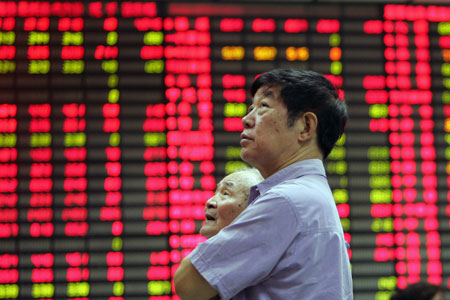
Asian shares rose, with the regional benchmark index heading for an seven-week high, and Japanese bonds rallied while the euro headed toward an 11-year low after the European Central Bank expanded its asset-buying program. Oil jumped after Saudi Arabia’s King Abdullah died.
The MSCI Asia Pacific Index climbed 0.6 percent by 2:38 p.m. in Tokyo, heading for the highest close since Dec. 4. Hong Kong stocks gained as China’s manufacturing contraction unexpectedly slowed. Standard & Poor’s 500 Index futures slid 0.1 percent. Brent crude advanced 2.1 percent, paring its drop since Jan. 16 to 1.3 percent. Japan’s 10-year yield dropped the most since April 2013. The euro bought $1.1325 and China’s yuan weakened 0.3 percent.
The ECB will buy up to 60 billion euros ($68 billion) of assets a month through September 2016, President Mario Draghi said Jan. 22. The so-called flash China purchasing managers’ index from HSBC Holdings Plc and Markit Economics rose to 49.8 from 49.6 in December, where readings above 50 denote expansion. Prince Salman, named as Abdullah’s successor, will probably continue his predecessor’s policy of maintaining oil production to preserve the country’s 20 percent share of global crude sales.
“Asian markets are effectively tracking the overnight performance of Europe as well as the U.S.,” said Tai Hui, the Hong Kong-based chief Asia market strategist at JPMorgan Asset Management, which oversees about $1.7 trillion. The China PMI “doesn’t give the market a whole lot to cheer about, but it could potentially still maintain market expectation that the central bank could look to cut rates or reduce reserve-ratio requirements over the next three to six months.”
Global Rally
The Stoxx Europe 600 Index surged 1.7 percent to extend a seven-year high on Jan. 22. The ECB pledged to buy government bonds as part of an asset-purchase program worth around 1.1 trillion euros. In addition to monthly purchases, the ECB also reduced the cost of its long-term loans to banks.
The euro weakened 0.4 percent today and touched $1.1316, equaling yesterday’s lowest level versus the dollar since September 2003.
The S&P 500 rose 1.5 percent to 2,063.15, capping a fourth straight gain and erasing its loss for the year.
The MSCI Asia Pacific Index rose to 140.59. The S&P/ASX 200 Index rose 1.5 percent in Sydney while New Zealand’s main share index added 0.5 percent, heading for a record close. The Kospi index in Seoul was 0.6 percent higher.
The Hang Seng Index added 1.2 percent toward its highest closing level since Sept. 8, and a gauge of Chinese shares in the city advanced 1.6 percent.
China Streak
The Shanghai Composite Index rose 0.9 percent, close to erasing what would be its first weekly decline since Nov. 7. The gauge’s 10-week rising streak through Jan. 16 was the longest since 2007.
The HSBC preliminary PMI result exceeded the median estimate of 49.5 in a Bloomberg survey of economists. Along with data this week showing industrial output and retail sales improved in December, the first reading of the economy’s momentum in January may alleviate concerns of a deeper downturn.
The NZX 50 Index’s gain in Wellington took its advance for the year to 1.9 percent. Electricity generator Mighty River Power Ltd., up 15 percent led gains this year along with Summerset Group Holdings Ltd., an operator of retirement villages that’s climbed 13 percent.
West Texas Intermediate crude for March delivery traded 2.1 percent higher at $47.27 a barrel after slipping 3.1 percent on Jan. 22. The contract is down 2.9 percent this week after capping its first weekly gain since Nov. 21 on Jan. 16. Brent for March settlement was at $49.64 a barrel after falling 1 percent to end Jan. 22 at $48.52 a barrel.
Policy Stability
The Saudi king, who was born in 1924, died at 1 a.m. local time, the press agency said. Prince Muqrin has been named Crown Prince. A key indicator on crude production will be whether Salman, 79, retains the oil minister, Ali al-Naimi, who has driven decision-making since 1995.
“The Saudi leadership has already taken the tough decision to live with lower oil prices,” Florence Eid-Oakden, chief economist at London-based consultants Arabia Monitor, said by phone. “Naimi is well established, he is respected and there shouldn’t be a change as long as the current cabinet is in place.”
Depressing prices yesterday was a report showing that U.S. crude supplies surged the most since 2001 last week, exacerbating a glut that’s slashed more than 55 percent from benchmark prices since June and complicated central bank efforts to spur inflation.
The Bloomberg Dollar Index advanced 0.2 percent to 1,157.81, extending a 10-year closing high on Jan. 22. The gauge is up 1.6 percent for the week, its biggest such advance since June 2013.
Yield Differentials
The ECB’s shift exacerbates an emerging global divergence in monetary policy. While the Fed is now considering when to tighten credit, central banks in Denmark, Turkey, India, Canada and Peru all announced surprise rate cuts in the past week. The Danish central bank cut its certificate of deposit rate to minus 0.35 percent, the second reduction this week. The Swiss National Bank shocked investors by dropping a cap on the franc.
“Market expectations were high and Draghi managed to surprise even the highest of expectations,” said Nader Naeimi, who helps manage about $125 billion as Sydney-based head of dynamic asset allocation at AMP Capital Investors. “It clearly puts the ECB on the front foot. It should help to stabilize European growth.”
China’s yuan weakened to 6.2269 per dollar in onshore trade, the lowest level since Dec. 30. The People’s Bank of China cut its daily fixing by 0.16 percent to 6.1342 a dollar, the weakest level since Dec. 5.
The 10-year Japanese government bond yield rose the most since May 2013 on Thursday and was down today by as much as nine basis points. Futures on the notes rose by the most since 2010 today, while a measure of 60-day volatility for JGBs surged to its highest in 1 1/2 years, as the BOJ shrinks the market by buying as much as 12 trillion yen ($101.4 billion) of the debt every month.
Here we are to serve you with news right now. It does not cost much, but worth your attention.
Choose to support open, independent, quality journalism and subscribe on a monthly basis.
By subscribing to our online newspaper, you can have full digital access to all news, analysis, and much more.
You can also follow AzerNEWS on Twitter @AzerNewsAz or Facebook @AzerNewsNewspaper
Thank you!