
Baku demonstrates firm position in fight against nuclear terrorism
By Aynur Karimova
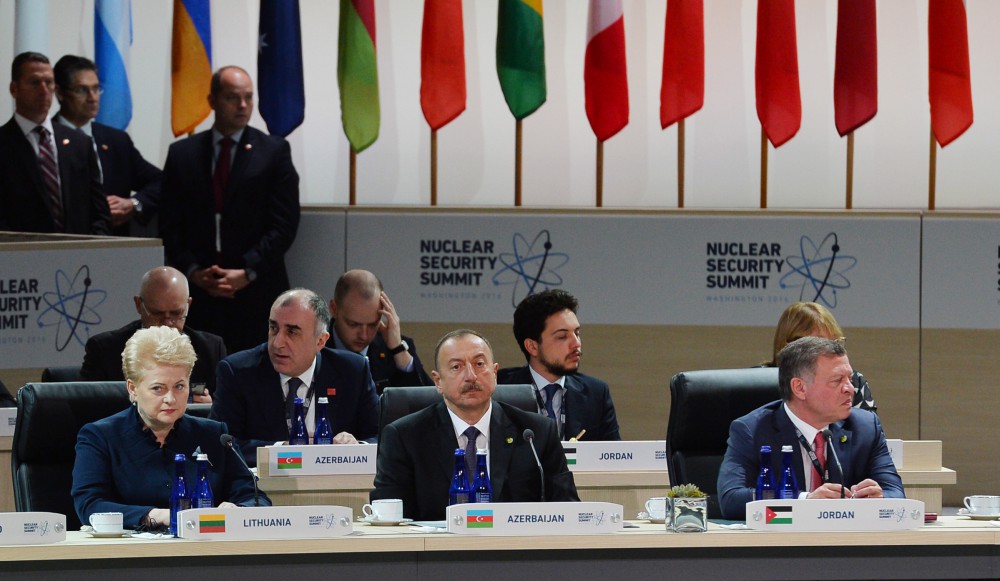
Azerbaijan as a very important partner of the international community in the global fight against terrorism has contributed to the prevention of proliferation and smuggling of nuclear materials. Therefore, participation of Baku at the 4th Nuclear Security Summit was quite noticeable.
The nuclear threat in today’s world is more complex and unpredictable than ever. Amid the rising nuclear threat, Azerbaijan has reiterated its support to the nuclear security and demonstrated a firm position in fight against nuclear terrorism.
President Ilham Aliyev, addressing the 4th Nuclear Security Summit in Washington, voiced Azerbaijan's support to the activity and efforts of President Obama to strengthen nuclear security in the world.
Azerbaijan, as a country suffering from Armenian aggression for more than two decades, attaches great importance to non-proliferation. On the background of emerging proliferation threats and due to its geographic location, Azerbaijan also attaches utmost importance to the prevention of possible use of its territory as a transit route for illicit nuclear trafficking.
"In close cooperation with our international partners we have developed a comprehensive national export control system with the solid legislation basis in line with international standards," President Aliyev said in his speech. "Up to date our national export control system has proved itself as a reliable mechanism in preventing illicit nuclear trafficking."
Unfortunately, due to the fact Armenia has occupied 20 percent of Azerbaijan's internationally recognized territories, Azerbaijan is not able to control these occupied lands, and to implement full scale programs.
From this point of view, Azerbaijan’s participation at the 4th Nuclear Security Summit was very important for counteracting the current threats for the whole South Caucasus region. During the summit, Azerbaijan raised a very serious issue related to the nuclear security of several countries in the region.
"Another issue which I want to draw your attention to is the functioning of the outdated Armenian nuclear power plant which was built in 1976," President Aliyev said. "It is situated in the very seismic zone with a shortage of water to cool its ageing reactor and poses a direct threat to the region. Instead of decommissioning the power plant Armenia plans to extend its operation until 2026. That means that the whole region, including Armenia itself will live under threat for another decade."
President Aliyev also urged the international community to influence Armenia to stop the activity of this power plant and to comply with the rules and procedures which the international community is expecting.
Baku, for many years, has been saying at all international platforms that the operation of Metsamor plant poses a serious threat, since it was constructed with old technology and its service life has expired.
Located in the earthquake-prone region, the operation of this outdated nuclear becomes even more dangerous day by day.
The accident at Japan’s newest nuclear power plant in Fukushima, caused by an earthquake in 2011, led to a huge environmental disaster. It is scary to think what will happen in case of a strong earthquake in Armenia, for example, similar to the one that happened in the country’s Spitak city in 1988.
Today, all the countries in the region, including Iran, Turkey, Georgia, Russia and Azerbaijan are exposed to the threat of suffering the same fate of the Chernobyl nuclear power plant, Sayano-Shushenskaya hydropower plant and the Japanese Fukushima nuclear power plant.
Azerbaijan and other countries in the region must continue drawing attention to a huge probability of technical accidents. As a result of these accidents, the region can be subjected to radioactive contamination.
Diplomatic triumph
President Aliyev's visit to Washington was of significant importance. Within three days the head of state held meetings with the U.S. officials, in particular with Vice President Joe Biden, State Secretary John Kerry, as well as senior representatives of political and business circles and heads of public organizations.
Azerbaijan, after restoring its independence in 1991, established diplomatic ties with the U.S. in 1992. The U.S. became one of the first countries to recognize Azerbaijan's sovereignty immediately after the Soviet Union collapsed. Azerbaijan opened its diplomatic mission in Washington on March 6, 1992, and the U.S. opened its mission in Baku on March 16, 1992. Immediate establishment of diplomatic relations between Azerbaijan and the U.S. shows the importance of Azerbaijan for Washington.
Baku, which has always pursued independent and multi-vector policy, eyes stable development of bilateral relations with the U.S. in many fields. The main direction of the mutual ties is strategic partnership in the field of energy, security and the development of economic relations.
The foundation of successful cooperation of Baku and Washington in the energy field was set in 1993, when Azerbaijan was in active negotiations to attract investment in the oil and gas sector of the country. These talks were followed by the Contract of the Century signed on September 20, 1994 (in which many U.S. companies participated), as well as construction and commissioning of the Baku-Supsa, the Baku-Tbilisi Ceyhan oil pipelines, and Baku-Tbilisi-Erzurum gas pipeline. It is not a secret that the administrations of Bill Clinton and George W. Bush provided their political support to the implementation of these projects.
It is noteworthy that the Baku-Tbilisi-Erzurum gas pipeline is the foundation and an integral part of a larger and more important project - the Southern Gas Corridor, which is strongly supported by the current U.S. government.
Besides strategic partnership in the energy sector and developed economic relations, Azerbaijan is an important ally of the U.S. in the field of security and counterterrorism.
Azerbaijan was one of the first states offering its help to the U.S. in fight against terrorism. Immediately after the September 11 terrorist attacks in New York and Washington, DC, then Azerbaijani President Heydar Aliyev proposed Baku's unconditional support to the U.S. in combating terrorism.
Azerbaijan, being a victim of terrorism and military aggression of Armenia, has allowed the NATO planes carrying non-combat loads for a mission in Afghanistan to fly through Azerbaijan's airspace and to use the country's airports. About 40 percent of all cargo destined for the NATO mission in Afghanistan pass through Baku (southern route, the so-called Northern Distribution Network). In addition, Azerbaijan has for many years participated in peacekeeping missions in Iraq and Kosovo.
All the above mentioned facts once again prove the triumph of Azerbaijan's diplomacy and the effectiveness of the government's foreign policy aimed at the prosperity of the country, the liberation of the occupied territories and the transformation of Azerbaijan into a major political and economic player in the region
Here we are to serve you with news right now. It does not cost much, but worth your attention.
Choose to support open, independent, quality journalism and subscribe on a monthly basis.
By subscribing to our online newspaper, you can have full digital access to all news, analysis, and much more.
You can also follow AzerNEWS on Twitter @AzerNewsAz or Facebook @AzerNewsNewspaper
Thank you!