
Japan’s new dawn
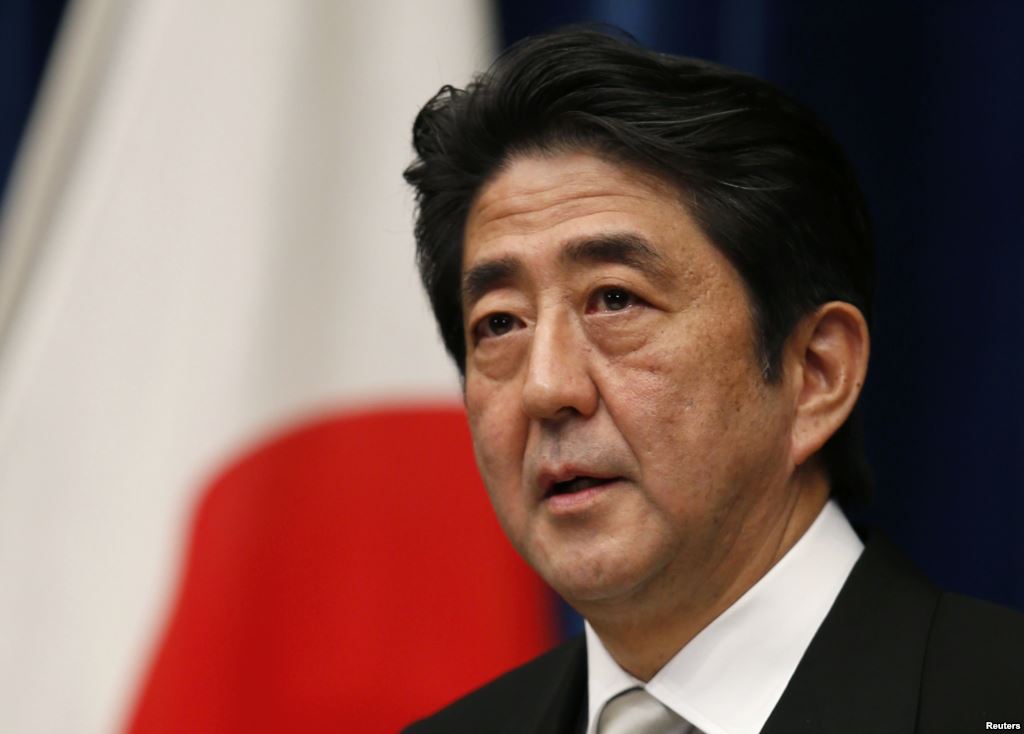
By Shinzo Abe
Prime Minister of Japan
For years, pundits called Japan the land of the setting sun.
They said that for an economy as mature as Japan's, growth would be
impossible. They said that our public debt was unsustainable. They
pointed to our supposed psyche of resignation as a symptom of
relative decline.
But now such voices are rarely heard. Japan's economy has swung
from negative to positive growth and is on the verge of breaking
free from chronic deflation. This spring, wages will increase - a
long overdue development that will lead to greater consumption. Our
fiscal position has also improved steadily, with my government on
track to consolidate public finances.
And, as the economy has turned around, Japan's people have become
more vibrant and upbeat - a mood reflected in public enthusiasm
over the choice of Tokyo to host the 2020 Olympic and Paralympic
Games.
So it is not twilight, but a new dawn, that is breaking over Japan.
And that is because we have overcome the notion that certain
reforms could never be carried out. I have maintained that I am
willing to act like a drill bit, strong enough to break through the
solid rock of vested interests. And so we have.
For example, we will completely liberalize Japan's electricity
market. By the time the Olympians arrive in six years, the power
sector will be fully competitive, with electricity generation
separated from distribution.
We will also foster medical care as an industry. Japan is on the
forefront of regenerative medicine, and we will make it possible to
generate stem cells at private-sector labs. And I have just
proposed additional reforms, because we also need large-scale
health-care providers in the form of holding companies, much like
America's Mayo Clinic.
Moreover, we are eliminating the "rice production adjustment"
system, which has been in place for more than 40 years. Barriers to
private companies' entry into the agricultural sector will be
removed, and farmers will be allowed to grow the crops they want,
without official control over supply and demand.
Soon, our deregulation package will be set in motion. Over the next
two years, in designated areas, no vested interests will remain
impervious. For example, in Japanese cities aspiring to world-class
status, limits on floor space will become a thing of the past. We
will soon see high-quality housing, business complexes, and
zero-emissions towns appearing, one after another.
Likewise, the Trans-Pacific Partnership (TPP) will remain a central
pillar of my economic policies, and we will press ahead with the
Japan-European Union Economic Partnership Agreement. As a result,
Japan's economy will become even more deeply integrated into global
flows of knowledge, trade, and investment. Companies and people
from abroad will find Japan among the most business-friendly places
in the world.
Japan's management of public funds - such as the Government Pension
Investment Fund, which now holds about $1.2 trillion - will also
undergo far-reaching change. We will press ahead with reforms,
including a review of the GPIF's portfolio, to ensure that public
funds contribute to growth-nurturing investments.
We must also make our corporate taxes internationally competitive.
In April, the tax rate on companies will fall by 2.4 percentage
points. And we will put in place tax incentives aimed at
encouraging companies to use their cash for capital investment,
research and investment, and wage increases.
At the same time, we will reform labor-market rules that tie
workers to old industries. New industries require innovative and
creative human resources, and we will redirect our subsidies so
that workers without meaningful employment in declining industries
can move on and find rewarding work in rising sectors.
Of course, given that Japan's population is rapidly aging, and the
number of children is falling, investors find themselves asking an
obvious question: "Where will Japan find the innovative and
creative human resources that it needs?"
Arianna Huffington once quipped that if Lehman Brothers had been
"Lehman Brothers and Sisters," the firm would have survived.
Japan's corporate culture is even more male-dominated - a world of
pinstripes and button-downs.
I was greatly encouraged when Hillary Clinton told me that Japan's
GDP could be 16% larger if women participated in the labor market
at the same rate as men. Indeed, Japan's female labor force is the
economy's most underused resource.
Japan must become a place where women shine. By 2020, we want women
to occupy 30% of leading management positions - a goal that
presupposes a more flexible working environment, as well as support
from foreign workers to take over domestic and personal
services.
A major impetus for change will come in the form of legal reforms,
to be introduced at the next parliamentary session, that will
increase the number of external directors on corporate boards. Next
month, we will also propose a stewardship code that will enable
institutional investors to play a greater role in corporate
governance.
I am confident that the combined effect of these reforms will
enable Japan to double its inward direct investment by 2020,
rebooting the entire country and changing its economic landscape
dramatically.
But there is still much to do. Soon, three years will have passed
since the catastrophic earthquake and tsunami struck northeastern
Japan on March 11, 2011, causing the failure of the Fukushima
Daiichi nuclear power plant. While the recovery is far from
complete, the love and compassion reflected in the world's response
touched us deeply, as has the survivors' spirit of perseverance and
mutual aid to overcome hardship.
It is in the same spirit that Japan is now set to contribute even
more positively to world peace and development. In our age, no
single country can preserve peace by itself. None of us alone can
solve the challenges that the world faces without helping one
another.
In Cambodia, for example, a Japanese-built hospital for mothers and
newborns has helped to reduce the country's infant-mortality rate.
In the Philippines, Japan's Self-Defense Forces mounted a major
relief effort after the devastating typhoon in November. And our
servicemen and women based in Djibouti remain on high alert against
piracy, protecting ships from around the world.
Japan is surrounded by neighbors with unlimited possibilities:
China, South Korea, the ASEAN countries, India, Russia, and, across
the Pacific Rim, the TPP partner countries. Indeed, with Asia
becoming the engine driving the world economy, the need to achieve
lasting peace and prosperity has never been greater, because the
global knock-on effect of any threat to regional stability would be
enormous.
The foundation underpinning prosperity is freedom of movement for
people and goods. On sea-lanes, in air space, and now in outer
space and cyber space, freedom of movement must remain secure. The
only way to maintain these indispensable public goods is by
rigorously upholding the rule of law and promoting fundamental
values like freedom, human rights, and democracy.
There is no alternative. Asia's growth dividend must not be wasted
on military expansion. We must use it to invest in innovation and
human capital, which will further boost growth in the region. As is
true elsewhere, trust among Asian countries is crucial for their
peace and prosperity, and this can be achieved only through
dialogue and adherence to international law, not through force or
intimidation.
In order to create a region of trust and order, I would like to
appeal to Asia and the world. To prevent unchecked military
expansion in Asia, defense budgets should be made completely
transparent, with verifiable public disclosure. Moreover, Asian
governments should create a mechanism for crisis management and
strong communication channels among our armed forces. We must also
establish rules that promote behavior based on international
maritime law.
Only then can we achieve lasting growth and prosperity in Asia,
enabling all of us in the region to realize our great
potential.
Japan has pledged that it will never again wage war, and we have
never stopped working for a world that is at peace. It is my
fervent hope that Japan's economic revival, with its promise of
increased global and regional prosperity, will help to bring such a
world closer.
Copyright: Project Syndicate
Here we are to serve you with news right now. It does not cost much, but worth your attention.
Choose to support open, independent, quality journalism and subscribe on a monthly basis.
By subscribing to our online newspaper, you can have full digital access to all news, analysis, and much more.
You can also follow AzerNEWS on Twitter @AzerNewsAz or Facebook @AzerNewsNewspaper
Thank you!