
Azerbaijan bets on Caspian winds to build its next energy export industry

Ulviyya Poladova
Read moreFor most of modern history, Azerbaijan's economic and political influence has been closely tied to oil and gas. The country built its reputation as an energy producer long before the current debate about energy diversification and the green transition became a global priority. Its pipelines connected the Caspian basin with international markets, while natural gas exports gradually strengthened Baku's position as a partner in Europe's energy security. But the global energy landscape is changing, and Azerbaijan has little reason to stand aside.
A prime example of this progress is the approximately 840 million cubic metres of natural gas that Azerbaijan saved in the first nine months of the year thanks to the growing number of renewable energy power plants. Less gas burned means lower emissions, and this figure offers a tangible indication of the direction the country is heading in.
This reflects a wider point made by Hikmet Hajiyev, assistant to the President of Azerbaijan and head of the foreign policy department of the Presidential Administration, in an interview with the well-known American economist and Columbia University professor Jeffrey Sachs. Hajiyev recalled that the strategic value of the country's oil fields once made Azerbaijan one of the most important targets for Nazi Germany, which sought to seize control of the resources of the Caucasus. Yet that oil heritage, he argued, does not stand in the way of the country's push into renewables.
"We understand perfectly well that green energy is the new reality. That is exactly why Azerbaijan is actively investing in the development of this field," he said. Hajiyev drew particular attention to the wind potential of Baku and the Caspian Sea. "We in Azerbaijan used to complain constantly about the strong winds in Baku. They caused people a lot of discomfort, and we almost saw them as a curse. Today, though, we are starting to understand that the Baku winds are, on the contrary, a real blessing, especially given the potential of the Caspian Sea," he added. In his assessment, the Caspian can compete in wind energy potential with the North Sea and other promising regions of the world, though realising those opportunities will require investment and consistent state policy.
The broad use of renewable energy sources has become one of the priorities of the energy policy pursued under the leadership of President Ilham Aliyev. Presidential Order No. 1209 of 29 May 2019 on accelerating reforms in the energy sector laid the legal groundwork for liberalisation, greater competition and the transition to green energy in the market. The move toward green energy, the push for higher energy efficiency and the building of a low-carbon economy also sit among the main targets of the Socio-Economic Development Strategy of the Republic of Azerbaijan for 2022 to 2026.
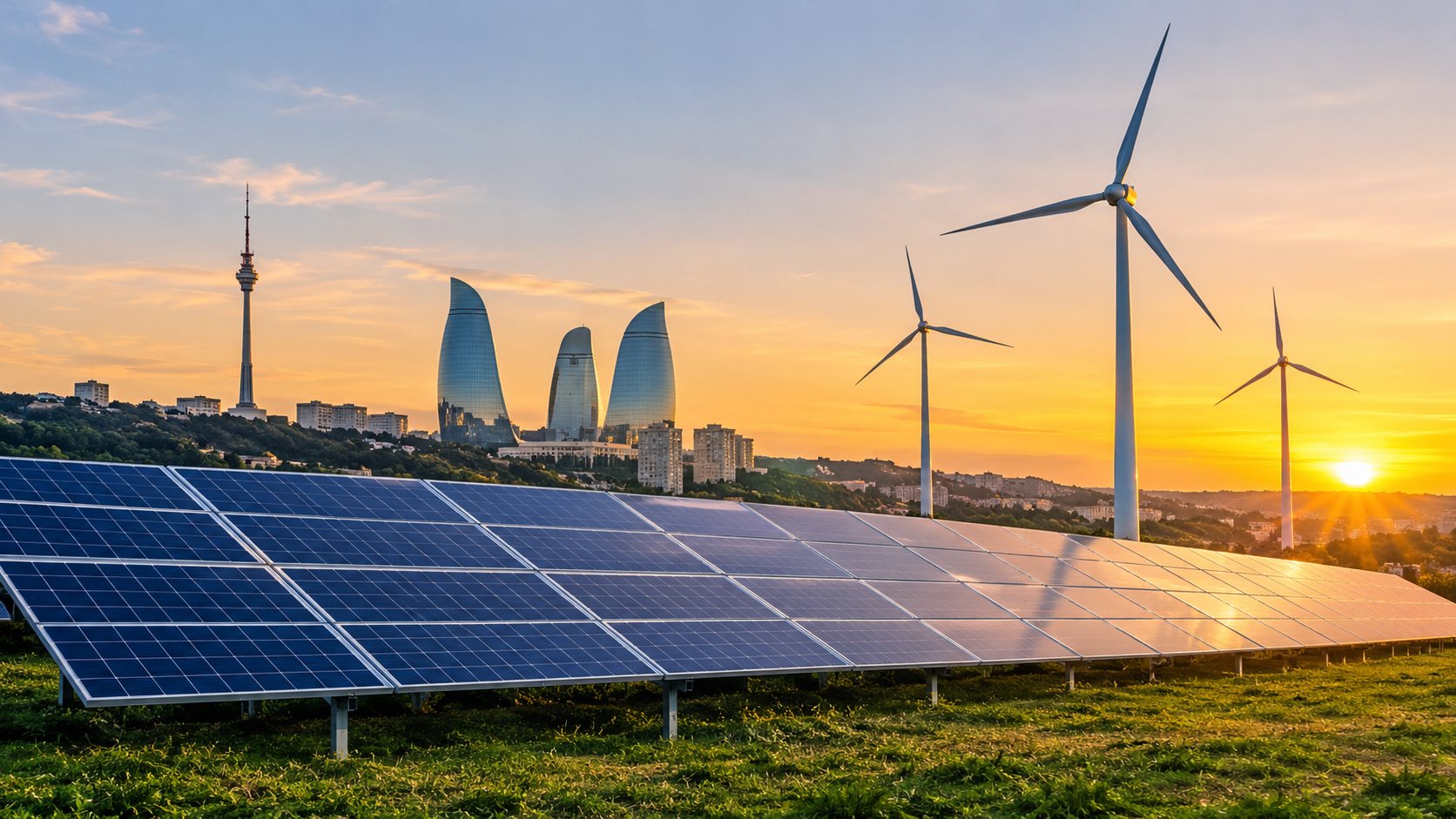
Power plants running on renewable sources now operate in the country with a combined capacity of 2,170 MW. These include 65 hydroelectric plants totalling 1,443.5 MW, 6 wind plants at 306.5 MW, 10 solar plants at 378.2 MW, one biomass plant of 37 MW and 3 hybrid plants of 7.3 MW. Taken together, renewable sources account for roughly 21.5 per cent of the country's total energy capacity.
Over 2027 and 2028, the country intends to add a further 2 gigawatts of electricity generating capacity from renewable sources. According to Deputy Energy Minister Elnur Soltanov, the Emirati company Masdar stands among Azerbaijan's main strategic partners in this area. Under its projects, the country expects to build more than 1 gigawatt of renewable capacity by 2028.
Soltanov was careful to note that developing renewables means far more than simply adding new generating capacity. Modernising and strengthening the electricity grid matters just as much. "Building new renewable capacity can attract billions of dollars in investment to the country. But to transmit this energy to the grid safely and efficiently, the state also has to allocate significant funds to reinforce the electricity networks. In its current state, the grid cannot absorb renewable energy in the volumes needed or with the flexibility required," he said.
It should be noted that managing the electricity produced by solar and wind plants is harder than managing conventional generation, since output depends on the weather. For that reason, it is important to build battery storage systems and to expand the capacity to balance the grid. Electricity is a particular kind of commodity whose production and consumption must stay in constant equilibrium. Any break in that balance can cause serious trouble for the power system and even lead to large-scale outages, so as the share of renewable sources grows, the questions of managing and balancing the grid only grow in importance.
The latest figures point to a system in transition. In January through September 2026, Azerbaijan produced 20 billion 29.6 million kWh of electricity, 2.3 per cent less than in the same period of 2025, according to the State Statistics Committee. Of that total, 19 billion 452.5 million kWh was commercial electricity, a decline of 1.8 per cent. Thermal power plants generated 15 billion 170.3 million kWh, down 9.5 per cent year on year. Hydroelectric plants produced 2 billion 739.5 million kWh over the period, up 15 per cent. Output at wind plants rose 27.1 times to reach 841.3 million kWh, while solar plants generated 533.2 million kWh, up 10.1 per cent.
Azerbaijan's renewable energy ambitions are developing at a time when the international energy market is undergoing a fundamental transformation. Electricity demand is increasing, new industries are becoming more energy-intensive, and governments are seeking to diversify their sources of supply. Thus, Baku has the opportunity to use its existing energy infrastructure, geographical position and international partnerships to participate in this changing market.
There are still considerable obstacles. Renewable generation must be supported by modern transmission networks and storage facilities. International electricity corridors require substantial investment and long-term political and commercial commitments. The country must also ensure that new projects are economically sustainable rather than simply adding installed capacity to official statistics. Yet the progress achieved so far suggests that Azerbaijan's green energy programme is moving into a more practical phase.
Azerbaijan is trying to make its energy sector more diverse, efficient and internationally connected. The real measure of success will be whether the country can turn its substantial renewable potential into a reliable source of electricity, a competitive export industry and a lasting economic advantage.
Here we are to serve you with news right now. It does not cost much, but worth your attention.
Choose to support open, independent, quality journalism and subscribe on a monthly basis.
By subscribing to our online newspaper, you can have full digital access to all news, analysis, and much more.
You can also follow AzerNEWS on Twitter @AzerNewsAz or Facebook @AzerNewsNewspaper
Thank you!