
China’s gold strategy signals broader shift in global investments

Ulviyya Poladova
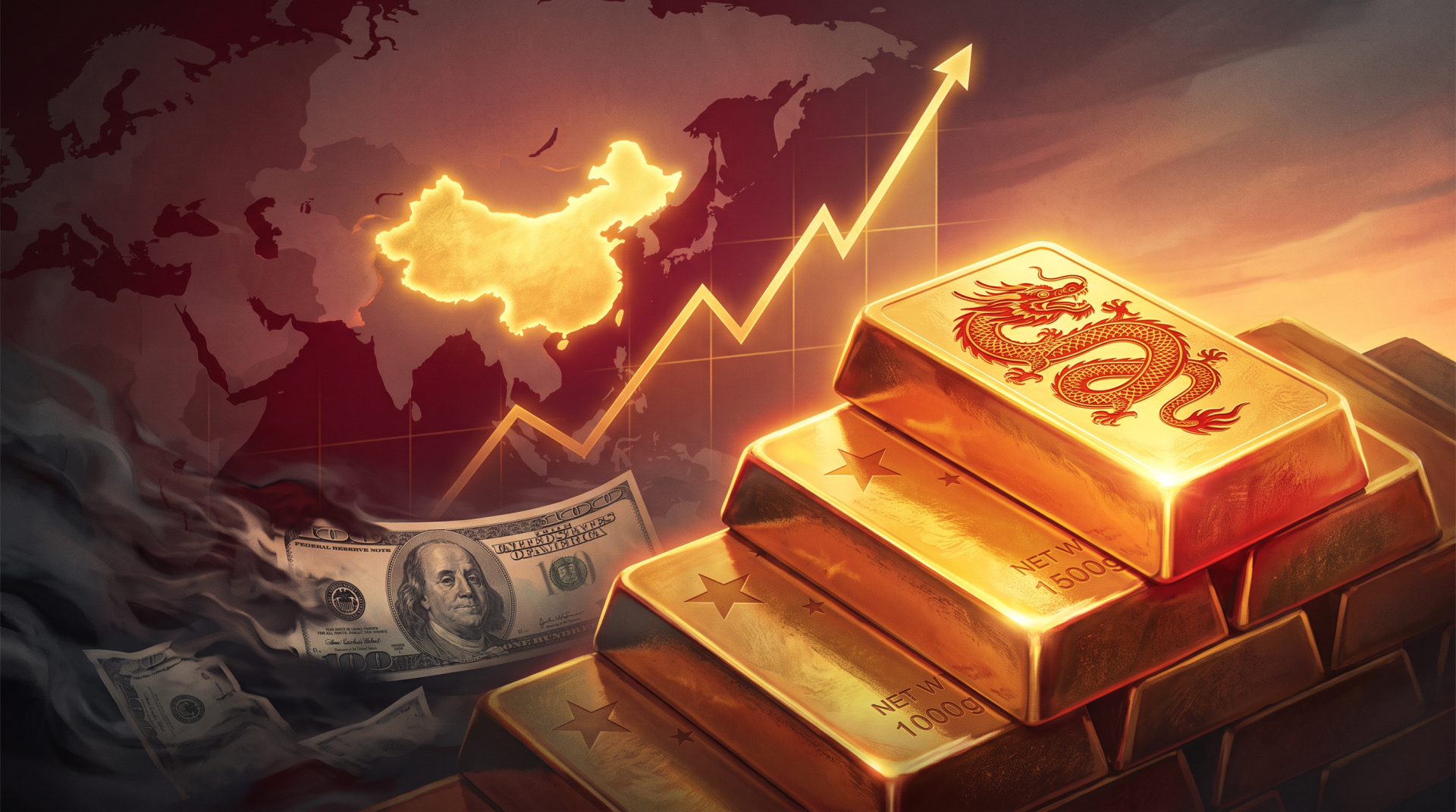
Read moreChina highly increased its gold purchases this year. Over the first eight months, the country imported more than 1,000 tonnes of the precious metal, spending a record 158.8 billion dollars on it. For comparison, in all of 2025 China imported 886 tonnes of gold for a total of 96.5 billion dollars.
The main reason behind this demand is the desire of both the state and private investors to protect their savings against the backdrop of geopolitical instability and the weak returns of other assets. According to the Financial Times, Chinese holdings of US Treasury bonds fell in July to 618 billion dollars, the lowest level since August 2008. At the same time, attractive investment options inside the country have shrunk. The property market crisis has continued since 2021, the CSI 300 index has lost 1.8% since the start of the year and stands more than a fifth below its early 2021 peak, while the yield on Chinese government bonds has also approached historic lows.
Meanwhile, the real volumes of the People's Bank of China's purchases may be higher than the official figures. Goldman Sachs estimates the central bank's July buying at 35 tonnes, against the 20 tonnes officially declared. China, in turn, is the world's largest producer of gold, yet its domestic output is clearly not enough for current demand. Last year the country mined 384 tonnes of gold.
The Chinese domestic market keeps gold prices slightly above global levels, which stimulates further imports. According to Jinrui Futures analyst Zijie Wu, an additional factor has been the strengthening of the yuan and shifts in world gold prices. A strong national currency creates more favorable conditions for purchases abroad. Against this backdrop, Chinese exchange-traded funds are also increasing their gold holdings. In August its gold reserves rose by 650,000 ounces, the largest monthly addition since 2023. The central bank has been steadily increasing its gold reserves for almost two years, Bloomberg writes.
It is no coincidence that last year China opened its first offshore vault for state gold reserves, on the territory of Hong Kong. Before that, it usually kept its gold only in the vaults of the People's Bank of China. The offshore vault will allow China to trade gold for yuan and for the national currencies of other countries, outside the dollar system. World Gold Council estimates show that China’s official gold reserves stood at around 2,366 tonnes in early September, accounting for about 8% of the global total and placing the country sixth worldwide.
China’s growing gold purchases have begun to influence prices worldwide, with the impact extending beyond the sheer scale of its demand. It is important to understand here that this is not only about volumes. China's behavior is changing the psychology of the market. When investors around the world see that both the central bank and private savers of an enormous economy are systematically, month after month, shifting into gold, it works as a signal. If Beijing is moving into an asset that carries no counterparty risk, then it is seriously preparing for turbulence. And that signal is picked up by others. Behind Chinese demand come funds, banks, and private buyers in the rest of the world, while talk of gold being undervalued grows ever louder.
In the end, a curious closed loop emerges. Geopolitical instability drives China into gold, Chinese purchases push the price up, the rising price attracts new buyers around the world, and the general frenzy only deepens the very anxiety that set the whole process in motion.
In a commentary to AzerNEWS, economist Natiq Mammadov said China’s surge in gold purchases should be viewed primarily as a long-term diversification strategy rather than simply a temporary reaction to geopolitical tensions.
He noted that while geopolitical uncertainty has certainly accelerated the process, China has been increasing its gold reserves for an extended period. According to Mammadov, the continued accumulation of gold by the People’s Bank of China suggests that the authorities are focused on long-term reserve diversification rather than short-term speculation.
At the same time, Mammadov stressed the importance of distinguishing between government purchases and China’s total gold imports. He pointed out that overall imports also reflect strong demand from households, institutional investors and the financial sector.
"For private investors, gold provides an alternative at a time when the property market has been under pressure and returns on some traditional domestic assets have been relatively unattractive," he said, adding that it represents a structural shift that has been reinforced by geopolitical uncertainty.
Mammadov noted that further growth in Chinese demand could provide significant support for global gold prices, particularly if it continues alongside purchases by other central banks. However, he stressed that China alone cannot determine the global price of gold, as interest rates, the US dollar, investment flows and global economic conditions will also remain important factors.
The expert highlighted what he considers to be the more important issue: the changing role of gold in the international financial system. He said China’s reduction of its holdings of US Treasury securities does not mean that gold is simply replacing the dollar. Rather, he explained, it indicates a broader effort to diversify reserve assets and reduce dependence on any single type of asset.
In the long term, Mammadov said, gold could become increasingly important as a neutral strategic reserve asset alongside the dollar, the euro and other currencies. If China and other central banks continue accumulating gold while reducing their dependence on dollar-denominated assets, the strategic importance of gold in the international financial system is likely to increase.
Overall, Mammadov described China’s current gold purchases as part of a long-term restructuring of reserves, accelerated by geopolitical uncertainty. He added that the immediate effect may be stronger support for gold prices, while the deeper significance is that gold is gradually returning to a more prominent role as a strategic reserve asset in an increasingly diversified international monetary system.
Here we are to serve you with news right now. It does not cost much, but worth your attention.
Choose to support open, independent, quality journalism and subscribe on a monthly basis.
By subscribing to our online newspaper, you can have full digital access to all news, analysis, and much more.
You can also follow AzerNEWS on Twitter @AzerNewsAz or Facebook @AzerNewsNewspaper
Thank you!