
Iran ready to ensure Turkey's energy security
By Aynur Karimova
Iran has expressed its readiness to ensure the energy security of Turkey.
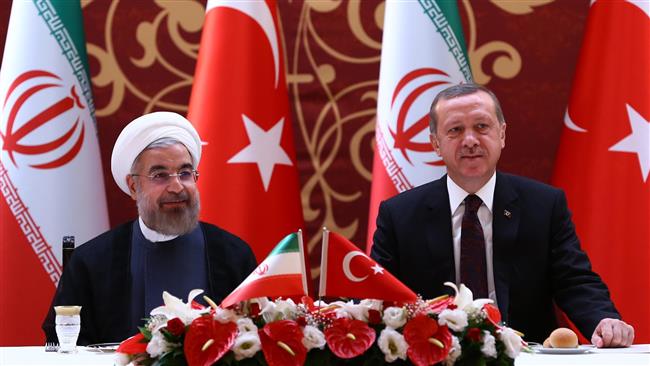
Iranian President Hassan Rouhani said at a joint press-conference with his Turkish counterpart Recep Tayyip Erdogan in Ankara on April 16 that Tehran can fully meet Ankara's gas, oil, electricity and petrochemical needs.
The press conference was aired live by Iran's state-run IRINN TV.
Tehran promised Ankara that it is able to ensure Turkey's energy security, Rouhani added.
Iran and Turkey, which enjoy grounds for boosting cooperation in various areas, have also agreed to expand multifaceted ties as the two countries' economies complement each other.
Rouhani believes that closer banking ties have big importance in the two countries' bilateral ties, therefore, Iran and Turkey need to remove obstacles to expand ties. Taking this fact into account, Tehran and Ankara also decided to expand banking ties.
He added that Turkish banks can open their branches in Iran in order to facilitate the mutual trade and economic ties.
Rouhani believes that the cooperation between the stock markets of Istanbul and Tehran can also lead to a very positive upheaval in the two countries' capital markets.
He urged the two countries' private sectors to make mutual investments to the export of joint products to third-parties, and also invited Turkish companies to invest in the infrastructure of Iran's tourism sector.
During the meeting the two presidents also discussed cultural, academic and scientific cooperation, joint researches, as well as regional issues, including the ongoing crises in Yemen, Syria and Iraq.
"We should help regional countries, such as Yemen, Syria and Afghanistan, to resolve their problems," he noted.
Iran and Turkey have no principal differences in political matters, Rouhani said, underlining that the differences in "minor issues" are natural.
Turkey, which is keen on giving a new impetus to its trade ties with neighboring Iran following removal of international sanctions, intends to take the rising golden opportunity in Iran's economy and to play a more active role on the Islamic Republic's market by its private sector.
Being the Middle East’s two powerful players, Iran and Turkey share very close economic ties despite taking part in opposing political blocs.
Tehran and Ankara are already clashing over a number of issues, in particular their supporting opposing sides in the Syrian crisis.
However, both sides are determined not to allow the political tensions to affect their economic goals as the Iranian market promises a huge opportunity to Turkey in various sectors, including tourism, automotive industry, clothing, textiles, machinery, chemistry, petrochemistry and energy industry, as well as banking, telecommunications and transportation.
Apparently, Turkey is not going to lose this tempting market for political disputes.
Speaking at the press conference, Erdogan said that Turkey and Iran will develop relations in all the areas.
Erdogan believes that despite Iran and Turkey are neighbors, some problems have recently emerged in economic relations between the two countries.
He said there are political differences between Iran and Turkey, but this fact doesn't affect the joint fight against terrorism.
Erdogan noted that the two countries can invest in third countries, as well within the bilateral relations.
Rouhani arrived in Ankara on April 15 evening to hold bilateral talks with high-ranking Turkish officials, especially with his counterpart Erdogan.
As part of his visit to Ankara, Iran and Turkey signed several memorandums of understanding.
The two sides signed documents for cooperation in various sectors, including social welfare, as well as culture, science, education and standards, while the justice ministers of Iran and Turkey also signed a joint statement.
The trade turnover between Turkey and Iran stood at $22 billion in 2012 before dipping to $14.5 billion in the following year due to the economic sanctions imposed on Tehran by the West.
Trade turnover between the two countries stood at $13.71 billion in 2014 and $9.76 billion in 2015. Currently, Tehran and Ankara intend to raise their bilateral trade to $30 billion per year.
Although the trade turnover dropped by 29 percent in 2015 compared to the preceding year, many observers believe that the decline came amid global economic crisis ruling out the role of the political disagreements.
--
Aynur Karimova is AzerNews’ staff journalist, follow her on Twitter @Aynur_Karimova
Follow us on Twitter @AzerNewsAz
Here we are to serve you with news right now. It does not cost much, but worth your attention.
Choose to support open, independent, quality journalism and subscribe on a monthly basis.
By subscribing to our online newspaper, you can have full digital access to all news, analysis, and much more.
You can also follow AzerNEWS on Twitter @AzerNewsAz or Facebook @AzerNewsNewspaper
Thank you!