
Iran, Pakistan mull bilateral ties, economic cooperation
By Aynur Karimova
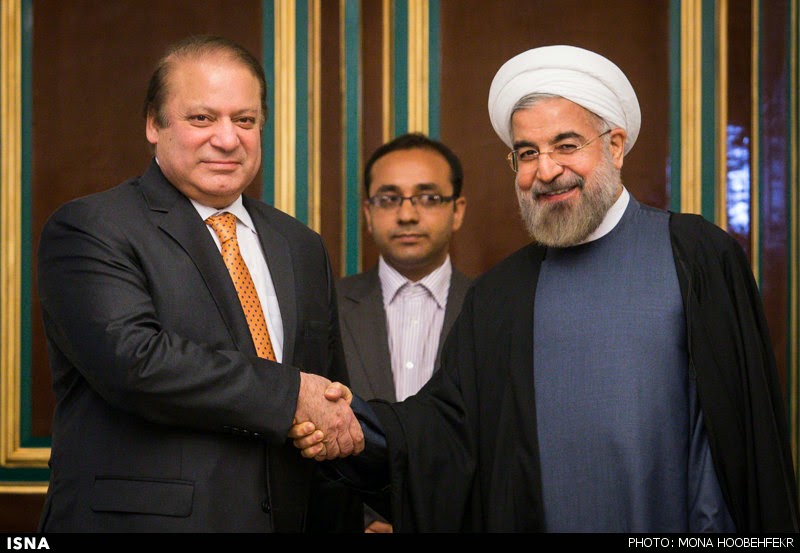
Iran and Pakistan have discussed issues of mutual interest, economic cooperation at regional and international levels, as well as development of bilateral relations.
The discussions were held between Iranian President Hassan Rouhani and Pakistani Prime Minister Muhammad Nawaz Sharif in Islamabad.
President Rouhani arrived in Islamabad on a visit on March 25 heading a top-ranking delegation, as well as a 60-member group of Iranian businesspersons and representatives of private sector.
The milestone of this visit was signing of six documents, mostly focused on boosting economic ties.
Following the signing ceremony, President Rouhani said that Iran and Pakistan are determined to promote their bilateral relations, particularly in the economic field and in the fight against terrorism.
"We discussed economic relations and the capacity to expand them, including in the fields of energy, gas, and export of electricity," he said while talking about the meeting with the Pakistani prime minister.
As part of the visit, Iran and Pakistan also held a business
forum, where President Rouhani said that Iran is ready to increase
bilateral trade with Pakistan from current level of $1 billion a
year to $5 billion.
Rouhani further said that the role of entrepreneurs, private and
public sectors of the two countries for realizing the $5 billion
annual trade target is very important.
He also underlined that Tehran will contribute to the energy
security of Pakistan. Rouhani ensured Pakistani side that Tehran,
as a “strategic partner” will spare no effort to meet Pakistan’s
oil, gas and electricity needs.
Rouhani believes that the two sides should boost banking and trade
ties and prepare grounds for free mutual trade, moving towards
preferential trade.
Later, speaking at a press conference to wind up his two-day visit to Pakistan on March 26, President Rouhani said Iran has laid the pipeline up to the border to export gas to neighboring Pakistan encouraging the government in Islamabad to speed up measures to complete its share on its soil.
He stressed that Iran is determined to increase its relations with Pakistan in energy, ports, customs, roads, railways, cultural, academic, and scientific areas.
“Expansion of Tehran-Islamabad ties will serve the interests of the Iranian and Pakistani nations, region and the world,” he added.
President Rouhani also reminded that the Iranian port of Chabahar and Pakistani port of Gwadar are complementary and in a sound competition can be gateways of the land-locked Central Asian countries to the Indian Ocean.
“We are following up launching a West-East corridor between the two ports. Further road, railways, and shipping links can help establish the corridor and connect China to this region,” he said.
Tehran and Islamabad also agreed to increase Iran’s electricity export to Pakistan by 40 percent.
The agreement was achieved during the meeting of Iranian Energy Minister Hamid Chitchian and his Pakistani counterpart Khawaja Muhammad Asif in Islamabad on March 26.
The increase will be realized based on an amendment added to former agreement between the two countries which was signed in 2000.
The two ministers also held primary negotiations to increase the capacity of Iran’s electricity exports to Pakistan to 3,000 megawatts.
The sides agreed to finalize the issue during the visit of the Pakistani water and power minister to Tehran which is scheduled for May.
Also, Pakistan has allowed Iran to set up a branch of its largest commercial bank, Bank Melli in Pakistan, Tasnim news agency reported March 27.
Such a decision is envisaged in a Memorandum of Understanding, which was signed by Governor of Pakistan’s State Bank Ashraf Wathra and Head of Iran’s Central Bank Valiollah Seif on the sidelines of a joint business forum in Islamabad March 26.
Under the agreement, Pakistan’s Habib Bank will be allowed to open a branch in Iran as well.
Establishing correspondent banking relationships, opening banking accounts between Tehran and Islamabad, and preparing grounds for cooperation of the two countries’ commercial banks to facilitate the business are among the other contents of the deal.
The two sides also agreed to form a joint banking committee to pursue the process of implementation of the agreement.
--
Aynur Karimova is AzerNews’ staff journalist, follow her on Twitter: @Aynur_Karimova
Follow us on Twitter @AzerNewsAz
Here we are to serve you with news right now. It does not cost much, but worth your attention.
Choose to support open, independent, quality journalism and subscribe on a monthly basis.
By subscribing to our online newspaper, you can have full digital access to all news, analysis, and much more.
You can also follow AzerNEWS on Twitter @AzerNewsAz or Facebook @AzerNewsNewspaper
Thank you!