
World powers, Iran clinch historic nuclear deal
By Sara Rajabova
The world powers and Iran finally could ink a historic nuclear deal on Tehran’s nuclear energy program following the marathon-like talks over the past two weeks to work out the remaining technical and political issues.
The long-awaited deal showed the power of diplomacy in resolving the perennial conflicts through the negotiations despite the irreconcilability between the conflicting sides.
The Iran nuclear agreement is expected to bring some relief to the Middle East region that is grappling with conflicts and wars over the many years, as the current deal prevented the emergence of new and more dangerous war in the region, which could be disastrous not only for this region, but for the entire world.
The deal aims to limit Iran's nuclear work for more than a decade in exchange for the gradual suspension of sanctions that have slashed Iran's oil exports and crippled its economy.
Under the deal, sanctions imposed by the United States, European Union and United Nations would be lifted in return for Iran agreeing long-term curbs on a nuclear program that the West has suspected was aimed at creating a nuclear bomb.
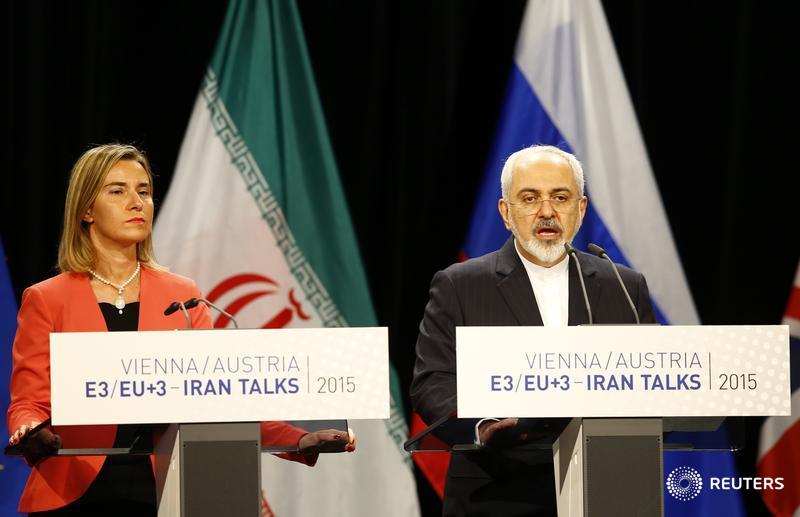
Iranian Foreign Minister Mohammad Javad Zarif and the European Union foreign policy chief Federica Mogherini have made a joint statement on the achieved nuclear deal between Iran and the P5+1, Iran’s state IRINN TV reported on July 14.
U.S. Secretary of State John Kerry as well as foreign ministers of France, Germany, the UK, Russia and China were also present in the Austria Center, Vienna where the statement was announced.
Iran asserts that it will not seek nuclear weapons under any circumstances, according to the statement which was read in English by Mogherini and in Persian by Zarif.
In return, all sanctions related to the nuclear program of the Islamic Republic will be lifted including the bilateral, multilateral, and UN Security Council sanctions.
The 100-page final accord reportedly included five technical annexes.
A final nuclear deal is a major policy victory for both U.S. President Barack Obama and Iran's President Hassan Rouhani.
For U.S. President Barack Obama, a successful nuclear deal would be a main foreign policy achievement and potentially the legacy of his presidency. As he has been criticized for his foreign policy tactics both at home and abroad, the deal will let Obama to end his tenure on a win.
As for Iranian Rouhani, he has vowed to put an end to the economic difficulties and isolation of his country. A failure of the talks would reduce people's confidence toward the government and threaten political stability, as Iranian people are waiting with great hope to get rid of their sufferings.
After reaching a deal, Rouhani said the nuclear deal between Iran and the six world powers has opened a new page, whose basis is based on resolving global disputes in simpler ways.
Meanwhile, Iranian parliament will hold voting on the nuclear agreement.
Zarif will return to Tehran on July 14 and submit the agreement between Iran and P5 +1 to the country’s parliament within a week, a source close to the talks told Sputnik agency.
The source added that the parliament meeting can be held either late this week, or early next week.
Washington said Iran will get rid of 98 percent of the enriched uranium.
Obama, in the meantime warned that if Iran violates this agreement, the sanctions will be brought back, RIA Novosti reported. He said Iran should comply with the agreement signed with the world powers.
He also added that the nuclear agreements with Tehran won’t eliminate all the disagreements between the U.S. and Iran. Obama said the U.S. will keep the sanctions on Iran due to “supporting terrorism”, violation of human rights and the program for developing ballistic missiles.
Following clinching the nuclear deal, some countries welcomed the agreement. Russia, Turkey and some other countries hailed the deal, saying the agreement on the Iranian nuclear program is very important, as Iran has significant resources of natural gas.
July 13 was the most recent deadline Iran and the group P5+1(five permanent members of the UN Security Council plus Germany) had given themselves to iron out the remaining differences and nail down a landmark deal.
The talks between the two sides started over 10 years ago. After the adoption of an interim joint action plan in Geneva in November 2013, the discussions between Iran and P5+1 have been held in Vienna, Montreux, Lausanne and Geneva in many rounds since February 2014. The final negotiation round has lasted in Austria’s capital for over 18 days.
--
Sara Rajabova is AzerNews’ staff journalist, follow her on
Twitter: @SaraRajabova
Follow us on Twitter @AzerNewsAz
Here we are to serve you with news right now. It does not cost much, but worth your attention.
Choose to support open, independent, quality journalism and subscribe on a monthly basis.
By subscribing to our online newspaper, you can have full digital access to all news, analysis, and much more.
You can also follow AzerNEWS on Twitter @AzerNewsAz or Facebook @AzerNewsNewspaper
Thank you!