
Iran, P5+1 still indecisive on preliminary deal
By Sara Rajabova
Following the extension of the nuclear talks on Iran’s disputed nuclear program, the six world powers and the Islamic Republic have been reported to be soon drafting a deal.
This comes after the failure of the sides to meet March 31 deadline on reaching a political understanding over the nuclear issue, though officials stated that the preliminary agreement is within reach.
Recent reports said Iran and the P5+1countries have started drafting a deal on the Islamic Republic’s disputed nuclear program.
Abbas Araqchi, Iranian deputy foreign minister and senior nuclear negotiator said the parties have started drafting the “solutions”, Iranian media reported.
Despite the hopeful remarks by some of the negotiating countries, in general statements don’t coincide with each other.
While Iran and Russia expressed optimism on drafting an initial agreement, France seemed not hopeful about the immediate deal.
Sergei Lavrov, Russian foreign minister said on April 1 that the P5+1 group and Iran agreed on all key aspects and are due to start drafting a preliminary deal on Tehran’s nuclear program, IRNA reported.
Reuters quoted Laurent Fabius, French foreign minister as saying that the negotiations in Lausanne are moving, but not fast enough for the agreement to be signed.
Following the extension of the talks, the U.S. State Department said there are several difficult issues still remaining.
Such contradicting remarks make it difficult to put forward any prediction about the possibility of clinching an initial agreement.
The main issues of disagreement between the world powers and Iran are the lifting of the international sanctions imposed on Tehran over its nuclear activity and its restoration if Iran violates the accord, as well as the Islamic Republic's nuclear centrifuge research.
Iran demands a full lifting of sanctions, saying the agreement on the Iranian nuclear program will not be achieved without complete removal of existing sanctions. However, Western negotiators support a gradual removal of sanctions.
“We insist on lifting financial, oil and banking sanctions immediately ... for other sanctions we need to find a framework. We insist on keeping research and development with advanced centrifuges," Abbas Araqchi told state television.
On the other hand, the sides are not willing to lose the chance for a preliminary agreement as it could lead to unknown consequences for both sides.
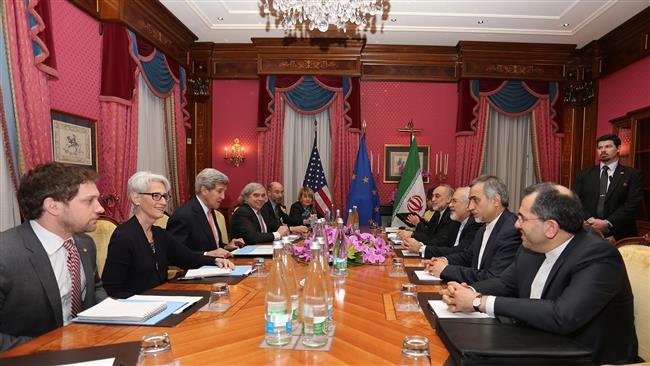
Negotiators from the P5+1 countries and Iran still continue nuclear talks in hope of bridging some of the existing gaps and ink an initial document on Tehran’s nuclear case.
On the 8th day of the nuclear talks on April 1, Mohammad Javad Zarif, Iran’s foreign minister and John Kerry, the U.S. secretary of state met once more in a two-sided session.
Their meeting came after the P5+1 foreign ministers ended a round of talks and each set for talks among their own delegations.
Iran and the P5+1 (the US, UK, France, Russia, China, and Germany) will issue a joint statement at the end of the ongoing talks, if they reach a conclusion on the all disputed issues, Iran’s State IRINN TV reported April 1.
The statement would read that progress and “general solutions” have been achieved in the negotiations and would include some working documents between Iran and the P5+1 as well as written texts, according to Araqchi.
Iran and the P5+1 are trying to hammer out a comprehensive agreement on the Islamic Republic’s nuclear program by July 1.
--
Sara Rajabova is AzerNews’ staff journalist, follow her on
Twitter: @SaraRajabova
Follow us on Twitter @AzerNewsAz
Here we are to serve you with news right now. It does not cost much, but worth your attention.
Choose to support open, independent, quality journalism and subscribe on a monthly basis.
By subscribing to our online newspaper, you can have full digital access to all news, analysis, and much more.
You can also follow AzerNEWS on Twitter @AzerNewsAz or Facebook @AzerNewsNewspaper
Thank you!