
Astana remain hopeful to overcome economic challenges
By Sara Rajabova
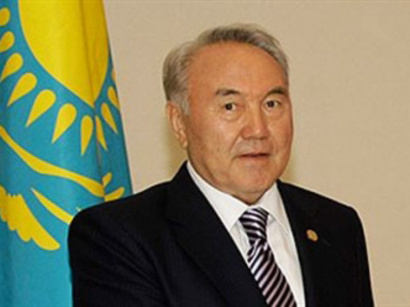
Kazakh president says there is no internal economic crisis and the country is able to withstand current global crisis resulted from the plunging global oil prices.
“I want to emphasize that there is no internal crisis … the global crisis is an external factor,” Nursultan Nazarbayev said at an extended government sitting on February 11, Kazakh media reported.
Kazakhstan, along with other oil-producing countries is facing economic challenges due to the dramatic fall in global oil prices. Such a sharp drop is expected to have a significant effect on the economic growth prospects of Kazakhstan, as the energy-rich country highly dependent on oil revenues.
Since mid-2014, the oil prices drastically dropped from $100 per barrel to about $50 per barrel. Oil prices started to fall after supplies increased by certain countries such as Saudi Arabia, the largest producer in the Organization of the Petroleum Exporting Countries and a lackluster global economic growth.
Kazakhstan’s economy also suffers from the harsh economic situation in Russia.
“Global prices of major Kazakhstan’s commodities such as metals, fertilizers and others have been declining. Besides, our economy is being hit by the Russia’s tumbling ruble and recession. In the member states of the Organization for Economic Cooperation, the number of the unemployed stands at 43 million … the unemployment rate in Europe stands at 11.5 percent. We are part of the globalized economy and we cannot evade the negative impact of external factors,” said Nazarbayev.
Nazarbayev also noted that Kazakhstan will take all necessary measures to prevent sharp fluctuations of national currency rate – tenge, calling on the holdings and national companies in the country to fix the tenge rate through exchange transactions.
There are rumors that the tenge exchange rate could sharply change in February. Some experts are afraid of a new devaluation, as Kazakhstan’s embattled currency has been devalued twice in the last six years, both times in February. Last time, in February 2014, the National Bank of Kazakhstan devaluated the tenge by 19 percent.
However, the Kazakh president rejected as baseless the rumors and called on Kazakhstanis not to believe rumors of imminent currency devaluation.
“Today, the Central Bank Governor has briefed me that all possible measures are being taken to curb inflation and prevent sharp changes of the national currency exchange rate. I have no grounds not to believe the Central Bank,” said Nazarbayev.
Meanwhile, Tengrinews.kz quoted Central Bank Governor Kairat Kelimbetov as saying that there will be no sharp change of the tenge exchange rate. He said NBK is determined not to allow drastic changes of the tenge exchange rate in 2015, adding that there is a sufficient margin of safety for that.
One of the reasons weakening the tenge is preference of individual and corporate savers to convert their national currency into foreign currency.
Experiencing the shocking devaluation in previous years, they are trying to hedge by converting their tenge savings into U.S. dollars. The dollarization trend, in turn, threatens to further weaken the national currency.
Besides, after the dramatic fall in Russian ruble at the end of 2014, people prefer to change exchange rate of tenge to rubles for shopping in cheap stores of the northern neighbor. Therefore, Kazakh producers are facing great difficulties to compete with cheap Russian goods.
Kazakhstan’s president called on Kazakhstanis to be patriotic and buy Kazakhstan-made products, adding it would be a great individual contribution into the national economy.
Nazarbayev said the weakening Russian ruble and the pressure of imported goods on the local producers have been damaging domestic manufacturing.
He, however, said the Eurasian Economic Union and the Customs Union are not responsible for the economic situation Kazakhstan is facing nowadays, putting an end to the idea to reintroduce customs with Russia. Some experts, proposed to restore customs posts between Kazakhstan and Russia to protect the domestic market.
The customs border was removed when Russia, Kazakhstan and Belarus formed an economic alliance - the Customs Union - in 2010, which was a first step in forming Eurasian Economic Union.The principle of four freedoms, that is, the freedom of movement of goods, services, capital and human resources are in force within the EEU that started functioning from beginning of 2015.
“The Union is the strategic path we have consciously taken. When working on its concept, we did understand there would be some adjustments. It would be unprofessional to assume the current economic hardships have been caused by the Eurasian Economic Union or the Customs Union,” said Nazarbayev.
In the meantime, the Kazakh president expressed hope to find the ways out of economic hardship, saying previous crises were not less severe and lasted for two or three years, however, the country's economy was able to successfully go through these periods.
However, as the other countries facing economic difficulties as a result of the oil prices fall and economic crisis, Kazakhstan also plans to reduce the costs.
Nazarbayev urged the government to be more rational in their spending, particularly in carrying out various projects, celebrations, anniversaries. He also suggested the government to redistribute the cash flow to certain objects, given their importance.
--
Sara Rajabova is AzerNews’ staff journalist, follow her on Twitter: @SaraRajabova
Follow us on Twitter @AzerNewsAz
Here we are to serve you with news right now. It does not cost much, but worth your attention.
Choose to support open, independent, quality journalism and subscribe on a monthly basis.
By subscribing to our online newspaper, you can have full digital access to all news, analysis, and much more.
You can also follow AzerNEWS on Twitter @AzerNewsAz or Facebook @AzerNewsNewspaper
Thank you!