
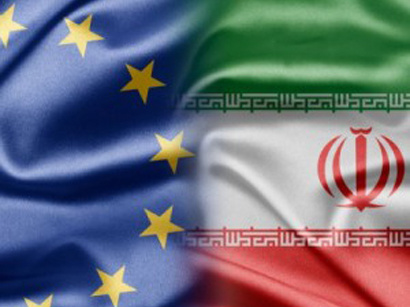
Iran enjoys positive trend of re-establishing relations with European states
By Saeed Isayev
Iran right now is enjoying a positive trend of re-establishing
relations with European countries, that have stayed away for
several years, while Iran was dealing with its nuclear program and
international sanctions.
While the Islamic Republic still suffers from the effect of
sanctions, the light at the end of the tunnel was eventually
spotted. On Nov. 24, Iran and the P5+1 group managed to sign an
agreement on nuclear program.
Iran has agreed to curb some of its nuclear activities for six
months in return for sanctions relief. While the U.S. and its
Western allies suspect that Iran is developing a nuclear weapon,
Iran has been denying it, claiming it uses nuclear energy for
medial research.
Nonetheless, after the agreement, it was once again underlined that
Iran has to work closely with the IAEA, which monitors the Islamic
Republic's nuclear activity, and keep the uranium enrichment under
a certain level.
Credit for this victory goes to Hassan Rouhani, who took this
matter into his own hands, right after he was declared the new
president of Iran. He substituted Iran's negotiating team, secured
Iranian Supreme Leader's approval, and as a result - Iran signed
the deal.
This caused a trend, mentioned in the beginning of the article.
Iran is considered by many European countries a solid economic
partner, if only it wasn't for the nuclear issue and sanctions.
Thus, as soon as the deal was signed, and Iran agreed to play
along, many countries started to reach out to Iran.
On December 13, 2013, an eight-member team from the European
Parliament arrived in Iran, and held talks with senior Iranian
lawmakers, including Iranian Parliament Speaker Ali Larijani and
Chairman of the Majlis National Security and Foreign Policy
Committee Alaeddin Boroujerdi.
Then on Dec. 21, Italian Foreign Minister Emma Bonino visited
Tehran, heading a high-ranking delegation. She was the first
Italian foreign minister to visit Iran in nearly a decade.
On Jan. 1, Iranian parliament said it received 10 requests from
foreign parliamentary delegations to visit Iran and meet with local
senior officials until the end of the current Iranian calendar
(ends on March 20).
Following Emma Bonino's visit, another delegation from Italy
visited Iran on Jan. 3, led by the chairman of the Foreign Affairs
Commission of the Italian Senate Lamberto Dini.
Boroujerdi said on Jan. 7 that delegations from Canada and Ireland
are also expected to visit Iran in the near future. He added that
the delegation, led by Chairman of the Oireachtas (the Irish
Parliament) Committee on Foreign Affairs and Trade, Pat Breen, will
arrive at the Iranian capital on January 11.
On the same day of Jan. 7, a British parliamentary delegation
headed by former foreign secretary Jack Straw arrived in Tehran on
Jan. 7, for a 3-day visit, to discuss issues of mutual interest
with senior Iranian officials.
And another meeting has reportedly been scheduled, as a group of
German lawmakers should be coming to Iran later in January, to
exchange views on the expansion of Tehran-Berlin parliamentary ties
with senior Iranian parliament officials.
This month of January for Iran is at least this - very good time to
earn some points on international arena, and improve its relations
with European countries.
Here we are to serve you with news right now. It does not cost much, but worth your attention.
Choose to support open, independent, quality journalism and subscribe on a monthly basis.
By subscribing to our online newspaper, you can have full digital access to all news, analysis, and much more.
You can also follow AzerNEWS on Twitter @AzerNewsAz or Facebook @AzerNewsNewspaper
Thank you!