
West hopes for newly elected Rohani over Iran nuclear dispute
By Sara Rajabova
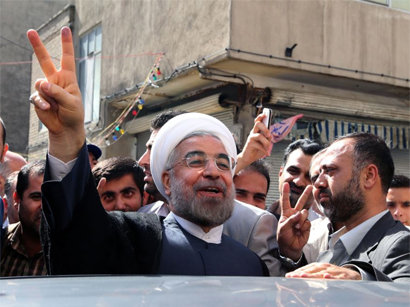
The Iranian nation as well as the world awaits changes from the newly elected president Hassan Rohani.
Rohani, who won the 50 percent of votes in the elections, promised better relations with the world, solution of the nuclear dispute over the country's nuclear program and more freedom, to resolve the economic issues and unemployment problems at home.
Before the election, Rohani said that if he is elected president, his administration would pursue the country's nuclear energy program.
He also stated that at the same time he would seek ways to end the Western sanctions through greater interaction, noting that this would not happen overnight.
Meanwhile, after Rohani's win in the presidential election, the Western governments, especially the United States, expressed high hopes for the newly elected Iranian president.
US officials and analysts said that Rohani's election win offers a possible opening for resolving a dispute with the U.S. over Tehran's nuclear activities.
The White House said Sunday that the election of Rohani, a mid-ranking Shiite cleric and former nuclear negotiator, is a "potentially hopeful sign" if he lives up to his campaign promises to "come clean" over the nuclear program, Reuters reported.
"If he (Rohani) is interested in, as he has said in his campaign, mending Iran's relations with the rest of the world, there is an opportunity to do that," President Barack Obama's chief of staff, Denis McDonough, told CBS' "Face the Nation" program.
"But to get to that point, we need him to live up to the obligation on the nuclear program and if he does I think there is a great opportunity for Iran and the people of that storied country to have the kind of future they would justifiably want," he added.
Also, the EU nations have reacted positively to the news of the election of a moderate candidate as Iran's next president, Deutsche Welle reported.
A statement released by the European Union's top diplomat on Saturday stressed the 27-nation bloc's willingness to engage with newly elected President Hassan Rohani.
"I remain firmly committed to working with the new Iranian leadership towards a swift diplomatic solution of the nuclear issue," Catherine Ashton, the EU's foreign policy chief and the chief negotiator in talks between six world powers and Tehran, said in a statement.
A spokesman for Foreign Minister Guido Westerwelle of Germany, which is part of that group of six, expressed hope that the new leadership in Iran would cooperate in efforts to find solutions to issues of international and regional concern.
Westerwelle described Rohani's victory as a "vote by the people for reforms and a constructive foreign policy."
Two other European countries involved in the nuclear talks, France and the UK, both permanent members of the United Nations Security Council, expressed similar sentiments.
"The international community has high expectations from Iran, especially about its nuclear program and its involvement in Syria," French Foreign Minister Laurent Fabius said. "We are ready to work on this with the new Iranian president."
A statement released by the British Foreign Office called on Rohani "to set Iran on a different course for the future: addressing international concerns about Iran's nuclear program, taking forward a constructive relationship with the international community."
On the other hand, the states which hope for a change in Iran's foreign policy after Rohani's election cautioned that the moderate cleric does not wield the power to enforce changes. Because Iran's Supreme Leader, Iran's most powerful man, Ayatollah Ali Khamenei, defines the foreign policy of the country and any deal with the West would require his consent.
Besides, while the other countries hopes for high expectation from Rohani, Israel noted that Iran's supreme leader, not the country's president, has the last word on foreign policy.
"Iran will continue to be judged by its actions, in the nuclear sphere as well as on the issue of terror," an Israeli foreign ministry statement said.
Israeli Prime Minister Benjamin Netanyahu said that the international community must not give in to wishful thinking or temptation and loosen the pressure on Iran for it to stop its nuclear program.
Furthermore, newly-elected Rohani reportedly has to deal with the enormous internal problems inherited from his predecessor. He faces many domestic challenges, above all, an economy that is suffering due to soaring inflation and a weakened currency that analysts charge are the result of international sanctions and economic mismanagement during Mahmoud Ahmadinejad's eight years in office.
According to official statistics, more than 3.5 people are unemployed in the country.
But Rohani said that his administration will make every effort to reduce the effects of economic sanctions.
Rohani said helping resolve all outstanding economic problems was his motive for entering the presidential race.
He argued that instead of adopting extremist approaches on domestic and foreign fronts, the next administration needs to forge some kind of alliance with all branches of the government as well as the elite.
However, the time will show how the new president will overcome the challenges, after he takes office.
Rohani won just over 50-percent of the votes in the June 14 presidential election, allowing him to avoid a run-off. More than 72-percent of the country's 50 million eligible voters turned out to cast their ballots.
The lone moderate candidate in the race, Rohani was supported by reformists and has promised to end what he called the "eight-year dark era" of Ahmadinejad by promoting freedom of expression and the press. He has long been an outspoken critic of Ahmadinejad and accuses him of being needlessly hostile with the international community.
Rohani, 64, served in parliament from 1980 until 2000, when he became a member of the Assembly of Experts, the body that oversees the work of Ayatollah Ali Khamenei. He also held Iran's top security post as secretary of the Supreme National Security Council from 1989 to 2005.
Here we are to serve you with news right now. It does not cost much, but worth your attention.
Choose to support open, independent, quality journalism and subscribe on a monthly basis.
By subscribing to our online newspaper, you can have full digital access to all news, analysis, and much more.
You can also follow AzerNEWS on Twitter @AzerNewsAz or Facebook @AzerNewsNewspaper
Thank you!