
Russian FM: Sanctions against Iran counterproductive
By Sara Rajabova
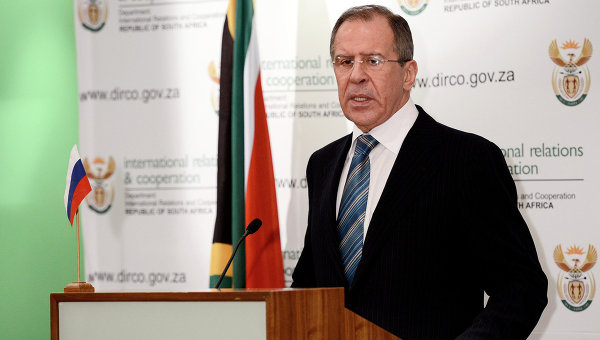
Russia believes that unilateral sanctions against Iran will only make the resolution of the country's nuclear issue more difficult, Russian Foreign Minister Sergei Lavrov said on Tuesday.
"Threats, unilateral sanctions are only making things worse," he said after talks with his South African counterpart, Maite Nkoana-Mashabane, adding that "a creative, forward-looking approach is needed here."
Speaking about the upcoming new round of talks between Iran and a group of international mediators on Tehran's controversial nuclear program in Alma-Ata on February 26, Lavrov said the discussion will concern uranium enrichment.
A UN Security Council resolution requires that Iran freeze its enrichment activities, Lavrov said, adding that the enrichment process is currently overseen by the International Atomic Energy Agency (IAEA).
The same day Iran's Foreign Ministry Spokesman Ramin Mehmanparast confirmed on Tuesday that Iran is converting a 20 per cent refined uranium stockpile to nuclear fuel.
Conversion is one way for Iran to slow the growth in its stockpile of material that could be used to make a bomb.
Mehmanparast stressed that all of the information about this issue was submitted to IAEA completely.
"The Tehran Nuclear Research Centre (TCNC) needs fuel to produce radio-medicine," he said.
According to the IAEA's recent report, Iran's stockpile of 20 percent enriched uranium is 135 kg. Iran converted 100 kg of its higher-grade enriched uranium to nuclear fuel last year.
Separately, officials from the IAEA are due to hold talks in Tehran on Wednesday in the hope of restarting their long-stalled inquiry into Iran's nuclear program.
The U.N. agency, whose mission is to prevent the spread of nuclear weapons, has been trying for a year to negotiate a so-called structured approach with Iran that would give its inspectors access to sites, officials and documents.
The IAEA especially wants access to the Parchin military complex southeast of Tehran where it believes explosive tests relevant for nuclear weapons development may have taken place and been subsequently concealed, allegations that Iran denies.
Besides, Iran and the group of countries comprising Britain, China, France, Russia, the United States and Germany, known as P5+1, have held three rounds of talks over the Iranian nuclear issue last year, following a one-year break in negotiations. These talks, however, did not lead to a breakthrough, as the sides cannot agree on the true nature of Tehran's nuclear ambitions.
The United States, Israel and some of their allies accuse Iran of pursuing military objectives under the guise of its peaceful nuclear energy program. Iran rejects these allegations, arguing that as a signatory to the nuclear Non-Proliferation Treaty and as a member of the International Atomic Energy Agency, it is entitled to develop and acquire nuclear technology for peaceful purposes.
Here we are to serve you with news right now. It does not cost much, but worth your attention.
Choose to support open, independent, quality journalism and subscribe on a monthly basis.
By subscribing to our online newspaper, you can have full digital access to all news, analysis, and much more.
You can also follow AzerNEWS on Twitter @AzerNewsAz or Facebook @AzerNewsNewspaper
Thank you!