
Lavrov: Russia not to revise Geneva agreement on Syria
By Sabina Idayatova
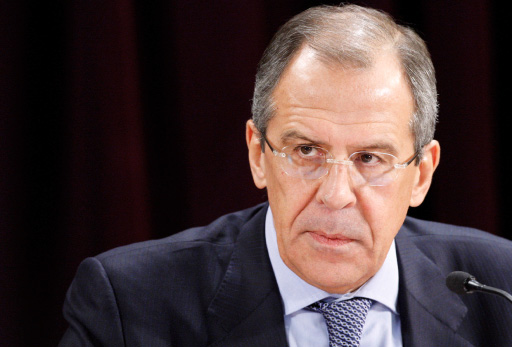
Foreign Minister Sergei Lavrov has said Russia does not intend to revise the agreement on the Syrian issue reached in Geneva, RIA Novosti news agency reported.
Lavrov told a press conference in Amman that Moscow has no intention to consider "any attempt to distort" the document or its content.
A statement adopted after the Geneva talks on June 30 with five permanent members of the UN Security Council and some neighboring states of Syria suggested to establish a transitional government in the country. It also envisages the possibility of revising the Syrian constitution on the basis of a national dialogue. Furthermore, holding multi-party elections and setting up new state bodies are planned after restoring constitutional order.
Moscow has repeatedly urged the UNSC to endorse the Action Group's Geneva communique on Syria.
Lavrov blamed some participants in the Geneva talks for attempts to unite the opposition on the platform of continuous armed struggle rather than negotiations.
"Moscow would like to know the Syrian opposition's assessment of the current situation in Syria," Lavrov noted during a Middle East tour.
"It is important for us to use this opportunity to get familiar
with your mood about the developments in the country," he said at a
meeting with Riyad Hijab, a former prime minister of Syria and also
one of the prominent figures of the Syrian opposition.
During his Middle East tour, which started on Sunday, Lavrov has
met with the Egyptian and Jordanian leaders, as well as Mahmoud
Abbas, the head of the Palestinian Authority, Nabil al-Arabi,
Secretary General of the League of Arab States (LAS), and deputy
chief of the Hamas Political Bureau, Mousa Abu Marzouq, reports
say.
Chemical weapons use
Russia excludes the use of chemical weapons by the Syrian government.
"I rule out the use of chemical weapons by the incumbent Syrian regime," Lavrov said after talks with his Jordanian counterpart Nasser Judeh. "We received appropriate assurance."
"We do not expect any threat yet. A threat may exist, if the weapons fall into the hands of terrorists," Lavrov said.
In July Syrian Foreign Ministry spokesman Jihad Makdisi said his country might use its chemical weapons in the case of foreign military intervention, but such weapons would never be used against civilians. Makdisi assured that the available reserves of chemical weapons in Syria are under the control and protection of the Syrian army.
Representatives of US intelligence agencies and the Middle East said earlier that the Syrian authorities have dispersed chemical weapons stockpiles and components for their production across 20 cities in a measure aimed at ensuring the country's safety.
The Syrian stockpiles of chemical weapons are believed to consist mostly of large amounts of Sarin, in addition to tabun (nerve agents) and mustard gas, and the country is reportedly producing and preparing VX for weapons, RIA Novosti reported.
Russian arms supplies
Lavrov also said Russia has completed the weapons supply to Syria
under previous contracts, and does not plan bargaining upon new
ones.
"We are completing the deliveries in accordance with old contracts that are relevant to the defense of the country," Lavrov noted.
According to Lavrov, Western countries supply weapons to Syria. "There are about 50 Stingers in the territory of Syria," he said.
"I was surprised to hear that the BBC has the information that we are delivering weapons of mass destruction to Syria," Lavrov responded to the question of the same channel`s reporter. "Those who are arming the opposition do not provide it with a defense system."
According to Lavrov, such export of arms has a defensive purpose and doesn't counter any international conventions.
Earlier, Lavrov said that Russia supplies only defensive weapons to Syria and is fulfilling the commitments on supplying air defense systems. The Russian-Syrian military cooperation has been directed at strengthening the defense of Syria in the face of a possible external threat, rather than to support Assad or anyone else, he added.
The unrest that erupted in Syria in March 2011 soon escalated into armed clashes between the opposition and government forces. Syrian officials say that anti-government forces in the country are supported from the outside. According to UN representatives, up to 20,000 people have become victims of the violence to date.
Here we are to serve you with news right now. It does not cost much, but worth your attention.
Choose to support open, independent, quality journalism and subscribe on a monthly basis.
By subscribing to our online newspaper, you can have full digital access to all news, analysis, and much more.
You can also follow AzerNEWS on Twitter @AzerNewsAz or Facebook @AzerNewsNewspaper
Thank you!