
UN assists Iran to prevent fallout from drying lake
By Sara Rajabova
The United Nations Development Programme (UNDP) has allocated $135 million to Iran to resolve environmental problems with shoaling Lake Urmia, head of an Iranian environmental group said Tuesday.
"The main problem with Iran's lakes, including Lake Urmia, Parishan and Hamun and some others, is that much water of the rivers flowing into the lakes is used indiscriminately," Mohammad Javad Mohammadizadeh, who heads Iran's Environment Protection Organization, was quoted by Mehr news agency as saying. "This leads to their becoming shallow, news agencies reported."
According to foreign media, UNDP has allocated $235 million to Iran, including $135 million to resolve the problems with Lake Urmia within the development program for 2012-2016.
Lake Urmia in the northwestern tip of Iran is one of the largest permanent hypersaline lakes in the world and the largest lake in the Middle East. It extends as much as 140 km from north to south and is as wide as 85 km east to west during high water level periods. The area of the lake is about 6,000 square kilometers. Drying-up of the lake has an impact on the flora and fauna of the region.
Threat of environmental disaster
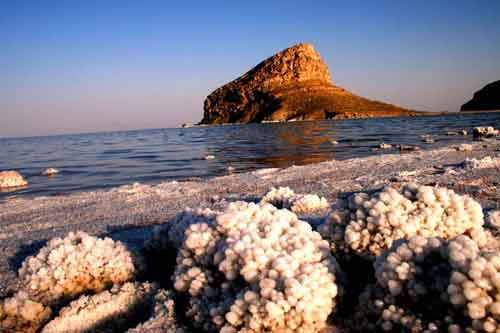
The unfolding environmental disaster threatens to leave much of the lake's bed a salt-covered wasteland. Scientists have warned that continued decline would lead to increased salinity, collapse of the lake's food chain and ecosystem, loss of wetland habitat, windblown "salt-storms", alteration of local climate and serious negative impact on local agriculture and livelihoods as well as regional health.
According to official figures, around 70 percent of Lake Urmia has become shallow. Currently, a liter of lake water contains up to 400 grams of salt, compared to the previous 160-170 grams.
The watershed of the lake is an important agricultural region with a population of around 6.4 million people; an estimated 76 million people live within a radius of 500 km.
As lake levels decline, the exposed lakebed is left with a covering of salts, primarily sodium chloride, making a great salty desert on much of the 400 sq.km of lost surface area. These salt flats will not support agriculture and inhibit growth of most natural vegetation. The salts are also susceptible to blowing and will likely create "salt-storms" like the ones that have resulted from the drying of the Aral Sea, located 1,200 km to the northeast of Lake Urmia. Blowing salts from the Aral Sea have been linked to vegetation mortality in some cases or, more frequently, reduced vegetation growth, reduced crop yields, ill effects on wild and domestic animals, respiratory illness, eye problems, and throat and esophageal cancer. Based on the experience of the Aral Sea salt storms, it is likely that many of the tens of millions of people who live within a few hundred kilometers of the lake will be close enough to experience the impact of these salt storms.
The decline is generally blamed on a combination of drought, increased water diversion for irrigated agriculture within the lake's watershed and mismanagement.
In addition, a causeway has been built across the lake with only a 1,500 m gap for water to move between the northern and southern halves of the lake. It has been suggested that this has decreased circulation within the lake and altered the pattern of water chemistry; however, evidence suggests that the impact of the causeway on the uniformity of water chemistry in the lake has been minimal.
A project on directing 600 million cubic meters of water from the Araz River into Lake Urmia was launched during a visit of Iranian President Mahmoud Ahmadinejad and members of the government to Tabriz in 2010. It was planned to allocate $1.2 billion to implement the project.
The Iranian government allocated $900 million for this purpose in September 2011. This amount has been granted to transfer water from rivers in the Aras and Kurdistan provinces to Lake Urmia.
Also, at the beginning of this year Iran halted construction of eight dams over rivers along the route of Lake Urmia.
Seeking solution
The widely suggested solution for halting the drying up of Lake Urmia is to divert water from elsewhere to make up for the lost water volume no longer reaching the lake.
A few possible sources have been put forward including the Zab River, the Araz River and the Caspian Sea.
In the case of the Caspian Sea, however, the distance of the proposed transfer route is around 300 km and the cost has been estimated at around $4 to $5.5 billion. In addition, the timeframe for completing such a project is expected to be around five years and even the most aggressive rates of transfer would take an additional year to restore the lake level to what it was in 2003.
Finally, transfer from the Caspian Sea would require negotiated agreements with the other coastal countries. So far, talks have been unsuccessful in reaching an accord.
While transfers from other river basins in the region could be less time consuming and expensive, the total volume of water available would be limited, and by some accounts would be inadequate. The relatively smaller potential volume would also mean a greater possibility that transfers could impact the source basins negatively.
The Zab River basin is located in Turkey and Iraq and would require cooperation of those two countries. The Araz River basin is split roughly in half between Iran and Azerbaijan. News reports suggest that talks have been initiated between the two countries regarding the use of Araz water for water transfer to Lake Urmia.
Also, earlier in May Iranian media reported that the project, which includes diverting water from Araz River to Lake Urmia, would be implemented by one of the largest investment companies in Turkey. According to the media reports, executives of the Turkish company and officials of the West Azerbaijan province of Iran have reached a preliminary agreement in this regard.
Thousands of protesters took to the streets in the cities of Tabriz and Urmia in late August and early September 2011 in connection with the shoaling of Lake Urmia, saying that authorities have done too little to save the lake. Dozens of Iranian Azerbaijanis were arrested.
Those around the lake fear a fate similar to that of the population surrounding the nearby Aral Sea, which has dried up over the past several decades. Disappearance of the Aral Sea has been an environmental disaster, affecting people throughout the region with windblown salt-storms. The population surrounding Lake Urmia is much denser, putting more people at risk of an adverse impact.
Here we are to serve you with news right now. It does not cost much, but worth your attention.
Choose to support open, independent, quality journalism and subscribe on a monthly basis.
By subscribing to our online newspaper, you can have full digital access to all news, analysis, and much more.
You can also follow AzerNEWS on Twitter @AzerNewsAz or Facebook @AzerNewsNewspaper
Thank you!