
Qatar emir: Arab states should intervene in Syria to stop bloodshed
By Sara Rajabova
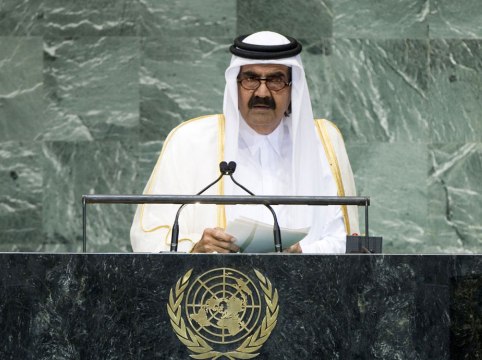
The Emir of Qatar, Sheikh Hamad bin Khalifa Al-Thani, given the United Nations Security Councils' failure to agree on collective action in relation to Syria, on Tuesday urged countries to contribute to the provision of support to the Middle Eastern country's people until they gain their "legitimate rights", the UN website said.
"We have used all available means to get Syria out of the cycle of killing but that was in vain. The Security Council failed to reach an effective position," Sheikh Al-Thani said in his statement at the 67th UN General Assembly's General Debate, which began on Tuesday.
Western powers have made clear they are opposed to direct intervention and the Security Council will not sanction action against the wishes of Russia and China.
"In view of this, I think that it is better for the Arab countries themselves to interfere out of their national, humanitarian, political and military duties and do what is necessary to stop the bloodshed in Syria and the killing of innocent people and their displacement in order to guarantee a peaceful transition of power in Syria," Al-Thani noted.
"We had a similar precedent when Arab forces intervened in Lebanon in the mid-'70s ... to stop internal fighting there in a step that proved to be effective and useful," Al-Thani added.
More than 18,000 people, mostly civilians, have died since the uprising against the government of Syrian President Bashar al-Assad began 18 months ago. Amidst reports of an escalation in violence over recent weeks, UN agencies now estimate that some 2.5 million Syrians are in urgent need of humanitarian assistance.
"We urge all countries that believe in the cause of the Syrian people to contribute to the provision of all sorts of support to this people until it gains its legitimate rights," Al-Thani said.
However, on Monday, Qatar's Prime Minister, Sheikh Hamad Bin Jassim Al Thani, gave a glimmer of hope by telling that there is indeed a "Plan B" for Syria, CNN reported.
"We believe that we can solve it peacefully," said Al Thani, who is also in New York for the yearly UN General Assembly, and added that Arab countries are working on a plan of their own.
While Al Thani wouldn't offer up specifics about who will participate in this Plan B, he said the support might be wider than expected.
"I believe there are a lot of Arab countries that will participate. And there are also European countries that will participate."
Nonetheless, he said the region needs the United States to step in.
Al Thani said he isn't looking for military intervention and that Qatar is not providing weapons to the Syrian uprisings, but said his country is providing logistical help, citing humanitarian aid and medicine.
Qatar played a key role in the liberation of Libya as the first Arab nation to recognize the rebels and to support NATO's mission there.
President Assad was recently quoted in the Al Hayat newspaper criticizing the tiny, wealthy nation, saying, "Qatar uses the power of money and revolves in the orbit of the West to repeat the Libyan scenario."
Qatar, along with Saudi Arabia and Turkey, strongly supports the mainly Sunni Muslim Syrian rebels, while mainly Shia Iran backs Assad, whose Alawite minority is an offshoot of Shia Islam.
Here we are to serve you with news right now. It does not cost much, but worth your attention.
Choose to support open, independent, quality journalism and subscribe on a monthly basis.
By subscribing to our online newspaper, you can have full digital access to all news, analysis, and much more.
You can also follow AzerNEWS on Twitter @AzerNewsAz or Facebook @AzerNewsNewspaper
Thank you!