
Obama warns time is running out to resolve Iran dispute
By Sara Rajabova
Discussions over Iran's nuclear program topped the UN General Assembly's agenda on the opening day of its general debate on Tuesday, with United States and France's Presidents Barack Obama and Francois Hollande highlighting the issue in their addresses.
Iran's nuclear activities have been of international concern since the discovery, in 2003, that Iran had apparently concealed its nuclear activities for 18 years, in breach of its obligations under the Nuclear Non-Proliferation Treaty. Iran has repeatedly stated that its nuclear program is for the peaceful purpose of generating energy, but many countries charge it is seeking to develop nuclear weapons.
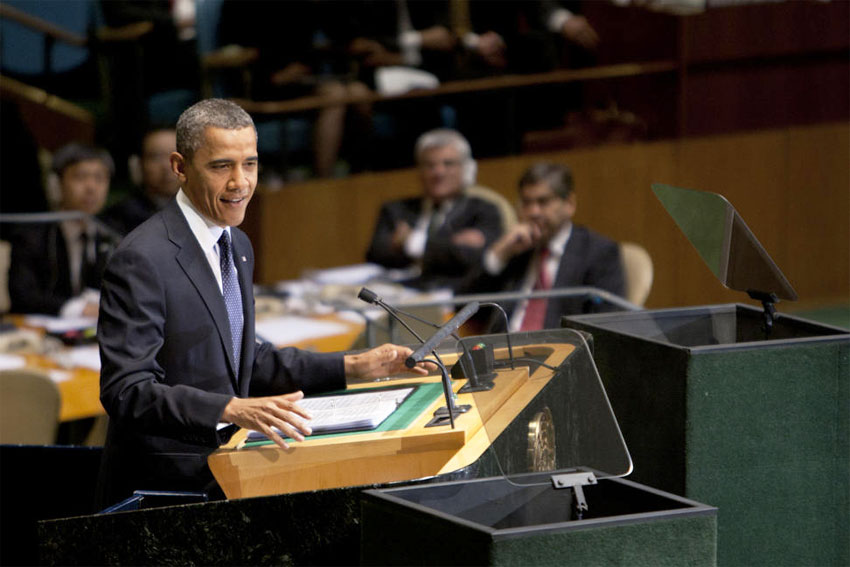
President Obama told the UN General Assembly that the U.S. would do what it must to prevent Iran becoming a nuclear power.
Obama stopped short of agreeing to an Israeli demand that Washington set a specific "red line" that Iran must not cross if it wants to avoid military action.
"The Iranian government continues to prop up a dictator in Damascus and supports terrorist groups abroad. Time and again, it has failed to take the opportunity to demonstrate that its nuclear program is peaceful and to meet its obligations to the United Nations," the US leader said.
Earlier, Israeli Prime Minister Benjamin Netanyahu pressed the United States for a stronger line on Iran and Obama now clarified his position on the issue in his U.N. remarks.
"America wants to resolve this issue through diplomacy, and we believe that there is still time and space to do so," the US president said. "But that time is not unlimited."
"Make no mistake," Obama continued, "a nuclear-armed Iran is not a challenge that can be contained."
In a speech to the General Assembly, Obama said the U.S. could not tolerate an Iran with atomic weapons.
"It would threaten the elimination of Israel, the security of Gulf nations, and the stability of the global economy. It risks triggering a nuclear-arms race in the region, and the unravelling of the non-proliferation treaty. That is why a coalition of countries is holding the Iranian government accountable. And that is why the United States will do what we must to prevent Iran from obtaining a nuclear weapon," Obama noted.
Iranian President Mahmoud Ahmadinejad would not respond directly to the president's remarks, saying he did not want to influence the U.S. presidential election in November.
But he argued that the international outcry over Iran's nuclear enrichment program was just an excuse for the West to dominate his country. He claimed that the U.S. has never accepted Iran's choice of government after the 1979 Islamic revolution.
Ahmadinejad said some world leaders have suggested to him that Iran would be better off holding nuclear talks only with the U.S.
"Of course I am not dismissing such talks," he said, asked if he were open to discussions with the winner of the American presidential election.
In turn, in his first appearance before the United Nations as President of France, Hollande also accused Iran of developing a nuclear program without any final civilian purpose, warning that France will not accept such an act that threatens regional security. France, together with its European partners, is prepared to impose a new set of sanctions to increase pressure on Iran and force it back to the negotiating table, he said.
Western sanctions on Iran tightened markedly this year with an EU ban on crude oil purchases from Iran and U.S. sanctions targeting banks that deal with Iran's central bank. Those sanctions have not yielded tangible progress toward a diplomatic solution.
French Foreign Minister Laurent Fabius said the next round of European Union sanctions over Iran's nuclear program would focus on the financial industry and trade, Reuters reported.
Asked about the possibility of stronger sanctions against Iran's central bank, Fabius said: "It could be that. (Those sanctions) are not fully exhausted."
However, Iran's permanent representative to the International Atomic Energy Agency (IAEA) Ali Asghar Soltanieh said Iran has offered to stop enriching uranium to a purity level of 20 percent if the West lifts sanctions against Tehran, semi-official Mehr news agency reported Wednesday.
Soltanieh said the offer was made in a meeting between Iran's chief nuclear negotiator Saeed Jalili and European Union foreign policy chief Catherine Ashton in Istanbul earlier this month.
"We are prepared to suspend enrichment to 20 percent, provided that we find a reciprocal step compatible with it," Soltanieh was quoted as saying.
"We said this in Istanbul," he said, adding that "If we do that, there shouldn't be sanctions."
On September 18, Ashton met with Iranian officials in Istanbul in a bid to end the standoff over the Iranian nuclear program. Jalili said the two sides were satisfied with what they had agreed during the talks.
On the other hand, the U.N. diplomats say the possibility of further U.N. Security Council sanctions is slim at the moment since Russia and China are opposed to the idea.
Senior foreign ministry officials from the five permanent council members and Germany will meet on Thursday in New York to discuss the situation in Iran.
Here we are to serve you with news right now. It does not cost much, but worth your attention.
Choose to support open, independent, quality journalism and subscribe on a monthly basis.
By subscribing to our online newspaper, you can have full digital access to all news, analysis, and much more.
You can also follow AzerNEWS on Twitter @AzerNewsAz or Facebook @AzerNewsNewspaper
Thank you!