
Russian, Uzbek leaders concerned by Arab spring
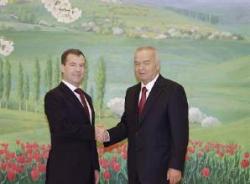
TASHKENT – A wave of protests sweeping North Africa and the Middle East this year could undermine stability in Russia and its neighbours, Russian president Dmitry Medvedev said on a visit to Tashkent on Tuesday, Reuters reported.
In remarks broadcast on Russian state television, Medvedev told Uzbek leader Islam Karimov he hoped events in the region would develop in a way "that is clear and predictable for us".
"We are linked with many of these states by a large quantity of unseen threads... not only economic relations, trade relations, but a mass of humanitarian and cultural ties," he said. "They can be very positive, but can have a difficult and sometimes even destructive character."
Medvedev's comment was an apparent reference to the involvement of Arab militants in the Islamist insurgency in Russia's North Caucasus, where unrest persists a decade after it drove separatists from power in Chechnya.
Karimov, who later echoed Medvedev's concerns over the Arab Spring uprising, also fears outbreaks of militancy in the volatile Ferghana Valley, which Uzbekistan shares with other Central Asian nations.
"Everything that relates to providing for regional security and stability, and consequently what is occurring in North Africa and the Middle East, cannot fail to concern Russia and Uzbekistan," Russian news agency Itar-Tass quoted him as saying.
Karimov tolerates no dissent in the mostly Muslim nation of 28 million, where rights groups say thousands of political prisons languish in jails rife with torture. Russia-based human rights group Memorial warned in March that Karimov, in power since the Soviet era, could end up fighting against his people like Libya's Muammar Gaddafi.
Opponents of Russia's government say it could also face mass street protests in the coming years if it does not improve democracy and implement economic reforms. Kremlin opponents say Russia has rolled back democracy and civil rights in the past decade.
IMF sees Iran success with inflation, subsidies
TEHRAN – Iran's monetary policies helped trim inflation to 12.4
percent for 2010-11 from 25.4 percent two years earlier, the
International Monetary Fund said in a statement on Monday following
talks in Tehran, Reuters reported.
The IMF, which held regular consultations in Iran from May 28 to June 9, said strong growth in non-oil sectors and good performance in agriculture helped the country recover to 3.5 percent growth in 2009-10 despite a fall in oil prices.
Iran has achieved "early success in the implementation of their ambitious subsidy reform program" with increases in prices of energy, public transport, wheat, and bread having removed almost $60 billion of subsidies, the IMF said.
"At the same time, the redistribution of the revenues arising from the price increases to households as cash transfers has been effective in reducing inequalities, improving living standards, and supporting domestic demand in the economy," the statement said.
The subsidy cuts would temporarily raise the inflation rate, but also improve Iran's medium-term growth outlook by boosting efficiency in energy use, increasing export revenues and strengthening overall competitiveness, it said.
"Maintaining macroeconomic stability in the near term through coordinated and adequately tightened monetary and fiscal policies is essential to preserve the benefits of the subsidy reform," the statement said.
The IMF noted that high international commodity prices and Iran's large-scale privatization program had helped drive high prices in the stock market, underscoring the financial sector's key role in driving economic growth.
Here we are to serve you with news right now. It does not cost much, but worth your attention.
Choose to support open, independent, quality journalism and subscribe on a monthly basis.
By subscribing to our online newspaper, you can have full digital access to all news, analysis, and much more.
You can also follow AzerNEWS on Twitter @AzerNewsAz or Facebook @AzerNewsNewspaper
Thank you!