
Turkish prime minister likely to win third consecutive term
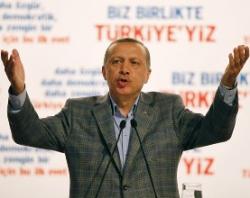
ISTANBUL – Turkish Prime Minister Recep Tayyip Erdogan is likely to win a third term in office during elections Sunday. The opposition is worried that Erdogan wants to rewrite the constitution to bolster his own political power.
Turkish voters are likely to re-elect the incumbent, Islam-rooted Justice and Development Party (AKP) to a third consecutive term in office during general elections Sunday, raising opposition concerns that the party is accumulating too much political power.
Although the center-left Republican People's Party (CHP) could increase its share of the vote from 20 to 30 percent, the AKP is still likely to secure a one-party government, with polls currently indicating that the conservative party enjoys 45 percent support.
Campaigning under the slogan "Target 2023," the AKP plans to develop Turkey into one of the 10 largest economies in the world with a per capita income of $25,000 compared to the current $10,000 (7,000 euros).
The opposition is splintered with the Nationalist Action Party (NHP) expected to exceed 10 percent and Kurdish-backed independent candidates poised to take some 30 seats in the 550-seat parliament.
"The opposition is not credible," economist Ahmet Insel told the news agency AFP. "It cannot position itself as an alternative capable of governing without a coalition government. And Turks had very bad memories of coalition governments in the 1990s."
Constitutional reform
The AKP, led by Prime Minister Recep Tayyip Erdogan, hopes to win
at least 330 seats in Turkey's parliament, which would allow it to
call a referendum on constitutional change, effectively shutting
the political opposition out of the process.
Should the AKP win over two-thirds of the vote and acquire 367 seats, it could unilaterally rewrite the constitution without resorting to a referendum or seeking opposition support.
"These elections are not about who wins, but about whether the AKP will win a strong majority to rewrite the constitution," Sinan Ulgen, from the Istanbul-based Centre for Economics and Foreign Policy Studies, told the Reuters news agency.
Although Erdogan has not publicly said what constitutional reform would look like, speculation is rampant that he wants to change Turkey to a presidential system with himself at the helm.
"I have many dreams but I'm unable to realize them as fast as I'd like to. There are many obstacles," Erdogan said in an interview on Kanal D television.
'Wiretapping government'
The new leader of the secular CHP, Kemal Kilicdaroglu, has accused
Erdogan of subverting democracy by monopolizing power through a
"wiretapping government" that seeks to keep political rivals in
check.
Erdogan, Turkey's most popular politician, has led the nation through a period of robust economic growth and instituted democratic reforms intended to put Istanbul in line with European Union standards. Turkey is currently in negotiations to join the EU, although the process has largely stalled.
Yet Erdogan's government also faces mounting criticism for jailing journalists, condoning police clampdowns on street protests and instituting creeping restrictions on the Internet and alcohol sales.
The AKP first came to power through a decisive electoral victory in 2002, which raised concern among Turkey's powerful and politically influential military that the Islam-influenced party would undermine the country's secular ideology.
Here we are to serve you with news right now. It does not cost much, but worth your attention.
Choose to support open, independent, quality journalism and subscribe on a monthly basis.
By subscribing to our online newspaper, you can have full digital access to all news, analysis, and much more.
You can also follow AzerNEWS on Twitter @AzerNewsAz or Facebook @AzerNewsNewspaper
Thank you!