
Dinner, with Questions
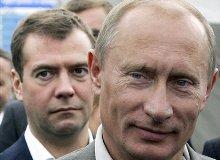
Putin Treats Foreign Guests to Vodka, Discussion, and Queries of His Own
SOCHI – Prime Minister Vladimir Putin invited around 50 foreign guests to dinner this week and told them he was aware of the risk that Russia's autocratic political system could concentrate too much power on one man.
That is why, he said, he and President Dmitry Medvedev – who he helped elevate to Russia's top job in 2008 – are sharing power. Longer term, he said, Russia will need to develop political institutions to broaden decision-making.
Nevertheless, most guests took away the opposite message: Power in Russia isn't going to be decentralized soon. And the person it would be centralized on was their host, who many present felt sent a signal that he plans on returning as president in 2012.
This was the seventh time Mr. Putin has submitted himself to questions from an invited group of foreign academics and journalists, an annual exercise rare for the leader of a major country.
The venue this year was a Soviet-era sanatorium built for senior Communist Party officials and converted into a government guest house in the Black Sea resort of Sochi. Its marble terraces overlook lawns, palm trees and the sea.
Inside, guests sat down to a five-course meal including Siberian pelmeni, a ravioli-like dish filled with venison, and green shchi soup, with chicken and sorrel. Also served were vodka and wines including a California pinot noir and a riesling from Alsace.
At the dinner, which lasted for more than two hours, Mr. Putin, looking relaxed and younger than his 57 years in an open-necked shirt and beige jacket, ate and sipped wine, which regular attendees said had rarely happened.
However, they said, it was a typical Putin performance. Combative when challenged, the prime minister didn't try to engage personally with his audience. He never admitted error, ignorance on any subject, nor the need for Russia to draw on other countries' experience.
He told his guests that Franklin D. Roosevelt was elected president of the U.S. four times in a row, and that didn't damage the U.S. Constitution. "Neither I nor President Medvedev would do anything to run counter to the federal constitution," he said.
The Russian Constitution would allow Mr. Putin, who stepped down in 2008 after eight years in power, to run for two successive six-year terms until 2024.
Angela Stent, director of the Center for Eurasian, Russian and East European Studies at Georgetown University, said Mr. Putin appeared to be planning a return as head of state. "The impression that came over is that he is not leaving power and that he will likely be president in 2012," she said.
But Lord Robert Skidelsky, the British historian and economist, said he had a different impression: that Mr. Putin's taste for power was waning. "He didn't say anything forward-looking," he said.
"The message was that Russia's modernization doesn't need lessons from Europe, China or anywhere else," said Piotr Dutkiewitch, head of the Center for Governance and Public Policy at Carleton University, Ottawa.
Mr. Putin laced his answers with anecdotes about individual Russians – including an elected mayor who ran away rather than visit a district suffering in the recent fires that didn't vote for him. Democracy, he implied, at least at the local level, produces some suspect officials.
Mr. Putin repeatedly threw back questions at his interrogators. Asked by a British reporter whether Lenin's tomb should be moved from Red Square before the 2017 centenary of the Russian revolution, he pointed out that all over England are statues of Oliver Cromwell, the 17th-century English Puritan leader who overthrew the monarchy:"Who do you think was worse: Cromwell or Stalin?"
Why did Russian police need to deal so brutally with street protestors? It was no different, he responded, from the way police in London and Paris handle demonstrators.
Asked why in Russia's autocratic political system most problems landed at his door, he said it was the same in the U.S. with the oil spill in the Gulf of Mexico, where President Barack Obama was expected to step in. "If he doesn't interfere, he's guilty, though he's guilty of nothing," he said.
Mr. Putin praised Mr. Obama, in contrast with his tirade against the U.S. president last year, saying the two leaders' common views on problems would provide a basis for better U.S.-Russia relations. And he said several times, sometimes unprompted, that Russia saw no threat in China.
Globalization would trigger a competition for global leadership – including military competition, he said. But "I don't think this will be between Russia and China. Russia and China will be natural partners in solving many problems," he said.
It was the third time Mr. Putin has invited the group to Sochi, which seems improbably far south to be the site designated for the 2014 Winter Olympics, a project that Mr. Putin himself is leading. However, construction is evident all over the city, just a few miles away from the disputed Georgian territory of Abkhazia, over which Georgia suffered a defeat to Russian forces in a war in August 2008.
Since then, Russia has recognized Abkhazia's independence and that of the other breakaway Georgian region of South Ossetia, but remains the only country to have done so.
Mr. Putin said the International Court of Justice, which decided in July Kosovo's 2008 declaration of independence from Serbia was legal, could rule on the independence of the two regions. He talked of "cooperation" between Georgia and the two regions but said: "I don't know what form that cooperation would take."
Robert Legvold of Columbia University said Mr. Putin's comments on Georgia were surprising. "He implied that there was a path to restoring Georgian territorial integrity," he said.
Asked about the development of "Putinism" outside Russia – a reference to the domination of a political system by one individual – Mr. Putin returned to a familiar tactic. "What is Putinism?" he retorted. "Is it good or bad?"
Here we are to serve you with news right now. It does not cost much, but worth your attention.
Choose to support open, independent, quality journalism and subscribe on a monthly basis.
By subscribing to our online newspaper, you can have full digital access to all news, analysis, and much more.
You can also follow AzerNEWS on Twitter @AzerNewsAz or Facebook @AzerNewsNewspaper
Thank you!