
Turkish prime minister, business lobby face off
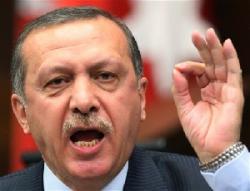
ISTANBUL – Prime Minister Recep Tayyip Erdogan warned Turkey's largest business lobby that it risks "elimination" if it doesn't take a stand on the country's Sept. 12 referendum on constitutional change, as the campaign to influence the vote turns increasingly hostile.
Twice this week, Mr. Erdogan has called on Tusiad, the Turkish Industrialists and Businessmen's Association, to say whether it is for or against the government's proposed constitutional amendments. The changes, if passed, would transform the makeup of the country's top courts, which are currently bastions of secularist opposition to Mr. Erdogan's Islamic-leaning government.
"Declare your stance. If it is no, say 'No.' If it is yes, say 'Yes.' ...He who is neutral will be eliminated," Mr. Erdogan said in a speech at a dinner Tuesday night, noting that smaller business lobbies had come out in favor of the changes. "We will not leave this country to the hegemony of capital. You were able to play with governments as if you were playing with cats and dogs in the past, but you cannot do it with this government."
Rhetoric has become increasingly virulent in recent days between the supporters of amendments – which include the Justice and Development Party, or AKP – and opposition politicians and the secularist establishment. Politicians on both sides have been holding rallies while party minibuses have crisscrossed the country tossing fliers on roadsides.
Opposition leader Kemal Kilicdaroglu has repeatedly over the past week referred to Mr. Erdogan as Recep, which some AKP members found disrespectful. Mr. Erdogan has called Mr. Kilicdaroglu a "civil servant," shorthand for underachiever.
On Wednesday, a spokesman for President Abdullah Gul confirmed that he had called on all sides to calm down, warning that otherwise party leaders would be incapable of doing business with each other after the referendum.
Tusiad, which says it represents 50% of Turkey's private-sector economy and 80% of exports, is an important policy voice in the country. Mr. Erdogan has a history of friction with Tusiad, some of whose members, including the Dogan media group's newspapers, had been critical of his political movement.
"The striking fact is that Tusiad really has said nothing against the referendum. To the secularists, this seems to confirm their worst nightmares, that it is not enough to stay neutral now – you have to become an AK party supporter" to escape punishment, said Atilla Yesilada, Istanbul-based analyst for Global Source Partners, an economic consultancy. "The environment is already so poisoned that a lot of people are saying the first priority of the [referendum] winner will be to take revenge."
Tusiad said Mr. Erdogan was taking "an unfortunate approach." In a statement issued Tuesday, it added: "To warn an institution of civil society that 'the neutral will be eliminated' ... will not strengthen role of civil society in modern democracy."
Mr. Erdogan's comments "should not be taken as a threat," said a spokesman for the prime minister, adding that the main thrust of his speech had been to challenge Tusiad to explain why it was staying neutral now when it had joined a 2001 public petition in favor of constitutional reform.
In its statement, Tusiad said the 2001 petition was in favor of general constitutional reform, not of the government's current proposed amendments.
The prime minister's comments triggered concern in Turkey's establishment business community, which is already worried by the government's levy of massive tax fines against the Dogan media group. On Wednesday, Dogan Yayin Holding AS said a Turkish court had upheld a 713.3 million lira ($476 million) tax fine, part of a series of fines the government has imposed on the company that now total 4.8 billion lira.
The referendum, if approved, would expand Turkey's Constitutional Court to 17 members from 11, with Mr. Gul of the AKP playing a key role in the new appointments.
The court blocked legislation to permit the wearing of headscarves in universities, and in 2008 came within one vote of banning the AKP.
The Supreme Board of Judges and Prosecutors, which plays a key role in appointing and disciplining the judiciary, would expand to 22 members from 7.
The government says the changes are key to breaking the so-called military tutelage of Turkish democracy since the republic's foundation in 1923, and to securing entry to the European Union. EU officials have backed the package, while saying more changes are needed.
Critics worry that with opposition from key institutions tamed, the government will use the courts and various other levers of government to crush opponents.
The referendum is also being watched closely as a predictor of next year's elections, which must be held by July. Recent polls predicting the referendum outcome are inconclusive. Many analysts predict a win for the government.
Economists say the AKP, chastened by defeat or an inconclusive victory in the referendum, could embark on a pre-election spending spree that could undermine Turkey's fiscal stability. Last week, the government rattled markets by delaying adoption of a new fiscal rule that would cut the budget deficit to 1% of gross domestic product within 10 years.
"For the referendum period and beyond, political risk in Turkey will be much more on investors' agenda," said Imran Khan, an economist at Royal Bank of Scotland. "If we do get a defeat of the AK party we could end up seeing a much looser fiscal policy."
Here we are to serve you with news right now. It does not cost much, but worth your attention.
Choose to support open, independent, quality journalism and subscribe on a monthly basis.
By subscribing to our online newspaper, you can have full digital access to all news, analysis, and much more.
You can also follow AzerNEWS on Twitter @AzerNewsAz or Facebook @AzerNewsNewspaper
Thank you!