
A Persian alliance after NATO's withdrawal from Afghanistan?
By Mikhail Bushuev
Deutsche Welle, August 17
BERLIN – As NATO's problems in Afghanistan deepen amid talk of a withdrawal, the region's three Farsi-speaking countries are contemplating an alliance for the post-war political order, raising suspicions in the West.
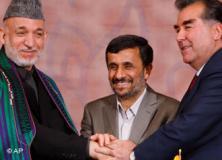
Iranian President Mahmoud Ahmadinejad has proposed an alliance between his country, Afghanistan and Tajikistan. The three Farsi-speaking nations would act as a counterweight to NATO influence in the region, according to Ahmadinejad's vision.
Deutsche Welle spoke to Afghanistan expert Citha Maass from the German Institute for International and Security Affairs about the feasibility of such an alliance and its implications for the region.
DW: How realistic is a Persian alliance made up of Tajikistan, Iran and Afghanistan?
Citha Maass: I view it as unrealistic, because President Karzai knows that in the coming years he will need American and international help in both civilian and military terms. He knows that if he were to enter into a direct alliance with Iran he would immediately be cut off by the Americans. I see, however, another dimension at play. Karzai is already consolidating his power position for the period after the ISAF forces withdraw, not the Americans, but other ISAF contributors.
So he's working on a scenario in which his clan can strengthen its power after the majority of the international forces have left. And when he engages in discussions with other states, I would also count China and Russia for example, he sends a signal to the Americans that he has greater negotiating leverage. That is what's decisive to me.
Why did Ahmadinejad choose this point in time to make his statement?
I cannot say much in regards to Ahmadinejad right now, because I don't have all the relevant information. But take Tajikistan for example. Tajikistan as well as Uzbekistan and Turkmenistan are deeply concerned that President Karzai will use the reconciliation process in Afghanistan to maintain his power by integrating conservative Islamic or even militant Islamic forces in the political system.
The Central Asian states see a greater risk that militant Islamists could become active in their own countries. That means that they're watching with great reservation and will consider exactly how closely they will work together with Karzai.
How good are the relations between the three countries in reality?
The language is a fundamental element because language stands for culture and deeper values. At the moment I don't see any real agreement. Another issue is the drug trade. Iran and Tajikistan suffer tremendously from it because they are transit countries for drugs coming out of Afghanistan. So there is a common interest here, even if it is restricted to a very specific sector and problem. Otherwise I don't see any larger common interests. Naturally from the Iranian side they want to reduce American influence in Afghanistan, to restrict it. But that doesn't seem like enough to me for an alliance to be created.
Here we are to serve you with news right now. It does not cost much, but worth your attention.
Choose to support open, independent, quality journalism and subscribe on a monthly basis.
By subscribing to our online newspaper, you can have full digital access to all news, analysis, and much more.
You can also follow AzerNEWS on Twitter @AzerNewsAz or Facebook @AzerNewsNewspaper
Thank you!