
Armenia halts ratification of Turkey peace deal
Armenia on Thursday suspended ratification of peace accords with
Turkey, setting back to square one U.S.-backed efforts to bury a
century of hostility between the neighbors, Reuters reported.
Armenia and Turkey signed accords in October last year to establish diplomatic relations and open their land border. But the process was already deadlocked before Thursday's decision, with each side accusing the other of trying to re-write the texts and setting new conditions.
Neither parliament has approved the deal, which would bring huge economic gains for poor, landlocked Armenia, advance Turkey's admission to the EU and boost its clout in the strategic South Caucasus, Reuters said.
Analysts said the Armenian decision, two days before the 95th anniversary of the alleged "genocide", was not the end of the road, but a bid to increase pressure on Turkey.
Armenia was angered by statements by Turkish Prime Minister Tayyip Erdogan saying that ratification would depend on Armenia reaching terms with Azerbaijan, Turkey's close ally and energy trading partner, over the Upper Garabagh conflict.
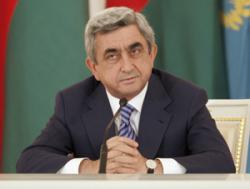
"We have decided...not to exit the process for the time being, but rather, to suspend the procedure of ratifying the protocols. We believe this to be in the best interests of our nation," Armenian President Serzh Sarkisian said.
He claimed in an address to the nation that Armenia would keep its signature to the accords, "because we desire peace."
"...We shall consider moving forward when we are convinced that there is a proper environment in Turkey and there is a leadership in Ankara ready to re-engage in the normalization process."
Erdogan said in Ankara Turkey remained committed to the process. "We have frequently expressed our commitment to the protocols in word and in spirit and our goal to fulfill them."
But he gave no sign that he would withdraw the condition that Armenia and Azerbaijan reach a deal on Upper Garabagh, something that has evaded mediators for more than 15 years.
"We have expressed clearly, to all parties concerned, our intention to achieve comprehensive peace in the region."
Erdogan also said passing such a decision two days before the date considered by Armenians to be the anniversary of the alleged mass killings will not affect the content of US President Barack Obama’s April 24 speech on the Ottoman-era developments.
Analysts noted the wording of the Armenian decision - a suspension, not a withdrawal.
"This was a lot weaker than feared," said Yerevan-based U.S. analyst Richard Giragosian. "This is a political tactic rather than a shift in strategic policy."
Both governments face opposition at home, and in Armenia's case from its huge diaspora, many of whom trace their roots to the alleged World War One killings and deportations.
Armenian opponents say the accords betray Armenian efforts to have the 1915 events internationally recognized as "genocide".
Turkish critics say the deal is a betrayal of fellow Turkic-speaking Azerbaijan, an oil and gas exporter and one of the West's key hopes for gas for the planned Nabucco pipeline.
Turkey closed its border with Armenia in 1993 in solidarity with Azerbaijan during the war over Upper Garabagh, when ethnic Armenians backed by Armenia invaded the region with the collapse of the Soviet Union.
Azerbaijan says the frontier must stay shut until ethnic Armenian forces pull back.
Analysts and diplomats had said they see little prospect of either side giving ground.
Armenia's decision came as the country of 3.2 million approaches the "anniversary" of the alleged killings, when tens of thousands lay flowers at a hilltop monument in the capital.
Turkey dismisses the Armenian claims that up to 1.5 million Armenians were killed beginning in 1915 and that it amounted to genocide -- a term used by some Western historians and foreign parliaments.
Armenians have been trying to muster international support for the recognition of the alleged genocide worldwide, and are again pressing Obama to fulfill a campaign pledge to label the killings as "genocide". But his using the term appears unlikely for fear of alienating NATO-member Turkey, according to Reuters.*
Here we are to serve you with news right now. It does not cost much, but worth your attention.
Choose to support open, independent, quality journalism and subscribe on a monthly basis.
By subscribing to our online newspaper, you can have full digital access to all news, analysis, and much more.
Subscribe
You can also follow AzerNEWS on Twitter @AzerNewsAz or Facebook @AzerNewsNewspaper
Thank you!