
Moscow seeks to bolster clout in Caspian region
Russia`s top officials and chiefs of power-wielding
agencies mulled ways of countering construction of trans-Caspian
pipelines bypassing the country and warding off military presence
of non-regional states in the basin in a meeting presided by
President Dmitry Medvedev on Monday, influential Kommersant
newspaper reported.
The significance of the meeting, which focused on Russia`s strategy in the resource-rich Caspian region, was highlighted by the participation of senior government officials, including the foreign and defense ministers, the chief of the Federal Security Service border service, the presidential aide on border delimitation, as well as the heads of Russia`s energy giants Lukoil and Gazprom. The meeting took place during Medvedev`s visit to the Astrakhan province.
The Caspian region has been increasingly turning into a key aspect in Russia`s foreign policy. This May, President Medvedev signed Russia`s national security strategy until 2020, terming the basin and Central Asia as priority regions for Moscow and noting that policymakers worldwide will be focusing in the long term on acquiring sources of energy resources. As is known, Moscow too is seeking to grab control over the Caspian`s abundant hydrocarbon reserves, and routes of their transit to energy-thirsty European markets in particular.
Concern is mounting for Russia by the year due to the impetus being given to trans-Caspian pipeline projects, which, if materialized, could deprive the country of control over the transit of energy resources from Central Asia. 2006 saw the opening of the first major pipeline bypassing Russia - the Baku-Tbilisi-Ceyhan (BTC) main export pipeline. Construction of the conduit, which transports Azerbaijan`s crude to world markets through Georgia and Turkey, received considerable backing from the United States. Kazakhstan is also exporting its crude via BTC, delivering it to Baku by tankers. But Astana has actually indicated that it is seeking to build a pipeline to the Kazakh port of Aktau along the Caspian seabed. Work is also underway to implement the project on the trans-Caspian pipeline to become part of the Nabucco project that seeks to deliver Azerbaijani and Central Asian gas to European markets while bypassing Russian territory. The feasibility study of the project is being developed on account of a US government grant.
A source close to the government has told Kommersant that, indeed, participants of Monday`s meeting of Russian officials pointed out the need to block regional pipeline projects bypassing Russia. Moscow believes that one of the reliable roadblocks for trans-Caspian projects will be adopting a convention on the legal status of the basin edited by itself. Back in 2007, the littoral states passed a declaration at the Tehran summit stipulating that the convention is to be developed "as soon as possible", but the document was not endorsed due to the outstanding differences among the sides.
Of note, the Russian president, addressing the Astrakhan meeting, called to step up talks on determining the legal status of the Caspian Sea, which has been unresolved for over a decade. "It is necessary to step up the negotiating process on the Caspian status," local RIA Novosti news agency quoted him as saying.
Medvedev also emphasized that "these talks are not moving easily and, at times, they are not moving at all", adding that "it is in the interest of all coastal states to give a major political impetus" to the work on drafting the status convention.
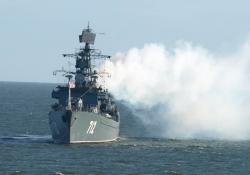
Russian Foreign Minister Sergei Lavrov stated his country`s position on the issue during his visit to Baku in April. Moscow insists that the Caspian be divided along the seabed, while its waters remain in common use, which would allow Russian warships to freely float in the sea. Moreover, it says the convention should contain a ban on stationing military forces of non-regional states in the Caspian. This demand is explained with the increasing efforts by the rival U.S., which has allocated $130 million to Azerbaijan and Kazakhstan under the Caspian Guard program for the upgrade of their naval fleet. To participate in the program, Baku and Astana rejected the Russian idea on creating the common naval group Casfor. In Moscow, the U.S.-backed program was deemed as an attempt to explore a possible stationing of a NATO base in the Caspian region. According to Kommersant, the Russian officials meeting in Astrakhan once again cited the need to persuade partners to adopt a document as soon as possible that would forbid basing foreign military bases in the basin.
To bolster its clout in the strategically important region, Russia apparently does not rule out even the use of force. The mentioned national security strategy indicates that struggle for the Caspian`s resources may, in fact, "spark a disruption of the shaped-up balance of forces near the Russian Federation`s borders." This being said, the strategy says, Russia should increase its military presence in the region. Moscow considerably advanced in pursuit of this goal by fighting a brief war with Georgia in August 2008, which allowed it to begin creating large military bases in South Ossetia and Abkhazia as well as to strengthen its contingent in the northern Caucasus. In addition, Moscow plans to set up a major military unit in Central Asia under the auspices of the Collective Security Treaty Organization (CSTO), the military arm of the former Soviet bloc CIS, which is to include the Caspian fleet. President Medvedev has repeatedly said that this regional force should be equipped on par with NATO units. This objective was laid out at Monday`s meeting.
Nonetheless, the Kremlin, evidently, realizes that Russia will not be able to counter undesirable tendencies in the volatile region and therefore needs an ally. It appears that Iran is likely to play a key role in these endeavors. "At this stage, our position on the Caspian largely overlaps with Tehran`s views," a government source told Kommersant.
Russia and Iran face discrepancies on the division of the Caspian, with Tehran calling for the division of the basin into equal national sectors, but they see eye-to-eye on countering trans-Caspian pipelines and military presence of non-regional states in the region.
During the Astrakhan meeting, Medvedev also said experts of the five littoral states in charge of developing an agreement on cooperation and security in the basin should meet as soon as possible. According to him, multilateral interaction among the coastal nations should focus on ensuring security in the area of fighting terror, preventing the proliferation of weapons of mass destruction and drug trafficking.
In September 2008, Azerbaijan distributed a draft agreement on Caspian security among the littoral states. Further, the sides issued preliminary comments on the document and confirmed their readiness to hold a meeting to discuss security issues and ways of surmounting new challenges and threats in the basin. However, the meeting, due in Baku, has not been held yet, and it is currently uncertain when it will take place.
Azerbaijan, Russia and Kazakhstan signed an agreement in 2001 on the delineation of the Caspian`s northern area into national sectors, with Azerbaijan and Russia each possessing 19%, while the Central Asian state received 29%. However, the issue has yet to be agreed with the other two coastal nations - Iran and Turkmenistan.
Here we are to serve you with news right now. It does not cost much, but worth your attention.
Choose to support open, independent, quality journalism and subscribe on a monthly basis.
By subscribing to our online newspaper, you can have full digital access to all news, analysis, and much more.
Subscribe
You can also follow AzerNEWS on Twitter @AzerNewsAz or Facebook @AzerNewsNewspaper
Thank you!