
Obama`s message sparks fury
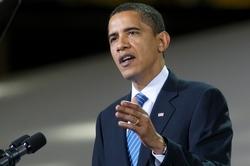
US President Barack Obama did not use the term
"genocide of Armenians", a claim regarding alleged World War I-era
mass killings, in his message to the Armenian community on Friday,
but made moving comments lamenting the 1915 developments in Ottoman
Turkey.
"Ninety-four years ago, one of the worst atrocities of the 20th
century began. Every year we commemorate the millions of Armenians
killed during the last days of the Ottoman Empire. Meds Yeghem must
live on in our memories the same way it lives in the hearts of the
Armenian people," Obama said in the statement by using Armenian
words.
"Meds Yeghem" is literally translated from Armenian as "great
disaster."
Further, the US president said he backs efforts by the Turkish and
Armenian people as they seek to normalize relations, which have
been historically strained.
He also touched on the "road map" recently agreed by the two
countries with Switzerland`s mediation. "I support this shift and
call on the governments of both countries to keep their
promises."
The government in Yerevan has accused Turkey of genocide against
Armenians in the latter years of the Ottoman Empire, which preceded
modern Turkey. The Turkish government says massacres took place,
but as part of clashes that related to Armenian groups supporting
Russia against Turkey during World War I. Ankara insists the
killings were not orchestrated by the Ottoman government and
Turkish President Abdullah Gul has proposed opening Ottoman
archives to international scholars to try to resolve the
dispute.
The Armenian community is striving to secure recognition of the
1915 events as genocide, both in the U.S. and around the world. One
of the Armenian diaspora`s key goals is to achieve the use of this
term in addresses by White House leaders, and this issue comes to
the fore every year on April 24, the day considered by Armenians as
the date marking the alleged genocide. Despite Armenian hopes,
however, US presidents consistently sidestep the term, trying to
avoid protests from Turkey, an important ally and a key power in
the region.
Obama`s predecessors - George Bush and Bill Clinton - also had to
abide by balanced statements on the "genocide" issue, keeping the
balance between the Armenian community and Ankara. On different
occasions they regarded the Ottoman Empire events as "a great
tragedy of the 20th century", "a great catastrophe", "mass
killings", but never used the term "genocide."
During his pre-election campaign, Obama`s website used the term
"Armenian genocide." Also, in his reply to a question during his
visit to Turkey in early April, he said that "I have not changed my
view."
Thus, both Turks and Armenians, who were expecting the US
president`s April 24 speech with a great deal of anxiety, this time
witnessed a new diplomatic move by the White House.
Commenting on Obama`s written statement, President Gul said it
contained some content that he disagrees with.
"There are hundreds of thousands of Turks and Muslims who lost
their lives in 1915. Everyone`s pain must be shared," Gul said in
televised remarks to reporters on the sidelines of a gas summit in
Sofia.
The Turkish leader emphasized that politicians and statesmen should
not give assessments of historical developments.
"Now is the time to look forward. Although today`s events are
interpreted differently, we should give diplomacy a chance that
aims for the future. These steps are important for the whole
region. I am satisfied with the support of all countries which are
interested in this region and can relate to this issue.
"For the first time, considerable advances are taking place in the
efforts of each of the parties interested in the normalization of
Turkish-Armenian and Armenian-Azerbaijani relations and the
solution of all outstanding issues in the entire region. Everyone
who could contribute to their solution has tackled the issue on the
highest level," Gul said.
However, Turkey`s Foreign Ministry has issued a statement saying
some of the expressions used by Obama were unacceptable.
"Common history of the Turkish and Armenian nations has to be
assessed solely through impartial and scientific data, and
historians must base their evaluations only on such material," the
ministry said in a statement.
Meanwhile, Armenian Diaspora organizations have issued a statement
accusing President Obama of failing to keep the promise he made
while on the campaign trail. Obama "had the opportunity to set a
new course aimed at normalizing Armenia-Turkey ties" in his
Friday`s address by recognizing the alleged genocide but had failed
to do so, PanArmenian.net quoted the Armenian Assembly of America
as saying.
Brian Ardouny, the group`s executive director, said "empty promises
will not change anything."
"His inability to assert a glorious chapter in US history by
recognizing the first genocide of the 20th century undermines
confidence in the United States with regard to preventing
genocides," Ardouny said.
Ken Hachikian, the head of the Armenian National Committee of
America (ANCA), echoed the statement, saying US Armenians were
deeply troubled by what he called Obama`s failure to keep his
promise.
"By sidestepping the word `genocide`, Barack Obama let the U.S.
succumb to Turkey`s policy of blackmail," he alleged.
Further, Hachikian said the Armenian community calls on Obama to
urgently revisit his administration`s position on the "genocide"
recognition and make an effort toward the adoption of a genocide
resolution in the US Congress.
Gist of "road map"
The gist of the "road map" to normalize relations reached by the
governments of Turkey and Armenia has been revealed by an
influential Turkish newspaper.
The Sabah (Tomorrow) newspaper, which is close to the Turkish
government, said the document, which outlines future relations
between Ankara and Yerevan, consists of five key provisions.
The first one says that Armenia, a former Soviet republic, accepts
the 1921 Gars agreement signed by Turkey and the USSR, which
defined the current border between the two countries.
Second, a joint commission of historians is to be set up to
research Armenian genocide claims. A third country could be
represented in the commission as well.
The third provision envisions signing of documents on opening the
Turkey-Armenia border and forging bilateral trade ties.
The fourth provision says that Turkey and Armenia, having mutually
accredited their ambassadors to neighboring Georgia in Ankara and
Yerevan, will establish diplomatic ties.
The last provision stipulates that any issues reflected in the
"road map" that require legislative approval will be discussed in
the parliaments of the two countries.
Although the Armenia-Azerbaijan Upper (Nagorno) Garabagh conflict
is not reflected in the document, Turkish-Armenian rapprochement
will be carried out along with seeking ways to resolve the
long-standing dispute, Sabah said.
The "road map" is the first move by Ankara and Yerevan to mend ties
since Turkey closed its border with Armenia in 1993 due to its
occupation of the territories of Azerbaijan, Turkey`s ally, and
genocide claims.
Following the conclusion of the verbal "road map" agreement, the
Turkish Foreign Ministry said, in a statement posted on its
website, that Turkey and Armenia "have agreed on a comprehensive
framework for the normalization of their bilateral relations in a
mutually satisfactory manner." The statement did not specify,
however, how the "genocide" issue would be resolved and whether or
not Turkey and Armenia had agreed on opening their shared
border.
"We are not inclined to provide any additional comments on what the
statement says," a source from the Turkish ministry said. "We will
continue pursuing a policy of quiet diplomacy. It is not time yet
to issue statements about the work to be done."
The US government was quick to positively assess progress in
Turkish-Armenian talks. Less than an hour after Ankara`s
announcement, Robert Wood, the acting US State Department
spokesman, said Washington welcomes the movement by Ankara and
Yerevan to normalize relations.
"It has long been, and remains the position of the United States,
that normalization should take place without preconditions and
within a reasonable time frame. We urge Armenia and Turkey to
proceed according to the agreed framework and roadmap. We look
forward to working with both governments in support of
normalization, and thus promote peace, security and stability in
the whole region."
Efforts at reconciliation between the two nations have gathered
momentum since President Abdullah Gul traveled to Armenia`s
capital, Yerevan, in September, the first visit to the country by a
Turkish head of state.
US Secretary of State Hillary Clinton said earlier that she was
"very encouraged by the bold steps" being taken by Turkey and
Armenia to reconcile with each other and with their "painful
past."
Steps toward "normalizing relations and opening their borders will
foster a better environment for confronting that shared, tragic
history," Clinton said in comments to the House Foreign Affairs
Committee in Washington.
Nonetheless, the U.S. realizes all too well that Turkey has
concrete obligations to Azerbaijan. It is for this reason that
Secretary Clinton immediately made it clear that the United States
intends to intensify its efforts to settle the Garabagh conflict
peacefully.
"We assured the Azerbaijani government that we will strengthen our
efforts to resolve the Upper Garabagh conflict and other key
outstanding issues between Azerbaijan and Armenia," she said. "The
Minsk process [the OSCE`s Minsk Group brokering the peace process]
is in place, and the U.S. is part of it. The State Department has
delegated its representative to Azerbaijan twice over the past
three weeks, and we hope to achieve progress in this area in the
near future."
It appears that Washington, while directly linking these two
conflicts, is trying to display, at least in its public statements,
that their settlement is to be carried out simultaneously, analysts
say.
The Azerbaijani government has responded to the Turkey-Armenia
rapprochement. Elkhan Polukhov, the acting spokesman for the
Foreign Ministry, said forging ties with other states is a
country`s sovereign right, however, Baku believes that
normalization of Turkey-Armenia relations and the opening of the
border between the two countries must be carried out only and
strictly in parallel with the process of the pullout of the
Armenian military units from the occupied Azerbaijani
territories.
Zakir Hashimov, the Azerbaijani ambassador to Turkey, said that
Baku could agree with the border opening only after Armenia has
withdrawn from five out of the seven Azerbaijani districts around
Upper Garabagh that it currently occupies and Azerbaijanis ousted
from their land during the military conflict in the early 1990s
have settled there. The remaining occupied regions - Upper Garabagh
and the other two districts adjacent to it - are to be vacated in
the later stages.
It was previously reported that first the Turkish-Armenian border
will open once a week symbolically, to be followed by a full
gradual opening, but diplomatic sources have now refuted those
reports. They say Armenia`s steps regarding the Garabagh conflict
will play a crucial role in the border opening issue.
Following the "road map" announcement, Turkish President Gul
telephoned his Azerbaijani counterpart, Ilham Aliyev. Gul told
Aliyev about progress in the Turkish-Armenian talks, while the
Azerbaijani president communicated his country`s position on the
issue, the presidential press-service reports.
In an interview afterwards, Gul said the telephone conversation
went well. "There is no strain in Azerbaijani-Turkish relations as
it may appear. In fact, diplomatic relations at present are as
active as ever," he said.
Gul also voiced his assurances that every step taken thus far was
serving the interests of Turkey and Azerbaijan. "If our plans are
put in place, this will benefit Turkey, Azerbaijan, Armenia and the
entire region," he added.
Here we are to serve you with news right now. It does not cost much, but worth your attention.
Choose to support open, independent, quality journalism and subscribe on a monthly basis.
By subscribing to our online newspaper, you can have full digital access to all news, analysis, and much more.
You can also follow AzerNEWS on Twitter @AzerNewsAz or Facebook @AzerNewsNewspaper
Thank you!