
Moscow, Ankara see eye-to-eye on regional security
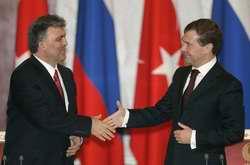
Russia is ready for comprehensive strategic
cooperation with Turkey, Russian President Dmitry Medvedev said
during a meeting with his Turkish counterpart, Abdullah Gul, in
Moscow on Friday.
Medvedev said the two countries would adhere to a common stance on
bolstering the security of the Caucasus and Black Sea regions,
emphasizing that both Moscow and Ankara were interested in
guaranteeing regional security.
"We absolutely concur on how this security will be ensured," the
Russian president said.
He noted that Russia backed Turkey`s recent proposal seeking to
promote peace in the turbulent region, adding that there were
opportunities to enact these programs.
Following a brief Russia-Georgia war in 2008, Turkish Prime
Minister Recep Tayyip Erdogan offered to establish a union, called
the Caucasus Peace and Cooperation Platform, in an effort to foster
cooperation among Azerbaijan, Armenia, Georgia, Russia and Turkey.
Azerbaijan earlier expressed its support for the initiative.
Medvedev indicated that forces outside the region were to blame for
instigating a military conflict that flared up with Georgia in
August 2008.
"We can solve our problems without the involvement of outside
forces. We see no need for the interference of third countries with
the solution of problems facing the Caucasus region."
Further, Medvedev emphasized that Russia was successfully
cooperating with Turkey in the fields of tourism, energy, transport
and industry. Bilateral trade turnover surged 35 times in the past
decade to reach $34 billion.
The Turkish leader, for his part, said Ankara was attaching great
importance to its relations with Moscow. He added that the
Russian-Turkish commodities turnover could rise to $50 billion in
the foreseeable future.
Presidents Medvedev and Gul signed a joint declaration on
friendship and partnership at the conclusion of the talks. The
document said Moscow and Ankara intended to develop
military-technical cooperation and speed resolution of problems
that could potentially arise in this area.
The two countries also described as pivotal the efficient work of
the inter-governmental commission dealing with military and defense
industry collaboration.
Touching on the political importance of the signed declaration,
President Medvedev stressed that it was much more than a formal
document. "This declaration will serve as a basis for deepening
cooperation between the two countries in the fields of foreign
policy, trade, economic relations and humanitarian aid."
Nuclear power deals
Russia may sign an agreement to build four nuclear reactors in
Turkey as the two countries continue discussing a power supply
agreement worth $60 billion. Moscow is close to securing the deal,
according to Russia`s energy minister.
Sergei Shmatko told journalists that the nuclear reactors would
have a capacity of 1,200 megawatts each and that the total cost of
the project would be between $18 billion and $20 billion, Reuters
reported.
Shmatko was speaking after meeting Turkish President Gul, who
discussed energy issues during his visit to Moscow last week.
Ankara is keen to push through energy projects that would boost
Turkey`s role in the region.
Shmatko said Russia`s proposal had been selected by the Turkish
government over several rival bids. The contract would involve the
construction of the reactors and participation in their
operation.
He also said Russia and Turkey were in discussions over a long-term
contract on electricity supplies, the local Interfax news agency
reported.
"The volume of the contract for the supply of electricity from
Russia to Turkey is valued at $60 billion over 15 years," Shmatko
said.
LUKOIL, Russia`s largest independent oil company, also plans to
invest $400 million in Turkey over the next decade, Chief Executive
Vagit Alekperov said this month. LUKOIL agreed last year to buy
Turkish fuel distributor Akpet.
Gas supplies
By 2010, the volume of Russian gas supplies to Turkey will exceed
30 billion cubic meters, Russian State Duma Chairman Boris Gryzlov
has told Turkish President Gul.
Russia and Turkey are linked by the Blue Stream natural gas
pipeline, which passes under the Black Sea.
Gryzlov said Russia had done its best to ensure gas supplies to
Turkey during the "gas crisis" in January, when daily supplies
through the Blue Stream pipeline increased from 22 to 48 million
cubic meters.
He added that the two countries had achieved great progress in
tourism cooperation, as 2.5 million Russians went to Turkey for
holidays in 2008.
Gul said, for his part, that Russia was the "number one partner"
for Turkey. "We have the relationship of good neighbors," he
said.
The Turkish president pointed to the uniqueness of the Blue Stream
pipeline and spoke of its effective use.
Here we are to serve you with news right now. It does not cost much, but worth your attention.
Choose to support open, independent, quality journalism and subscribe on a monthly basis.
By subscribing to our online newspaper, you can have full digital access to all news, analysis, and much more.
You can also follow AzerNEWS on Twitter @AzerNewsAz or Facebook @AzerNewsNewspaper
Thank you!