
`The winner of Davos`
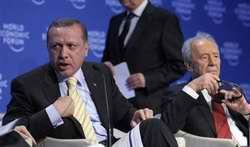
Turkish Prime Minister Recep Tayyip Erdogan`s tough
stance against Israel`s military action in Gaza voiced at the World
Economic Forum in Davos, Switzerland last week has been widely
acclaimed in the Islamic world.
A row was sparked as Erdogan clashed with Israeli President Shimon Peres during discussions on the situation in the Gaza Strip and subsequently left the event after a heated exchange.
Addressing the five-day forum, Peres staunchly defended Tel-Aviv`s latest military action. He claimed Hamas was to blame for the outbreak of violence in the Middle East and that there was no other way out. "If 100 rockets were fired upon Istanbul every day, what would you do?" he queried.
The Israeli leader`s emotion-filled statement was applauded by a group of participants. The Turkish premier, who witnessed such a reaction, blamed those welcoming the utterances for a bias.
Erdogan tried to respond to President Peres, but the host`s frequently interjecting his reply angered him. Erdogan, who was able to speak for only 12 minutes, compared to Peres`s 25 minutes, said the rules of the forum had been violated.
In response to the Israeli president, who spoke in a high tone, Erdogan said: "Honorable Mr. Peres, you are older than me. You are talking very loud, which suggests a psychology of being guilty. You know quite well how to kill. You are killing children. And the whole world witnessed you kill innocent people. I know some ministers in Israel who said when Israeli tanks entered Gaza that they felt very happy."
Further, Erdogan cited a quote from the Jewish holy book, the Torah. Article 6 of the book calls on Jews "not to kill."
In conclusion, the Turkish premier said, "Davos is over for me. I am not coming here again," and left the premises.
The Turkish Prime Minister`s spouse, Emine Erdogan, left the room crying. She told reporters afterwards that her husband`s address had been interrupted, while Peres`s remarks were completely based on lies.
Erdogan told a news conference that his criticism did not target the Jewish people and he had only asserted that the Israeli government`s actions committed in Gaza were a crime against humanity.
After the clash, the Israeli leader reportedly called Erdogan and extended an apology. He noted that he was very disappointed with the incident, claiming that he was speaking loud only because his voice could not be heard well in the room. Peres also emphasized that Israel and Turkey were maintaining strong bonds and expressed hope that the incident would not tarnish them.
However, a spokesperson for the Israeli president refuted reports that Peres had apologized to Erdogan. "They talked over the phone, and it was a positive conversation. But, despite what the Turkish media reported, our president was not apologizing."
The Israeli leader, himself, voiced hope that the bickering would not have any bitter ramifications.
"We don`t want a conflict with Turkey, we have a conflict with Palestinians," news agencies quoted him as saying in Davos.
"I don`t see either a personal or state problem here. Our relations can stay as they are. My respect [for Erdogan] remains unchanged. That was an exchange of opinions, and opinions are just opinions."
Erdogan, who returned home late that day was greeted in Turkey as a hero. About 5,000 people gathered outside the airport and applauded him upon arrival. The supporters of the Turkish premier were holding the flags of Turkey and Palestine as well as posters backing the stance he expressed in Davos. They called Erdogan "the winner of Davos."
Addressing the crowd, Erdogan said he had been insulted during the forum in the Swiss city.
Erdogan`s leaving the event after a strongly worded debate with the Israeli president has been widely praised in Gaza. A rally was held Friday in the Gaza Strip to show support to the Turkish head of government, the Turkish Zaman newspaper quoted the Hamas spokesman, Fawzi Barhoum, as saying.
Hamas has lauded Erdogan`s cause. "We bow to the courageous move by Turkish Prime Minister Erdogan who defended in Davos the victims of the Zionist battle targeting our children and women," it said in a statement.
Hamas added that it considered Erdogan`s leaving the room as support for those who have been subjected to a massacre by the Zionists.
The Mayor of Tehran, Mohammad Bagher Ghalibaf, has awarded Erdogan with an "honorary citizen" title due to his courageous move taken in Davos, CNN Turk TV channel reported. Ghalibaf said he saw the Turkish people as a benefactor of the Palestinians.
Iranian President Ahmadinejad has also thanked the Turkish premier. He said Erdogan was advocating for the sentiments of not only the Turkish people but also the nations of the entire region and the world.
It is noteworthy that the Erdogan-Peres discussions were moderated by Washington Post editor David Ignatius, an ethnic Armenian US citizen who is well known in the Middle East as a supporter of Israel.
According to the Turkish media, Ignatius was born to an ethnic Armenian family who moved to the U.S. in 1920. The journalist, who maintains close ties with the Armenian lobby in the U.S., is known for his stories critical of Erdogan and Turkey, and in particular of Ankara`s foreign policy.
Ignatius is also the author of a novel that was at the core of the Body of Lies film starring Leonardo di Caprio and Russel Crow, the most remarkable scene of which is a terror act perpetrated at the Incirlik military base in Adana, Turkey.
Turkey was one of the first countries to decisively condemn Israel`s military operations in the Gaza Strip and began undertaking initiatives to assist the Palestinian population. Therefore, Erdogan`s harshly-worded statement cannot be only linked to the moderator`s behavior, which was rather crude. Relations between Israel and Turkey are currently experiencing tough times compared to the period of joint projects carried out in the 1990s. The reason for the coolness is not merely the latest Gaza developments. Rather, Ankara`s policy toward Tel-Aviv cooled down after the Party of Justice and Development came to power in this country in 2002. The Turkish government, headed by the party`s chairman, Recep Tayyip Erdogan, started pursuing a political course aimed at a more active rapprochement with the rest of the Islamic world. Certainly, this couldn`t but pre-define a change in its attitude toward Israel, in particular, after the latest developments in the Middle East. It is common knowledge that Israel`s actions as early as the second Lebanon war in 2006 drew fire from Turkey. Then, the human rights commission of the Turkish parliament labeled Israel`s military action in Lebanon as "state terror and genocide." Moreover, all lawmakers representing the ruling party seceded from the inter-parliamentary group of friendship with Israel to condemn Tel-Aviv`s actions. MPs from the opposition People`s and Republican Party followed suit.
As for the tough stance taken by the Turkish premier in Davos, this is undoubtedly another indication of Ankara`s aspiration to play an important role in the Islamic world, analysts say. The point is that Turkey has its own interests in finding a solution to the Palestine conflict, as it has been striving to act as a regional powerhouse in the Middle East. Turkish officials insist on the need to follow the "road map" and UN resolutions in dealing with issues concerning a solution to the many-decade-long conflict. Turkey remains committed to the idea of a "two-state solution." On the other hand, Turkey has reaffirmed that its military-strategic partnership with Israel does not imply that it is ready to "sacrifice" its relations with other Muslim nations. Thus, such cooperation, which mainly envisions Israel`s arms supplies to Turkey, does not guarantee Ankara`s support for Israel`s policies in the Middle East.
As for Israel, this country deems it critical to maintain good relations with Turkey, which has considerably strengthened its clout in the Muslim world and could be a connecting bridge for forging ties with moderate Islamic governments. Israel is working hard to rebuild its relations with Turkey to the greatest extent and to return them to their previous level.
It is likely that any worsening of relations with Turkey would lead to the Jewish state`s isolation in the Middle East and it appears that Israel knows this well. Even David Ben-Gurion, a founder of the Israeli state and its first prime minister, had set out a goal of achieving a maximum rapprochement with non-Arab Muslim countries in the region, thus playing the card of differentiating between the Arab and non-Arab states to ensure that Israel would not face pressure from all Islamic countries at once. This strategy allowed Tel-Aviv to establish close relations with Ankara, particularly in the military field, which was and still is benefiting the Turkish army.
Moreover, the Israeli side has assured Turkey of support in its bid for European Union membership. Israel also demonstrates understanding of Ankara`s position regarding Turkey-Armenia relations that have been marred by history-long tension. Israel is even ready to assist in lifting the economic isolation of the unrecognized Turkish Republic of Northern Cyprus. Therefore, the Israeli leader`s statement that the Davos incident would not tarnish bilateral relations and that his country does not want a conflict with Turkey should be considered sincere.
Here we are to serve you with news right now. It does not cost much, but worth your attention.
Choose to support open, independent, quality journalism and subscribe on a monthly basis.
By subscribing to our online newspaper, you can have full digital access to all news, analysis, and much more.
Subscribe
You can also follow AzerNEWS on Twitter @AzerNewsAz or Facebook @AzerNewsNewspaper
Thank you!