
Baku-Novorossiysk termination not to create problem for Azerbaijan
By Gulgiz Dadashova
The 17-year old contract on the transit of Azerbaijani oil through Russian territory has been ceased.
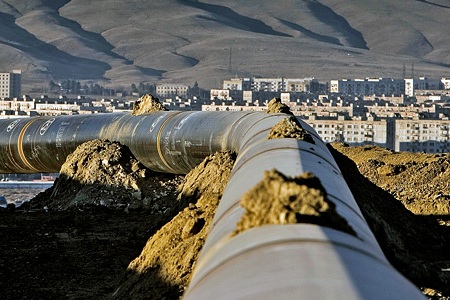
Russian Prime Minister Dmitry Medvedev signed an order early this May to cease the intergovernmental agreement, which envisaged transportation of 5 million tons of Azerbaijani oil via the Baku-Novorossiysk pipeline a year at a rate of $15.67 per one ton of oil transit.
Under the existing intergovernmental contract, Azerbaijani oil will be transported until late 2013
The Russian government grounded this decision with the extreme loss of the agreement.
The operator of the pipeline Transneft (TRNFP) said that the contract included the volume and rate which have been changed over the years.
"We do not see anything wrong with the abandonment of a political document and we will work as the two economic entities," Transneft spokesman Igor Demin told Trend.
Russia says it can resume the oil transit when the transit fee is renewed and a new agreement is signed. But does Azerbaijan need this?
This is a commercial decision and the matter has moved from the political perspective to the economic. The State Oil Company understands the decision of the Russian side, SOCAR President Rovnag Abdullayev told reporters on Wednesday.
Abdullayev said Baku will continue the oil transit through the Baku-Novorossiysk pipeline if it is economically feasible.
He said the parties will hold a series of meetings and negotiations on commercial terms to transport Azerbaijani oil via the Baku-Novorossiysk pipeline.
"If it is uneconomical, the supply will be halted," Abdullayev said
Azerbaijan has repeatedly stated about the possibility of making changes to the existing agreement, which would increase the volume of transport.
Baku in reality transported around 2.5 million tonnes through the pipeline, as it always strived for revision of tariffs or creation of oil bank. The volume of the Azerbaijani oil transportation via this route was 2.2 million tons in 2010, 2 million in 2011 and 2012.
Increase in the volume could reduce of oil transportation fees for Azerbaijan, but high quality Azerbaijani oil mixed with lower-quality Russian oil in Novorossiysk again would diminish the profit.
Urals - export oil mix (a mix of heavy and high-grade oil of Urals with light oil of Western Siberia) supplied through Novorossiysk and the Druzhba pipeline system was traded on the world exchanges at a price lower by $4 per barrel than the Azerbaijani crude.
Azerbaijan, the third-largest oil producer in the former Soviet Union, annually extracts about 50 million tons of oil, mostly from the Azeri-Chirag-Gunsehli block of fields in the Caspian Sea. Of this volume about 20 percent is used to cover the domestic demand and the rest is exported.
With huge export volumes Azerbaijan admitted Russia's offer to transport through Novorossiysk oil from its own fields, as well as oil of joint ventures and companies operating onshore in Azerbaijan. However, based on the relatively high rates of pumping oil through the Baku-Novorossiysk pipeline, as well as losses that occur when mixed with Russian oil (up to 20 percent of the oil price of), and about the same amount of payments of interest and penalties for delay of tankers in the Strait of Bosporus and stormy weather in the port of Novorossiysk, Baku found a more rational and mutually beneficial option. It carried out the reverse route of the Baku-Novorossiysk by being built the export pipeline Baku-Tbilisi-Ceyhan oil pipeline.
The Baku-Tbilisi-Ceyhan oil pipeline, has a number of advantages over any other routes that bring the raw materials to the Black Sea. This pipeline allowed to solve one of the most important challenges facing the owners of raw materials and their carriers, as it bypass the Turkish straits of Bosporus and the Dardanelles, that today significantly overloaded and have high environmental requirements.
In addition, the BTC partners have at the Mediterranean the Ceyhan terminal with its modern infrastructure can receive supertankers VLCC and ULCC, while Novorossiysk is significantly loaded with other oil producers.
In addition to the Baku-Novorossiysk pipeline (1,483 km) and the Baku-Tbilisi-Ceyhan pipeline (1,773 km) with a capacity of 50 million tons per year, the Azerbaijani oil is transported through the Baku-Supsa (837 km) to the Black Sea shores via Georgia. Its capacity is about 10 million tons a year. Both of these routes can fully meet the needs in pumping of the Azerbaijani oil.
So, Abdullayev said that the Baku-Novorossiysk pipeline is one of the routes for diversification of Azerbaijani oil supplies, whilst the termination of the process will not create a problem for the country.
Azerbaijan also actively participates in the Euro-Asian Oil Transportation Corridor (EOTC), which provides for the establishment of the route Odessa-Brody-Plock-Gdansk. If it is implemented, the Caspian oil will reach Western and Central Europe through the pipeline.
Thus, preserving of oil transportation via the Baku-Novorossiysk pipeline is of interest for Azerbaijan in terms of diversification, rather that the only route on which Azerbaijan entirely depends.
"We have the Baku-Tbilisi-Ceyhan route uploaded by 70 per cent, Baku-Supsa and the railroad," Abdullayev said.
Also, no competition is observed in the energy markets with Azerbaijan. Therefore, the issue is of economic character rather than political. If earlier losses of Transneft were mostly on paper, but now the losses are very real.
Here we are to serve you with news right now. It does not cost much, but worth your attention.
Choose to support open, independent, quality journalism and subscribe on a monthly basis.
By subscribing to our online newspaper, you can have full digital access to all news, analysis, and much more.
You can also follow AzerNEWS on Twitter @AzerNewsAz or Facebook @AzerNewsNewspaper
Thank you!