
Turkey, Azerbaijan sign accord on $7bn gas pipeline
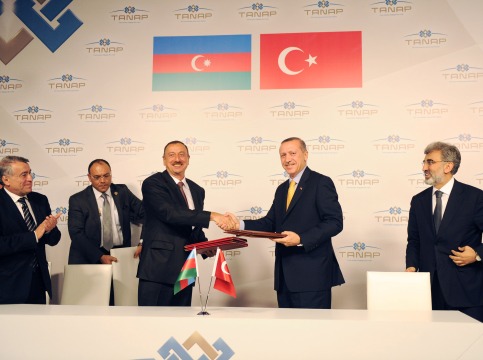
Turkey and Azerbaijan signed an inter-governmental agreement on Tuesday on the $7 billion Trans-Anatolian natural gas pipeline project (TANAP), planned to carry Azeri natural gas across Turkey to Europe.
Turkish Prime Minister Tayyip Erdogan and Azeri President Ilham Aliyev signed the deal at an Istanbul ceremony to launch a project, set to be completed in six years, to pipe 16 billion cubic metres of gas a year from Azerbaijan's Shah Deniz II field.
'Today's signing is the most important step in completing the legal framework for this project,' Erdogan said in a speech at a signing ceremony. 'This project won't just deepen ties between our countries, it will create an organic tie between Azerbaijan and Europe via Turkey.'
Turkey has a 20 percent stake in TANAP, while Azerbaijan's state oil company SOCAR holds 80 percent. In March, a Turkish Energy Ministry official said Turkey may raise its 20 percent stake in the project.
Construction is expected to start at the end of 2013 or in early 2014, and the project's first phase is seen ready in 2018.
Under the project, some 10 bcm of gas is planned to be shipped to Europe, while Turkey will get the remaining 6 bcm. The project is designed to be expandable to 30 bcm and ultimately 60 bcm.
Erdogan said the link will initially carry fuel from Shah Deniz II, then from other Azeri sources.
'Additionally, gas from the other side of the Caspian could be directed to the TANAP pipe, transiting via Azerbaijan,' Erdogan said.
Azerbaijani Presidential Administration official Ali Hasanov said the intergovernmental agreement on the Trans-Anatolia Pipeline will contribute to ensuring global energy security.
He told Azerbaijani news agency Trend on Wednesday that the TANAP project has three important features.
"First of all, this project aims to improve the economic component in implementing energy security projects, further strengthening the partnership and economic rapprochement between Turkey and Azerbaijan, which are two brotherly and friendly countries, Hasanov said.
"Second, the project is designed to supply large gas reserves extracted in the Azerbaijani sector of the Caspian Sea to the European market via Turkey," he said. "The volume of these reserves is not small. Today, the volume of Azerbaijan's proven gas reserves amounts to 2.6 trillion cubic meters. The project also involves firsthand gas sale and directing the profit to develop Azerbaijan and Turkey."
"Third, TANAP will contribute to the world's energy security in the third millennium, the expansion of cooperation in the South Caucasus, including Azerbaijan, Turkey, Georgia, Turkmenistan and other Caspian countries, diversification of the world's gas export routes, increasing the liquefied gas supply," he added.
Analysts have said TANAP could undermine efforts to bring online the 7.9 billion euro Nabucco pipeline project, which aims to ship 31 bcm a year of Caspian and Middle Eastern gas to Europe.
TANAP 'won't hurt' Nabucco prospects
But according to a Nabucco GmbH spokesperson, the project of Turkey
and Azerbaijan for the TANAP gas pipeline will not hurt the
prospects for the Nabucco project.
"TANAP won't stop the construction of Nabucco. TANAP is an additional opportunity, and it could be linked to Nabucco and feed natural gas into it," stated Christian Dolezal, spokesperson of Nabucco Gas Pipeline International, in an interview for the Bulgarian National Radio Tuesday.
As a result of the failure to procure sufficient gas supplies, Nabucco is now expected to survive as "Nabucco West" - a smaller, shorter pipeline, widely thought likely to begin at the Bulgarian-Turkish border rather than in Azerbaijan.
Nabucco was supposed to become the new gas bridge from Asia to Europe and the flagship project in the Southern Gas and Energy Corridor.
The pipeline was planned to link the Eastern border of Turkey, to Baumgarten in Austria - one of the most important gas facilities in Central Europe - via Bulgaria, Romania and Hungary, thus circumventing Russia.
The Nabucco Consortium has presented a revised, smaller version of the gas pipeline project called Nabucco West to the consortium developing the Shah Deniz II gas field.
The original pipeline was 3,900 kilometers long and ran from the Eastern border of Turkey to Baumgarten in Austria.
The Nabucco project aimed at lessening Europe's energy dependence on Russian energy was supposed to achieve a gas transport capacity of 31 bcm a year.
Nabucco's shareholders are Austria's OMV, Germany's RWE, Hungary's MOL, Turkey's Botas, Bulgaria's Bulgarian Energy Holding (BEH) and Romania's Transgaz.
MOL and RWE have questioned the feasibility of the original version of Nabucco, threatening to leave the project company.
OMV is counting on a shorter version of the Nabucco pipeline to win the business of carrying gas to Europe from Azerbaijan, Chief Executive Gerhard Roiss told Reuters earlier this month.
Here we are to serve you with news right now. It does not cost much, but worth your attention.
Choose to support open, independent, quality journalism and subscribe on a monthly basis.
By subscribing to our online newspaper, you can have full digital access to all news, analysis, and much more.
You can also follow AzerNEWS on Twitter @AzerNewsAz or Facebook @AzerNewsNewspaper
Thank you!