
Azeri leader concerned over delays in Nabucco pipeline build
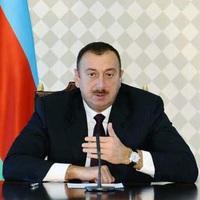
Azerbaijani President Ilham Aliyev has expressed frustration over
the delays in construction of the European Union’s planned Nabucco
pipeline, which would carry natural gas from the Caspian Sea to EU
markets, easing Europe's reliance on Russian gas.
"[Russian state gas giant] Gazprom has said it will buy whatever we supply. If Nabucco is delayed, we will sell more to Gazprom, it is clear," President Aliyev said in an interview with The Wall Street Journal newspaper on Wednesday.
In another interview, Aliyev said the EU must get "serious" about the Nabucco pipeline to compete with Russia’s Gazprom for Caspian natural gas.
Nabucco, the EU’s largest cross-border infrastructure project, is bogged down over financing, pricing and politics, Aliyev told Bloomberg Television late Wednesday at the World Economic Forum in Davos, Switzerland.
"If we are offered a good price and a serious approach, then it can happen," Aliyev said about Azerbaijan’s potential role as a supplier. "Political statements damage the process. We do not want to find ourselves in the middle of a battle between various forces that cannot agree."
The group lacks a clear leader able to attract the necessary financing or conduct talks with suppliers and transit countries, Aliyev said. The participation by some Nabucco countries in a rival Gazprom project "creates a kind of ambiguity," he said.
"So far we do not know who is that leader who will move this process forward," Aliyev said. "Who will engage itself in negotiations with gas producers, transiters? Who will do the marketing for this gas? What will be the pricing? So a lot of questions that are not answered for quite a lot of time."
Azerbaijan, which became a gas exporter in 2007, is interested in diversifying export routes, Aliyev said. Talks have stalled over the price of gas to Turkey, the only Nabucco partner not in the EU.
Bloomberg reminded that Bulgaria and Hungary, despite being shareholders in the Nabucco project, are cooperating on Gazprom’s South Stream, while Austria has also expressed interest in the project linking Russia to southeastern Europe via the Black Sea.
"This is justified criticism," Philipp Chladek, an oil and gas analyst at Raiffeisen Centrobank AG, said Thursday by telephone from Vienna. "He doesn’t know and a lot of people don’t know, including myself, who is taking the political lead, who is the ideological sponsor or driving force."
The project is headed by Austria’s OMV AG with shareholders RWE AG of Germany, Hungary’s Mol Nyrt., Romania’s Transgaz SA, Bulgaria’s Bulgargaz AD and Turkey’s Botas.
Azerbaijan, perched on the western Caspian between Russia and Georgia, was expected to be the first supplier to Nabucco, which would stretch 3,000 kilometers (2,000 miles) from Turkey to Austria. As preparations for the 7.9 billion-euro ($11.1 billion) project drag on, Russian gas exporter Gazprom has offered to buy all new gas from Azerbaijan in a bid to strangle competition from EU companies.
European Energy Commissioner-designate Guenther Oettinger could allay Aliyev’s concerns on the feasibility of Nabucco by visiting the Caspian region, RWE said.
Verbal support for Nabucco from Oettinger could help break the "Gordian knot" of developing Azerbaijan’s Shahdaniz gas field and securing fuel supplies, said Stefan Judisch, who heads RWE’s Supply & Trading unit. The executive referred to a legend where Alexander the Great solved a seemingly intractable problem with a stroke of his sword.
Aliyev also said Azerbaijan produced almost 25 billion cubic meters in 2009, more than double domestic demand. Gazprom started importing Azeri gas this year via a Soviet-era pipeline. The Russian company plans to double purchases from Azerbaijan to 1 billion cubic meters this year and again to 2 billion cubic meters in 2011.
"The advantage with Gazprom is that we don’t have any middlemen," Aliyev said.
RWE Chief Executive Officer Juergen Grossmann and Chief Strategy Officer Leonhard Birnbaum met Wednesday with Aliyev in Davos, Switzerland, and received "positive feedback" from the president, Judisch has said.
Oettinger, who governs the German state of Baden-Wuerttemberg, is due to start his new job and take over the role of EU energy commissioner from Andris Piebalgs next month.
Meanwhile, an executive of Austria's OMV said the Nabucco gas pipeline will not be built if an open season bidding process for capacity this year shows demand is too low, adding that demand looked strong, Reuters reported.
"We will start the open season process this year, then we will get enough demand or not," Werner Auli, OMV's head of oil and gas, told a conference.
"If not, Nabucco will not be built, this is very simple. We are a commercial company, we are not an institution. If the demand is not there, we will not build the pipeline," he said.
The open season process, where companies make bids for the pipeline's capacity, should take place from July to October this year with a final decision on investment by the end of 2010.
"We still have good indication that there is a lot of demand there," Auli later told reporters.
A Nabucco survey of potential customers in 2008 showed demand for capacity was expected to be two to three times the planned 31 billion cubic meters.
But analysts have since questioned whether future gas demand will be enough to make the project worthwhile and have voiced doubts over whether supplies will be secured in time, Reuters said.
In fact, the implementation of the Nabucco project appeared rather hazy from the very beginning. Analysts previously predicted that Russia would pose obstacles for this project by ratcheting up tension in the strategically important South Caucasus region. In this sense, the brief war fought in South Ossetia in August 2008 and other disputes appeared to be the greatest challenges. But Moscow chose another way. Despite contrary expectations, the Kremlin, instead of putting pressure on the South Caucasus and Central Asian states, became involved in the implementation of new energy projects. This being said, Russia’s seeking closer cooperation with Turkey is not by mere chance. Ankara received such lucrative proposals that the Erdogan government’s interest in the Nabucco project has begun to dampen. In some cases, Ankara even voiced conditions contradicting the plan on Nabucco’s realization. By making these efforts, Russia once again demonstrated that it remains a key gas supplier to energy-thirsty European markets. The policies pursued by the United States and other Western powers apparently failed to weigh in on the matter, and rival Moscow succeeded in advancing its cause.*
Here we are to serve you with news right now. It does not cost much, but worth your attention.
Choose to support open, independent, quality journalism and subscribe on a monthly basis.
By subscribing to our online newspaper, you can have full digital access to all news, analysis, and much more.
Subscribe
You can also follow AzerNEWS on Twitter @AzerNewsAz or Facebook @AzerNewsNewspaper
Thank you!