
Estonia sees Azerbaijan as `partner with great potential`
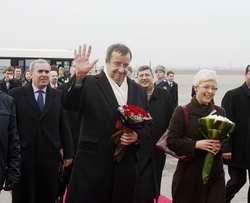
Estonia, like the rest of the European Union,
considers Azerbaijan a partner with great potential and is seeking
to boost both economic and political relations with the country,
President Toomas Hendrik Ilves said in a meeting with his
counterpart Ilham Aliyev in Baku on Tuesday.
At the meeting, President Ilves, who is the first Estonian leader
to visit Azerbaijan in the history of the two countries, focused on
the future of relations between the 27-member bloc and the
fast-growing South Caucasus republic, according to the Estonian
president`s website.
"The Caspian Sea region, and Azerbaijan, as one of the leading
countries in the area, has an important role to play in increasing
the energy security of the European Union. During the recent gas
dispute between Russia and Ukraine, it again became clear how
important the diversity of energy [supply] routes is for the EU,"
said Ilves.
"This is why we greatly appreciate Azerbaijan`s readiness to
participate in the implementation of the South Energy Corridor
projects-the NABUCCO gas pipeline and the Odessa-Brody-Plock oil
pipeline," he said.
The NABUCCO project, worth 8 billion euros, is designed to deliver
Azerbaijani and Turkmen gas to European markets through a
3,300-kilometer pipeline traveling through Azerbaijan and Turkey to
Romania, Bulgaria, Hungary and Austria. Six shareholders - German
RWЕ, Turkish Botas company, Romanian Transgas, Bulgarian Bulgargas,
Austrian OMV, and Hungarian MOL - hold equal stakes in the project
consortium. So far, only Azerbaijan has agreed to transport its gas
via NABUCCO. The conduit is to be commissioned in 2013.
President Aliyev stressed that, in the case of the NABUCCO gas
pipeline, the activities and responsibilities of each of the
parties must be clarified.
President Ilves encouraged Azerbaijan to make extensive use of the
opportunities provided by the Eastern Partnership initiative
prepared in the European Commission.
"The EU is convinced that the success of our eastern partners
depends on the readiness of each country and their will to truly
converge with the Community and its values," President Ilves
emphasized. "This means democracy, the rule of law, respect for
human rights, as well as increasing the pace of justice reforms and
administrative capabilities."
The Eastern Partnership program, initiated by Poland and Sweden,
envisions cooperation between the EU and East European countries,
including Azerbaijan, Georgia, Armenia, Ukraine, Moldova, and
Belarus. Agreements to be signed with the countries participating
in the program envision creating free trade areas. The ex-Soviet
states are also required to adopt a set of EU regulations, along
with simplifying visa regulations. Furthermore, such key issues as
democracy, respect for human rights and the rule of law should be
top priorities for the signatories. The implementation of joint
projects on student exchange, environmental protection and energy
supplies is planned as well.
According to President Ilves, Estonia does not presume to be a
teacher for any country or to teach it how to shape its future.
"However, if a country declares its wish to intensify relations
with the EU, it is natural that Estonia, as a member of the union,
can provide recommendations on how to successfully achieve
Euro-integration," he said.
The Estonian head of state also spoke about the freedom of the
press and the freedom for journalists and the media to operate,
which are inherent to and important for Europe.
Ilves also stressed the importance of closer economic ties between
Azerbaijan and Estonia, and cited information technologies as an
example of a field where close and businesslike ties could be
developed between the entrepreneurs of the two countries.
"Estonia and Estonian entrepreneurs are interested in Azerbaijan
and its developing economy as an investment environment as well as
a market," President Ilves said. "We want our investors to have a
secure entrepreneurial environment, characterized by a functioning
justice system, transparency, and the lack of excessive
bureaucratic obstacles."
Speaking about the Armenia-Azerbaijan Upper (Nagorno) Garabagh
conflict, Ilves confirmed the necessity of respecting the principle
of territorial integrity and said the conflict poses a risk for the
security and stability of the entire region, and inhibits the
economic, political and social development of the involved
parties.
"Estonia is thoroughly convinced that permanent solutions for such
conflicts can only be achieved at the negotiating table by
diplomats and politicians. I am glad that the Azerbaijani
leadership is of the same opinion."
Presidents Aliyev and Ilves also looked into ways of expanding
cooperation between Azerbaijan and NATO. The Estonian leader
acknowledged Azerbaijan`s participation in the missions led by the
alliance in Kosovo and Afghanistan, as well as in the international
coalition in Iraq.
"Estonia feels that respect for common values, flexible cooperation
and dialogue based on the needs of security policy are important to
the development of NATO partnership relations," the Estonian
president said.
A declaration on cooperation was signed in conclusion of talks
between the two presidents.
Further, Presidents Aliyev and Ilves participated at the opening of
a joint ICT forum in Baku.
"The 21st century has served up challenges along with risks. One
challenge is to make extensive use of the possibilities provided by
modern information and communications technology for the benefit of
our people," Ilves told the opening ceremony.
According to the president, both countries will benefit from
cooperation between Estonian and Azerbaijani entrepreneurs.
"This is the way for Estonia and Azerbaijan to reach their hands
out to each other in order to become reliable partners. We both
have the goal of being modern countries that are worthy of the 21st
century," Ilves said.
`Important oil producer`
Azerbaijan is an important oil producer in the Caspian region and
its significance as a gas producer is growing, President Ilves said
at a meeting with Prime Minister Artur Rasizada on the same
day.
"At the same time, it is an important energy partner for the EU,
with 90 percent of its oil and gas exports going to the Community
states," he said.
The Estonian president went on to say that Azerbaijan "has
demonstrated impressive economic growth, and the increase in
self-confidence based thereon is understandable."
Since oil and gas comprise 90 percent of the Azerbaijan`s exports,
the discussions included opportunities for diversifying the
economy, by using the country`s oil and gas revenues for easing
poverty, regional development and developing the rest of the
economy.
President Ilves emphasized that Estonian entrepreneurs are
interested in investing in Azerbaijan, in both the information and
communications fields as well as in real estate and infrastructure
development projects.
"Currently, Azerbaijan`s volume of trade places it 54th among
Estonia`s trading partners and this is clearly too modest a
position," Ilves said.
To date, Estonia has made direct investments totaling $26.5 million
in Azerbaijan, the largest of which- almost $22.1 million-is a real
estate project planned by 24 private Estonian investors near
Baku.
Also active in Azerbaijan are Estonian ICT companies that provide
e-state applications such as X-Road, e-police, e-tax board,
etc.
Protest ahead of visit
A group of Baku residents staged a protest just hours ahead of the
Estonian president`s visit against the arrest of two Azerbaijani
businessmen in the Baltic state.
About 30 people taking part in the action demanded that Ahliman
Zeynalov and Mirza Jamalov be released, charging that the two
entrepreneurs had been illegally held in detention in Estonia for
over a year.
Jamalov`s mother, Tebiet Jamalova, said during the protest that her
son was engaged in restaurant business in this country. She claimed
that no information is available concerning the reasons for his
apprehension. Jamalova pledged to launch a hunger strike and appeal
to the European Court of Human Rights if her son is not freed.
Zeynalov`s defense lawyer, Javanshir Suleymanov, said his client
had been arrested on charges of drug sales a year ago, dismissing
the charge as unfounded. The indictment said he had brought the
narcotics to Estonia from the Netherlands. Zeynalov`s trial has
been scheduled for April, Suleymanov added.
The protest was dispersed by the police due to its being
unsanctioned.
Here we are to serve you with news right now. It does not cost much, but worth your attention.
Choose to support open, independent, quality journalism and subscribe on a monthly basis.
By subscribing to our online newspaper, you can have full digital access to all news, analysis, and much more.
You can also follow AzerNEWS on Twitter @AzerNewsAz or Facebook @AzerNewsNewspaper
Thank you!