
UN Global Forum in Baku addresses outstanding challenges of Alliance of Civilizations - UPDATE
By Aynur Karimova
The 7th Global Forum of the UN Alliance of Civilizations on the theme “Living Together in Inclusive Societies: A Challenge and A Goal,” which kicked off in Baku on April 25, continued its work on April 26.
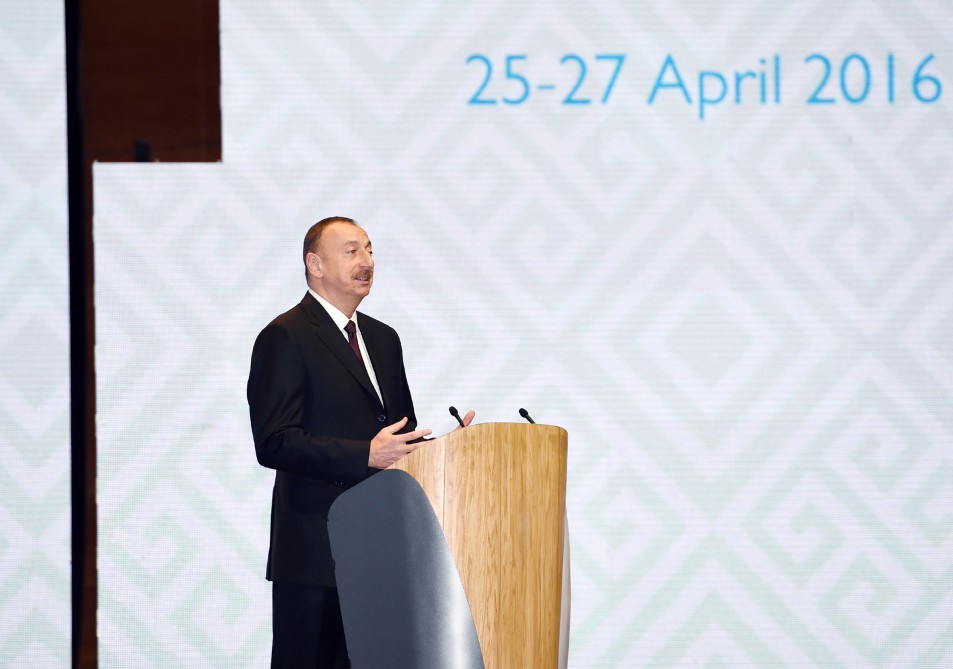
President Ilham Aliyev and his spouse Mehriban Aliyeva attended the opening of the forum.
President Aliyev welcomed the participants of the forum, in particular expressing gratitude to the founding fathers of the alliance.
"It is a big honor for us to host the 7th UNAOC Global Forum. We consider it a sign of appreciation of our activity and promotion of values of intercultural dialogue, multiculturalism," the head of state said in his opening speech.
"I'd like to express my gratitude to the founding fathers of the alliance - Turkey and Spain, President Erdogan and former Prime Minister Zapatero, for this extremely important initiative, which now lives for more than 10 years," President Aliyev said.
The president also thanked the UN High Representative for the Alliance of Civilizations Nassir Abdulaziz Al-Nasser for his leadership, contribution and promotion of the values of peace, solidarity and friendship.
The president went on to say that Azerbaijan is proud to have the representatives of more than 140 countries gather in Baku to address the important issues of the Alliance of Civilizations.
He said that Azerbaijan, for centuries, was a place where religions, cultures and civilizations met.
"We're not only a geographic bridge between East and West, but also a cultural bridge. For centuries, representatives of religions, cultures lived in peace and dignity in Azerbaijan," he said. "Religious tolerance and multiculturalism were always present here. There was no word multiculturalism, but the ideas were always present."
Ilham Aliyev added that as a result of that, Azerbaijan today is a multiethnic, multiconfessional country, where representatives of all religions and ethnic groups live in dignity and peace.
"This is one of our biggest assets," he said. "And we're proud of our history. We are proud of our historical monuments, which reflect the creation of representatives of different cultures."
The president reminded that one of the oldest mosques in the world, which was built in 743, is situated in Azerbaijani city of Shamakhi.
"Also, one of the oldest churches in the Caucasus, the ancient church of ancient state Caucasian Albania is also situated in Azerbaijan, close to another ancient city of Sheki," he said.
The president said the Azerbaijani government invests in construction and renovation of mosques, orthodox and catholic churches, synagogues.
"This is our policy and this is our lifestyle," he said. "For centuries, Azerbaijan is preserving this asset, regardless of political or social situation in the country."
Ilham Aliyev went on to add that Azerbaijan is relatively young as an independent country, only 25 years old, but it is ancient, with deep historical and cultural roots.
"Multiculturalism for us is a state policy," said the president. "We organize different events, addressing this important issue."
The president added that every two years, Intercultural dialogue forum takes place in Azerbaijan, and Baku International Humanitarian Forum is hosted regularly as well.
"The main idea is to bring the representatives of different religions together and how to establish more understanding between us," he said.
The president also reminded that Azerbaijan hosted the world summit of religious leaders, addressing important issues of interreligious dialogue.
"I think today this is one of the most important topics on global agenda," he said.
Speaking at the event, the UN High Representative for the Alliance of Civilizations, Nassir Abdulaziz Al-Nasser said that Azerbaijani President Ilham Aliyev's initiative to proclaim 2016 as the Year of Multiculturalism is widely acclaimed as an important step aimed at strengthening relations among the world's peoples.
"President Aliyev's leadership on this issue is especially noteworthy," added the UN official. "His initiative proclaiming 2016 as a Year of Multiculturalism is widely acclaimed as an important step that aims at strengthening relations among the peoples of the world."
"In that respect, we could not dream of a better venue than the city of Baku to hold this Forum," noted Al-Nasser.
He went on to add that the Alliance of Civilizations is the soft power tool established to contribute to a more peaceful world by countering radicalization and polarization, by encouraging greater intercultural understanding and engaging in projects and programs that advance these goals.
"And today we all have the opportunity to explore the gains we have made, the challenges that we face and the possibilities that lie before us," he said.
Al-Nasser also said the Forum's theme this year - "Living together in inclusive societies: a challenge and a goal" - converges with the four pillars of the UN: peace and security, human rights, rule of law, and development.
"More directly, it converges with the 2030 Agenda for Sustainable Development. Specifically, Sustainable Development Goal 16 calls upon us to 'Promote peaceful and inclusive societies for sustainable development, provide access to justice for all and build effective, accountable and inclusive institutions at all levels'," he said.
Al-Nasser added that sustainable development cannot be realized without peace and security, and at the same time, peace and security will be at risk without sustainable development.
Later, the participants of the event watched a video message of UN Secretary General Ban Ki-moon to the participants of the Forum.
He said in the video that division and exclusion only play into the hands of the extremists, but what they really want to destroy is our common ground.
"We live at a time of great crises. Record numbers of people have forced to flee their homes. Many escaped violence, extremism and prosecution," Ban Ki-moon noted. "We are walking around the world to resolve disputes, conflicts and consolidate peace. We are focusing on prevention by tackling the root causes of conflicts."
Further, Ban Ki-moon noted that the General Assembly has welcomed the UN plan of action to prevent violence and extremism.
This phenomenon is not rooted in any single religion, vision or nationality, he said, adding that stereotyping is dangerous and destabilizing.
In his remarks, Turkey's President Recep Tayyip Erdogan spoke about Islam religion, and said that Islam is the religion of peace, which calls for brotherhood.
Unfortunately, despite all efforts, the world is still unable to confront the growing radicalism and terrorism, he noted.
"Terror and terrorism have nothing in common with Islam," said the president adding that terrorists don't have religious affiliation and national identity.
Erdogan went on to add that none of the world's countries is insured from terrorism, and therefore, states should work together to fight terrorism.
Turkey's president believes that considering the situation in the world, it is important to hold the 7th Global Forum of the UN Alliance of Civilizations in Baku.
"Today the whole world is following the Global Forum of the UN Alliance of Civilizations that is being held in Baku," added Erdogan.
Speaking at the event, Spanish Foreign Minister Jose Manuel Garcia-Margallo y Marfil said that Baku is a route through which many new people, many ideas and cultures meet again.
"For centuries the karvansarays of Baku offered help to those who traveled along the Silk Road from Rome to Istanbul all the way to Asia," he noted. "The Silk Road was a sort of initial internet of prehistoric times and Baku was one of its main bases."
"We are today in Baku to renew our energies, to tell each other how it has been going, to look into and face the challenges and threats that surround us," he added. "We must face all the threats and help each other to resolve all the issues that take place in multicultural societies."
Later, during the ministerial meeting of the Forum, the participants adopted the Baku Declaration.
--
Aynur Karimova is AzerNews’ staff journalist, follow her on Twitter @Aynur_Karimova
Follow us on Twitter @AzerNewsAz
Here we are to serve you with news right now. It does not cost much, but worth your attention.
Choose to support open, independent, quality journalism and subscribe on a monthly basis.
By subscribing to our online newspaper, you can have full digital access to all news, analysis, and much more.
You can also follow AzerNEWS on Twitter @AzerNewsAz or Facebook @AzerNewsNewspaper
Thank you!