
Yerevan misleading world on peace talks
Azerbaijan has accused the Armenian government of attempts to
mislead the public on the gist of talks on the resolution of the
long-running dispute over Upper (Nagorno) Garabagh.
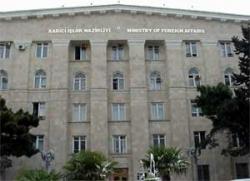
"After the meeting held in Madrid on the level of OSCE foreign ministers, Armenian officials launched intense propaganda aiming to create a false impression among the local and international community regarding the essence of peace talks," says a statement issued by the Foreign Ministry spokesman Khazar Ibrahim.
"We believe that this propaganda will be another alarm signal testifying to the real intentions of the Armenian leadership," he indicated.
Ibrahim described the efforts as a clear indication of "pre-election hysteria" in Armenia, which is due to hold presidential elections on February 19.
The OSCE Minsk Group co-chairs from the United States, Russia and France brokering peace talks and the three countries' officials submitted written proposals on the Garabagh settlement to the Azerbaijani and Armenian foreign ministers in the Spanish capital on November 28. The document is a set of basic principles for the peaceful settlement of the dispute.
The ministry spokesman reiterated his country's intransigent stance on the Garabagh settlement.
"We adhere to a firm position in the negotiating process based on the principle of full restoration of the territorial integrity and sovereignty of Azerbaijan over the entire occupied land, and the return of Azeris who fell victim of Armenia's policy of ethnic cleansing to their homes, including those in the Upper Garabagh region," the statement said.
Ibrahim made it clear that Azerbaijan, which continues to demonstrate goodwill, remains committed to seeking peaceful options to settle the conflict. "We don't think that diplomatic ways of solving the problem have been exhausted."
Ibrahim said that Armenia, on the contrary, is pursuing a policy based on the use of force by continuing occupation.
"Although the 51st article of the UN by-laws grants a full-fledged right of self-defense to countries that have been subjected to military aggression, the paradox here is the fact that the ratio of funds allocated by Armenia for military expenditure to its GDP exceeds the same indicator in Azerbaijan - 4.3% against 3.8% respectively. Moreover, Armenia has fully armed Upper Garabagh separatists," Ibrahim said.
He said Baku highly valued the stance of the world community, which unequivocally recognizes the territorial integrity of Azerbaijan, in line with the resolutions and statements passed on the level of governments and influential international groups.
Meanwhile, Azerbaijani Foreign Minister Elmar Mammadyarov said the latest proposals made by the Minsk Group co-chairs "should be worked on".
"We have some objections with regard to the document but are ready to work on them," he said.
The minister emphasized that the paper did not contain any new principles but only some new provisions and terms.
The intermediaries are due to pay their next visit to the region in mid-January to continue talks.
Azerbaijan and Armenia have been locked in conflict for over a decade. Peace talks kicked off after a lengthy war that ended with the signing of a cease-fire in 1994, but have brought little tangible result so far. Armenia continues to occupy Upper Garabagh and seven other Azerbaijani districts despite four standing UN resolutions on unconditional pullout of its armed forces and condemnation by a number of other international organizations.
Here we are to serve you with news right now. It does not cost much, but worth your attention.
Choose to support open, independent, quality journalism and subscribe on a monthly basis.
By subscribing to our online newspaper, you can have full digital access to all news, analysis, and much more.
Subscribe
You can also follow AzerNEWS on Twitter @AzerNewsAz or Facebook @AzerNewsNewspaper
Thank you!