
OSCE MG co-chairs highlight need for ensuring rights of Azerbaijani refugee, IDPs
By Sara Rajabova
The OSCE Mink Group co-chairs have highlighted the importance of securing the rights of all internally displaced people for the settlement of the long-standing Armenian-Azerbaijani Nagorno-Karabakh conflict.
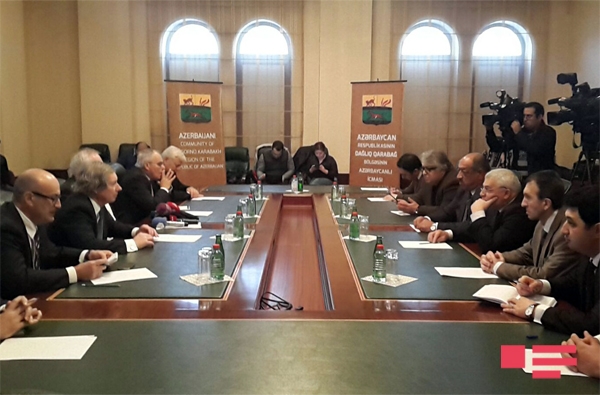
“No comprehensive solution can be achieved in the Nagorno-Karabakh conflict without resolving the problems of all IDPs and without ensuring their right to return to their homes,” said James Warlick, the U.S. co-chair of OSCE Minsk Group.
He made the remarks during the meeting with representatives of Azerbaijani community of Nagorno-Karabakh on October 28.
The OSCE Minsk Group co-chairs are on visit to Azerbaijan following a trip to Armenia and Azerbaijan’s territories under Armenian occupation.
Warlick noted they are aware of the fact that last 20 years have been very difficult for the Azerbaijani community.
“We met with the IDPs during our last visit to Baku. We visited a family and saw their desire of returning to their native lands. This meeting impressed us,” he said.
Warlick went on to say that when holding talks, the necessity of resolving the issue of returning the IDPs to their homes is always emphasized.
He added that moreover, during the meetings, the OSCE Minsk Group raised the issue of people’s diplomacy, which is regarded as a very important issue.
The bloody war, which flared up in the late 1980s due to Armenia's territorial claims against its South Caucasus neighbor, left 700,000 civilians of Nagorno-Karabakh and the regions adjoining it, as well as the regions bordering Armenia and Nagorno-Karabakh, without homes.
Moreover, 250,000 Azerbaijanis were expelled from Armenia and became refugees due to Armenia's ethnic cleansing policy after the emergence of the Nagorno-Karabakh conflict with Azerbaijan.
The Azerbaijanis who were displaced from their homes as result of the brutal war were forced to live under very difficult conditions in refugee camps.
Warlick further noted that there are no disagreements between the co-chairing countries – Russia, France and the U.S. – and they together are working on reaching a solution.
Russian Minsk group co-chair Igor Popov also stressed the necessity to return all IDPs and refugees to their native lands.
“We discussed this issue during the meetings in Armenia and Azerbaijan. We have certain disagreements, but we are united in the settlement of the Nagorno-Karabakh conflict,” he said.
While emphasizing that it is not an easy problem, Popov asserted the co-chairs will continue to work on it and results will be achieved when both sides reach an agreement.
“The decision is made not only by us,” he added.
Popov also said the Azerbaijani and Armenian presidents have intentions to meet, expressing hope that this meeting will be held by late 2015.
The latest meeting between President Aliyev and President Sargsyan took place in France last October.
French co-chair Pierre Andrieu also noted that they are aware of the importance of the refugee factor in the settlement of the conflict.
“We are discussing this issue. During meetings with ICRC representatives, we initiated the identification of those who died during the Karabakh war. This process is underway both in Azerbaijan and Armenia,” he noted.
Bayram Safarov, the head of public union “Azerbaijani community of Nagorno-Karabakh” voiced hope for a fair position of the Minsk Group on the Nagorno-Karabakh conflict.
“Unfortunately, the Minsk Group’s attempts did not yield results,” Safarov said, expressing hope that the MG countries will spare no efforts to restore justice, and Azerbaijanis will return to their lands.
Azerbaijan seeks to solve the conflict peacefully, he added.
For over two decades, Azerbaijan and Armenia have been locked in the exhausting conflict. Since a war in the early 1990s, the Armenian armed forces have occupied 20 percent of Azerbaijan's territory, including Nagorno-Karabakh and seven surrounding regions.
A fragile ceasefire has been in place since 1994, but long-standing efforts by U.S., Russian and French mediators have been largely fruitless so far.
Armenia has not yet implemented the U.N. Security Council's four resolutions on its pullout from the neighboring country's territories.
--
Sara Rajabova is AzerNews’ staff journalist, follow her on
Twitter: @SaraRajabova
Follow us on Twitter @AzerNewsAz
Here we are to serve you with news right now. It does not cost much, but worth your attention.
Choose to support open, independent, quality journalism and subscribe on a monthly basis.
By subscribing to our online newspaper, you can have full digital access to all news, analysis, and much more.
You can also follow AzerNEWS on Twitter @AzerNewsAz or Facebook @AzerNewsNewspaper
Thank you!